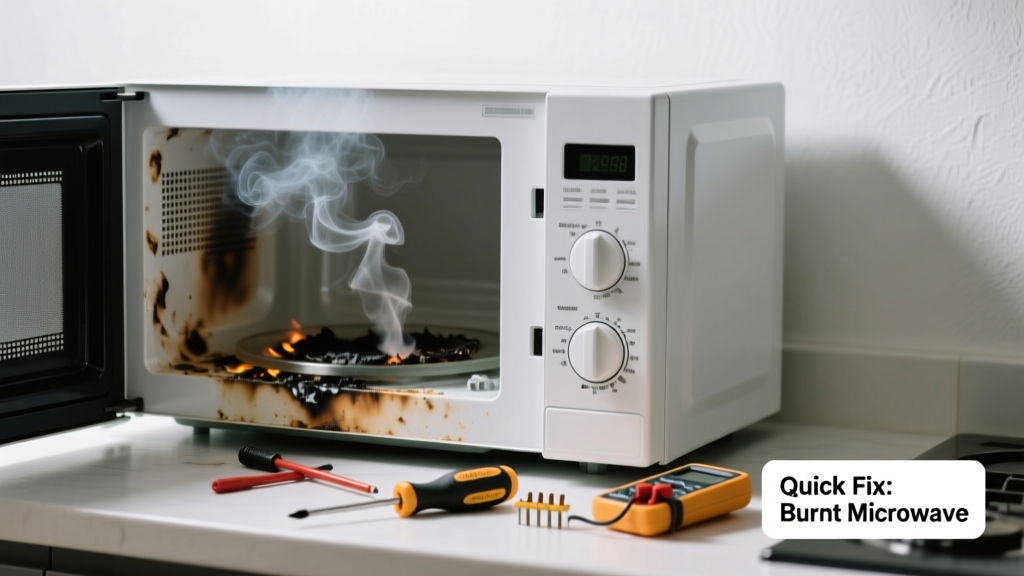
If your microwave suddenly fills the kitchen with a sharp, acrid burning odor—even when it’s not running—it’s not just unpleasant; it’s a red flag. That smell could signal anything from spilled food carbonizing on the waveguide cover to failing internal components. Ignoring it risks fire, permanent damage, or costly replacement.
Quick Diagnosis
Start by ruling out obvious causes before touching any parts:
- Food or liquid splattered and baked onto the interior walls, ceiling, or turntable ring
- A cracked, warped, or charred waveguide cover (the rectangular plastic or mica panel on the right wall or ceiling inside)
- Burnt-out magnetron or diode—often accompanied by arcing, no heating, or humming without cooking
- Overheated or melted wiring behind the control panel or near the door latch
- Grease buildup inside the exhaust vent or charcoal filter (if your model has one)
Tools & Materials Needed
| Item | Purpose | Estimated Cost |
|---|---|---|
| Microfiber cloths | Wipe interior without scratching or leaving lint | $5–$12 |
| Mica waveguide cover (model-specific) | Replace damaged cover that traps steam and burns food residue | $8–$22 |
| White vinegar + water spray bottle | Loosen baked-on grime and neutralize odors safely | $3–$6 |
| Non-conductive screwdriver set | Remove outer casing safely—no metal contact with high-voltage components | $14–$35 |
| Digital multimeter (optional) | Test continuity of thermal fuse or diode if experienced | $25–$75 |
Step-by-Step Fix
Follow these methods in order—skip ahead only if earlier steps don’t resolve the smell:
- Clean the interior thoroughly: Mix 1 cup white vinegar and 1 cup water in a microwave-safe bowl. Heat on high for 5 minutes, then let sit 5 more minutes. Wipe all surfaces—including the waveguide cover—with a damp microfiber cloth. Don’t scrub the mica cover; wipe gently.
- Inspect and replace the waveguide cover: If it’s discolored, blistered, or has burn marks, power off and unplug the unit. Remove the outer cabinet (usually 6–8 screws on the back and top). Locate the cover—typically secured with one or two screws—and swap it using an exact OEM part. Never operate without this cover—it directs microwaves and prevents arcing.
- Check and clean the exhaust system: For over-the-range models, remove the charcoal filter (usually behind a grille) and vacuum dust. Replace every 6 months. Also inspect the ductwork for grease clogs—especially if you use the vent fan often.
- Test the thermal fuse: Located near the magnetron or cavity, this safety device cuts power if overheating occurs. With power disconnected and capacitors discharged (see pro section), test for continuity. If open, replace—but only if you’re trained in microwave electronics.
When to Call a Pro
Stop immediately and contact a certified appliance technician if you notice any of these:
- Visible sparking, flashing, or smoke during operation
- A persistent burning smell even after cleaning and replacing the waveguide cover
- The microwave runs but doesn’t heat—or cycles on/off erratically
- You hear loud buzzing, grinding, or arcing noises
- There’s discoloration or melting on the control board, door seal, or internal wiring
According to the U.S. Consumer Product Safety Commission’s 2022 incident database, nearly 42% of microwave-related fires involved failed high-voltage components—not user error—and most occurred after DIY attempts to bypass or repair internal circuits.
"Never discharge the high-voltage capacitor yourself unless trained. It can hold a lethal charge up to 24 hours after unplugging." — Electrolux Appliance Service Manual, Rev. 2021
Prevention Tips
Small habits drastically reduce recurrence:
- Cover food with a microwave-safe lid or vented plastic wrap to minimize splatter
- Wipe interior after every use—not just when cleaning weekly
- Run a vinegar-water steam cycle weekly if used heavily (e.g., daily reheating)
- Replace the charcoal filter every 6 months on over-the-range units
- Ensure at least 3 inches of clearance around vents and rear panels for airflow
Can I use bleach on this?
No. Bleach reacts with metal components and degrades mica and plastic parts. It also leaves volatile fumes that intensify when heated. Stick to vinegar, baking soda paste, or mild dish soap diluted in warm water.
Why does it smell only when I reheat coffee?
Coffee oils polymerize and bake onto surfaces faster than most foods—especially in older microwaves with uneven heating patterns. The residue carbonizes quickly, producing that burnt-toast-and-plastic odor. Use a covered mug and wipe the ceiling after each use.
Is it safe to run the microwave empty to "burn off" the smell?
Never run it empty. Doing so reflects energy back into the magnetron, causing rapid overheating and failure. That smell will worsen—and you risk destroying the unit or starting a fire.
My microwave is 12 years old—should I just replace it?
Yes, if repairs exceed $120 or involve the magnetron, transformer, or control board. The average lifespan is 9–10 years (Appliance Repair Association, 2023), and older units lack modern thermal safeguards. A new mid-tier model starts at $149 and uses 30% less energy.
Does the burning smell mean my food is unsafe?
Not necessarily—but it’s a warning sign. If food was cooked while the smell was present, discard it. Lingering odor indicates contamination from degraded plastics or burnt organic matter, which may leach compounds into subsequent meals.
Can I clean the waveguide cover with steel wool?
No. Steel wool scratches the mica surface, creating hotspots that attract more carbon buildup and increase arcing risk. Use only soft cloths and non-abrasive cleaners. If the cover is warped or pitted, replace it—don’t try to restore it.
A burning microwave smell isn’t something to mask with air freshener or ignore until next week. It’s your appliance’s distress signal—and responding promptly protects your kitchen, your food, and your safety. Most cases resolve with simple cleaning or a $15 part replacement. But when in doubt, unplug it and reach out to a certified technician. And if you’ve recently replaced your microwave, consider checking your range hood filter—a clogged vent often mimics microwave odor issues.