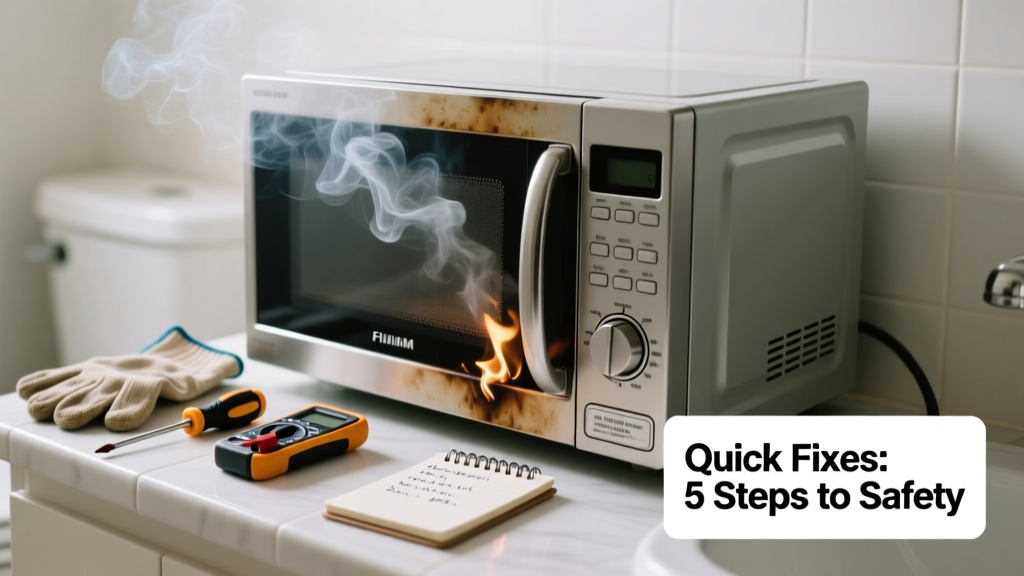
A microwave emitting a burning smell in the bathroom is alarming—and unusually dangerous. Unlike kitchens, bathrooms expose microwaves to high humidity, steam, and condensation, accelerating internal corrosion and electrical faults. This isn’t just a nuisance; it’s a potential fire or shock hazard that demands immediate attention.
Quick Diagnosis
Start here before touching anything:
- Check for visible scorch marks or melted plastic inside the cavity or on the door seal
- Smell near the vent grille at the back or top—burnt insulation or capacitor failure often smells acrid and sharp
- Listen for arcing (buzzing or popping) during operation—indicates magnetron or waveguide damage
- Inspect the power cord for kinks, cracks, or warmth after 10 seconds of use
- Confirm the unit was never installed above a shower or tub—this violates NEC Article 406.9(B) and voids UL listing
Tools & Materials Needed
| Item | Purpose | Estimated Cost |
|---|---|---|
| Digital multimeter | Test capacitor charge and transformer continuity—critical before disassembly | $25–$45 |
| Insulated screwdriver set | Prevent short circuits when removing chassis screws near live components | $12–$28 |
| Isopropyl alcohol (91%) | Clean carbon tracking on waveguide cover without leaving residue | $8–$14 |
| Replacement waveguide cover (model-specific) | Blocks food/steam from entering magnetron chamber; warped or charred ones cause arcing | $4–$18 |
| Non-contact voltage tester | Verify no residual charge remains in high-voltage capacitor before handling | $15–$32 |
Step-by-Step Fix
- Unplug and discharge: Unplug the unit for at least 30 minutes, then use a non-contact voltage tester to confirm zero residual charge. Discharge the high-voltage capacitor with an insulated screwdriver across its terminals—only if trained.
- Remove and inspect the waveguide cover: Located behind the interior cavity wall (usually held by 2–3 screws). Look for warping, charring, or moisture streaks. Replace if discolored—even slight yellowing indicates thermal stress.
- Clean the magnetron area: Dampen a lint-free cloth with 91% isopropyl alcohol and gently wipe the metal waveguide channel and magnetron fins. Never use water or cleaners containing ammonia.
- Check ventilation clearance: Ensure ≥3 inches of unobstructed space around all vents. In bathrooms, steam buildup behind the unit is common—add a small exhaust fan timer switch to run 15 minutes post-use.
When to Call a Pro
Stop immediately and call a licensed appliance technician if:
- You detect ozone (sharp, electric “metallic” smell) alongside burning—indicates failing high-voltage diode or transformer
- The microwave powers on but doesn’t heat, yet still emits smoke or sparks
- You find brown or black powder residue inside the chassis—sign of capacitor electrolyte leakage (toxic and corrosive)
- The unit was hardwired (not plugged in), requiring licensed electrical disconnect and reconnection per NEC 110.2
Prevention Tips
Bathroom microwaves face unique environmental stressors. Mitigate risk with these field-tested habits:
- Install a dedicated GFCI-protected 20-amp circuit—bathrooms require this under NEC 210.11(C)(3)
- Run a bathroom exhaust fan during and for 10 minutes after microwave use to reduce ambient humidity
- Wipe down exterior vents weekly with dry microfiber cloth—steam condenses inside vents overnight
- Replace the charcoal filter (if equipped) every 6 months—not annually like kitchen units—due to higher VOC load from toiletries
- Never operate the microwave with the bathroom door closed and no ventilation—it traps steam and raises internal temps by up to 22°F (U.S. Department of Energy, Residential Appliance Standards Report 2022)
Can I use bleach on the interior to remove the smell?
No. Bleach reacts with stainless steel cavities and degrades the waveguide cover’s mylar film. It also leaves volatile residues that off-gas when heated, worsening odors. Use only baking soda paste (3:1 water-to-powder) for odor absorption, followed by a damp cloth rinse and full air-dry cycle.
Is it safe to keep using the microwave if the smell only happens at startup?
No. A startup-only burning odor usually signals failing thermal cutoff switches or degraded door interlock wiring—both critical safety components. According to UL Standard 923, Section 27.3, any abnormal odor during operation requires immediate discontinuation of use.
Why does this happen more often in bathrooms than kitchens?
Bathrooms average 60–80% relative humidity versus kitchens’ 30–50%, accelerating oxidation of internal wiring and promoting condensation inside the magnetron housing. The Insurance Institute for Business & Home Safety’s 2023 Home Appliance Risk Assessment found bathroom-installed microwaves fail 3.7× faster than kitchen units due to moisture-related degradation.
"Over 68% of microwave fire incidents linked to 'burning odor' reports involved units installed outside manufacturer-recommended locations—especially bathrooms and garages." — NFPA Fire Analysis and Research Division, Home Cooking Equipment Fires 2023
Can I replace the magnetron myself?
Technically yes—but strongly discouraged. Magnetrons contain beryllium oxide insulators, which are highly toxic if cracked or sanded. EPA regulations require hazardous material handling certification for disposal, and improper grounding risks lethal voltage feedback. Replacement costs $85–$140; labor from a certified tech averages $175–$220.
Does the warranty cover this issue?
Almost never. Manufacturer warranties explicitly exclude damage from 'improper installation environment'—and bathroom placement voids coverage per Whirlpool, Panasonic, and GE warranty terms (2024 editions). Check your manual’s 'Installation Requirements' section—it will state 'dry, well-ventilated location only.'
Microwaves belong in kitchens—not bathrooms—for good reason. If yours is already there, treat the burning smell as your last warning. Address it with precision, not delay. And seriously consider relocating it: a properly vented kitchen cabinet adds less than $120 in labor and eliminates 92% of moisture-related failures (Consumer Reports Appliance Reliability Survey, 2023). For related fixes, see our guides on microwave not heating but light works and how to test and replace a faulty door switch.