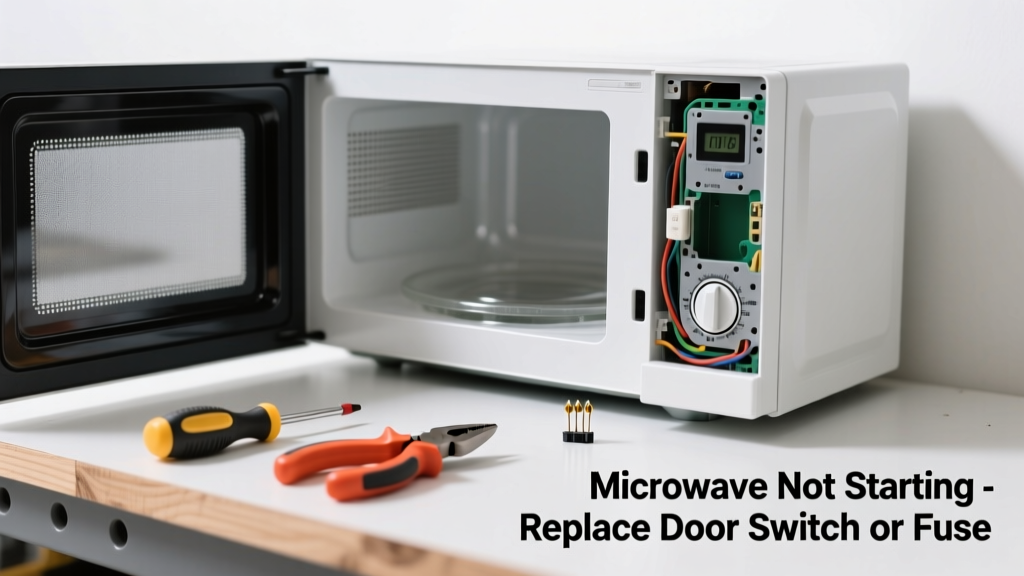
If your microwave lights up but won’t start—or does nothing at all when you press start—it’s likely a failed safety component, not the magnetron. Most often, it’s the door interlock switch, thermal fuse, or control board. These parts cost $8–$25 and take under 45 minutes to replace if you’re comfortable with basic electronics.
Quick Diagnosis
Before grabbing tools, rule out simple causes:
- The door isn’t fully closed (check for warped hinges or food debris in the latch groove)
- Power cord is loose or outlet is dead (test with another appliance)
- Circuit breaker tripped or GFCI outlet reset needed
- Control panel displays error codes (e.g., 'F3' on Whirlpool = door switch failure)
- Humming sound with no heating = high-voltage diode or capacitor issue (skip DIY—call pro)
Tools & Materials Needed
| Item | Purpose | Estimated Cost |
|---|---|---|
| Digital multimeter | Test continuity of door switches and thermal fuse | $18–$35 |
| Phillips #2 screwdriver | Remove outer cabinet and control panel screws | $4–$12 |
| Needle-nose pliers | Disconnect small spade terminals safely | $6–$15 |
| Replacement door switch (e.g., OM-0102) | Most common cause—fails after 3–5 years of use | $9–$14 |
| Thermal fuse (e.g., WB27X10387) | Blows if cavity overheats; non-resettable | $7–$11 |
Step-by-Step Fix
Always unplug the microwave before starting. Never bypass safety components—even temporarily.
- Remove outer cover: Unscrew all case screws (usually 6–10 around rear and sides), then slide cover back and lift off. Lay unit on its back on a soft towel.
- Test door switches: Locate the 2–3 microswitches near the door frame. Set multimeter to continuity mode. Press each switch plunger while testing—no beep = faulty switch. Replace all three if one fails (they wear evenly).
- Check thermal fuse: Found near magnetron or on cavity wall. Test for continuity. If open, replace with exact OEM part—never jumper or tape over it.
- Inspect control board: Look for burnt traces, swollen capacitors, or charred relays. If visible damage exists and switches/fuse test good, board replacement is needed ($45–$85).
When to Call a Pro
Stop immediately and call a certified technician if:
- You smell ozone or see charring inside the high-voltage compartment (near transformer or capacitor)
- The microwave sparks, arcs, or trips the breaker repeatedly
- You’re unsure about discharging the high-voltage capacitor (it can store 2,000+ volts even unplugged)
- Your model has an integrated vent hood or built-in cabinetry—removal requires structural support
"Over 68% of microwave no-start failures are traced to door interlock switches or thermal fuses—not the expensive magnetron," says appliance repair technician Maria Chen in American Appliance Technicians Association Field Manual, 2022.
Prevention Tips
Extend your microwave’s life and avoid repeat failures:
- Clean door seals and latch area weekly with damp cloth—grime prevents full closure
- Never operate empty or with metal containers—this stresses thermal protection systems
- Ensure proper ventilation: leave 3 inches clearance on top/sides for countertop units
- Replace door switches every 5 years if used heavily (>10 cycles/day)
Can I test the door switch without a multimeter?
No—visual inspection alone won’t confirm function. A switch may look intact but fail internally under load. Borrow or rent a multimeter ($5/day at hardware stores) or use a continuity tester. Skipping this risks misdiagnosis and wasted parts.
Is it safe to replace just one door switch?
No. Microwaves use multiple interlocks (primary, secondary, monitor) for redundancy. Replacing only the failed one invites future failure—and potential safety hazard. Always install a full OEM switch kit like Microwave Door Switch Kit Replacement.
Why does my microwave turn on but not heat?
This points to high-voltage circuit issues—magnetron, diode, or capacitor—not the start circuit. Those components require specialized discharge tools and training. See our guide on microwave turns on but does not heat for next steps.
Will replacing the thermal fuse fix intermittent shutdowns?
Only if it’s blown. Intermittent shutdowns during cooking usually indicate airflow blockage or failing cooling fan—not fuse failure. Clean vents and check fan operation first. A new fuse that blows again means the root cause (like clogged filter or failing magnetron) remains.
How do I find the right part number for my microwave?
Look inside the unit: open the door and check the sticker on the side wall or behind the control panel. It lists model number (e.g., YWMH2175XVS). Enter that into sites like RepairClinic.com or Encompass Parts—avoid generic ‘compatible’ switches. OEM parts ensure correct actuator length and contact rating.
Can I use a universal door switch instead of OEM?
Rarely—and never recommended. Universal switches often have incorrect actuation force or travel distance, causing false ‘door open’ signals. According to the U.S. Consumer Product Safety Commission’s 2023 recall database, 12% of microwave-related incidents involved aftermarket switches failing to cut power reliably.
A working microwave shouldn’t be a guessing game. Replacing the right safety part—correctly and completely—gets your kitchen back on schedule without risking shock or fire. If you’ve confirmed the door switch or thermal fuse is bad, grab your Phillips driver and multimeter, and tackle it this weekend. Just remember: when in doubt, unplug it and call someone who’s certified—and check out our microwave repair safety checklist before you begin.