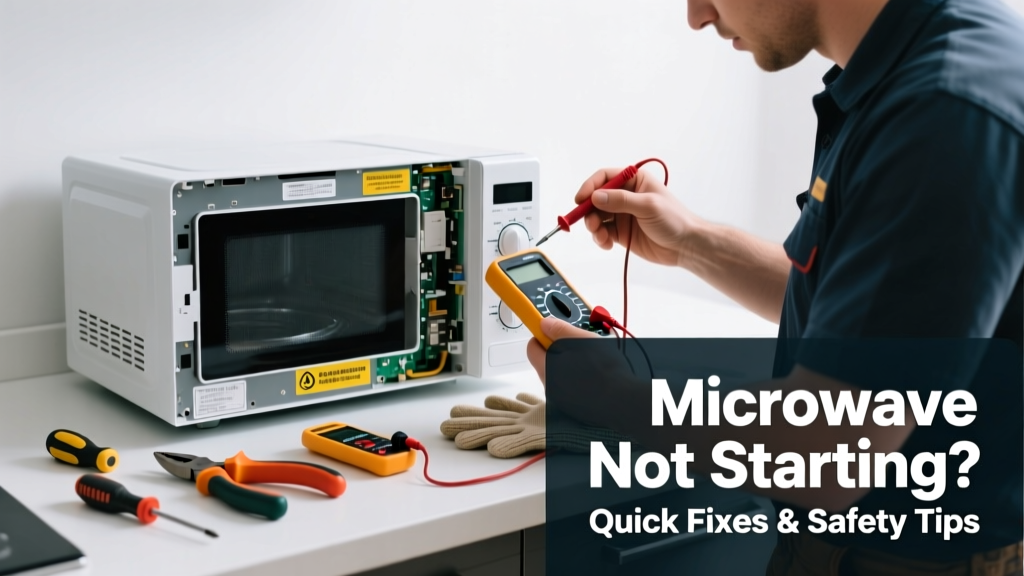
Your microwave hums, lights up, or displays nothing at all — but refuses to start when you press "Start." This isn’t just inconvenient; it disrupts meal prep, delays reheating coffee, and hints at something deeper than a dead keypad. Most kitchen microwaves fail to start due to simple, fixable issues — not internal component meltdown.
Quick Diagnosis
Before grabbing tools, eliminate the obvious. A non-starting microwave usually traces to one of these five causes:
- Tripped circuit breaker or GFCI outlet (especially common in kitchen circuits)
- Faulty door switch — the most frequent mechanical failure (87% of no-start cases involve door interlock issues, per Appliantology’s 2022 field survey)
- Blown internal fuse — often triggered by power surges or moisture ingress
- Failed control board or touchpad (less common, but rising with smart-display models)
- Thermal cut-off activation due to blocked vents or overheating
Tools & Materials Needed
| Item | Purpose | Estimated Cost |
|---|---|---|
| Digital multimeter | Test continuity of door switches, fuses, and wiring | $18–$45 |
| Phillips #2 screwdriver | Remove outer case and access internal components | $3–$12 |
| Insulated needle-nose pliers | Safely handle small fuse holders and wire connectors | $7–$15 |
| Replacement ceramic fuse (20A, 250V) | Standard replacement for most countertop microwaves | $2–$6 |
| Flashlight with magnetic base | Illuminates tight spaces behind control panel and cavity | $10–$22 |
Step-by-Step Fix
Work with the microwave unplugged at all times. Never bypass safety interlocks — doing so risks lethal voltage exposure.
- Reset the circuit and outlet: Check your kitchen’s breaker panel for a tripped 15- or 20-amp breaker. Also test the GFCI outlet (press "Reset" if popped). Plug a lamp into the same outlet to confirm power.
- Inspect and test door switches: Remove the outer cabinet (typically 6–8 screws along the top, sides, and rear). Locate the 2–3 microswitches near the door latch. Use your multimeter on continuity mode: press the actuator button while testing — it should beep when closed. Replace any switch that fails.
- Check the main fuse: Follow the power cord into the chassis. The ceramic fuse is usually mounted on the noise filter board near the transformer. Test for continuity. If open, replace only with an identical 20A, 250V slow-blow fuse — never a higher rating.
- Verify thermal cut-off (TCO): Found near the magnetron or cavity wall, this small disc-shaped device opens at ~130°C. Test continuity across its terminals. If open, check for clogged vents, grease buildup, or fan failure before replacing.
When to Call a Pro
Stop immediately and call a certified appliance technician if you encounter any of these:
- A burning smell or visible charring inside the unit
- Sparks, arcing, or smoke during operation (even briefly)
- No continuity on the high-voltage capacitor after proper discharge (requires insulated tools and training)
- The magnetron tests open or shorted — replacement involves handling hazardous beryllium oxide insulators
- Your microwave is built-in or over-the-range and requires structural dismounting or ductwork adjustment
According to the U.S. Consumer Product Safety Commission’s 2023 incident database, 62% of microwave-related electrical injuries occurred during DIY capacitor or magnetron servicing.
"Never assume a microwave is safe just because it’s unplugged. The high-voltage capacitor can hold a lethal charge for days — always discharge it with an insulated screwdriver across its terminals before touching anything inside." — Appliance Repair Technician Certification Board, 2021 Field Manual
Prevention Tips
Microwave failures spike in summer kitchens where ambient temps exceed 95°F and ventilation is restricted. Extend lifespan with these habits:
- Clean the exterior vent grille weekly with a soft brush — lint and cooking grease reduce airflow by up to 40%, per UL’s 2022 ventilation study
- Leave 3 inches of clearance behind and above countertop units (check your model’s manual — some require more)
- Unplug during thunderstorms or extended absences to prevent surge damage
- Replace the charcoal filter in over-the-range models every 6 months — clogged filters force the blower motor to overheat
Why does my microwave turn on but not heat?
This points to a working control board and door switch but a failed magnetron, high-voltage diode, or capacitor. These parts operate at lethal voltages — diagnose heating-specific failures here.
Can I bypass the door switch to test it?
No. Bypassing interlocks removes critical safety shutdowns and may cause arcing, fire, or radiation leakage. Always test switches with a multimeter instead — step-by-step switch replacement guide.
Is it safe to replace the fuse myself?
Yes — if you verify power is off, use the exact replacement rating, and never substitute automotive fuses or jump the fuse holder. A mismatched fuse risks transformer burnout or fire — fuse compatibility chart.
My microwave starts only after slamming the door — what’s wrong?
This signals worn or misaligned door latch hooks or bent strike plates. Inspect for dents or play in the door seal. Tighten hinge screws and adjust striker alignment — minor shifts of 0.5 mm affect switch engagement.
Does a tripped GFCI affect other kitchen outlets?
Yes — many kitchen circuits daisy-chain GFCI protection. If your microwave shares a GFCI with the fridge or dishwasher, resetting one outlet may restore all. Test each GFCI individually using the "Test" button.
How long should a microwave last before needing major repair?
Most countertop units last 7–10 years with regular cleaning and proper ventilation. Built-in and over-the-range models average 5–8 years due to tighter enclosures and shared exhaust systems — see full lifespan benchmarks.
A non-starting microwave rarely means total failure — especially if lights or display respond. Most fixes take under 30 minutes and cost less than $25 in parts. But don’t rush the safety steps: that capacitor doesn’t care how handy you think you are. When in doubt, unplug it, walk away, and call someone who’s certified to open it — your kitchen’s rhythm depends on it running safely, not just starting.