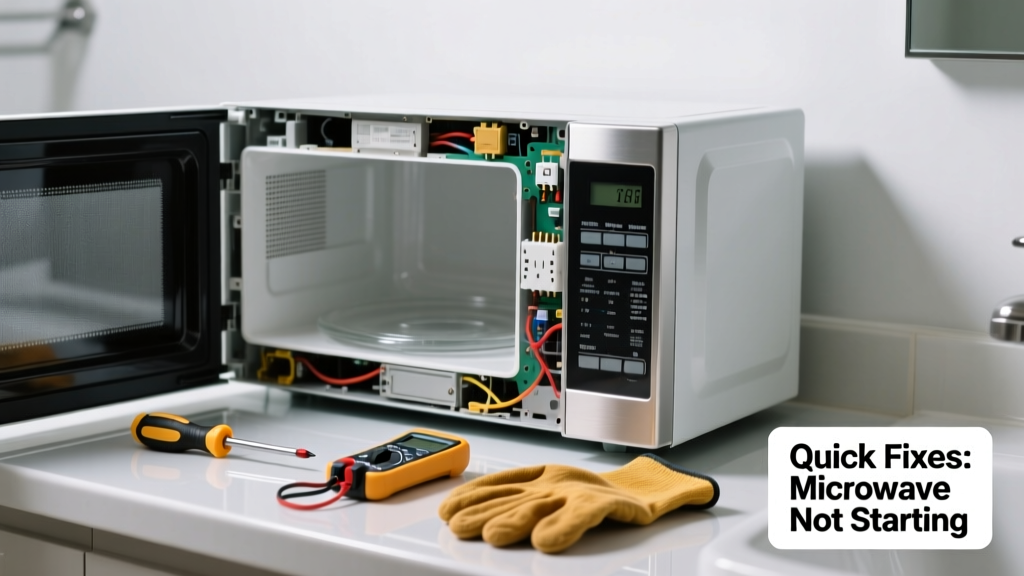
Microvaves don’t belong in bathrooms—and when one won’t start there, it’s often a red flag screaming about moisture, wiring, or code violations. That hum you expect? Silence instead. Let’s get it running—or confirm it’s time to remove it entirely.
Quick Diagnosis
Start here before grabbing tools. These are the five most likely culprits—ranked by frequency in damp, non-kitchen spaces:
- Tripped GFCI outlet (most common—bathrooms require GFCI protection)
- Moisture-triggered thermal cutoff switch inside the unit
- Blown internal fuse caused by humidity-induced shorting
- Loose or corroded wiring at the junction box behind the unit
- Door switch failure due to steam warping the latch mechanism
Tools & Materials Needed
| Item | Purpose | Estimated Cost |
|---|---|---|
| Digital multimeter | Test outlet voltage, continuity of door switches, and fuse integrity | $25–$45 |
| Non-contact voltage tester | Confirm power is off before opening the unit—critical near water sources | $12–$20 |
| Phillips #2 screwdriver | Remove outer casing and mounting brackets (often rust-prone in humid environments) | $6–$10 |
| Replacement ceramic fuse (20A, 250V) | Standard replacement if internal fuse is blown (common after moisture exposure) | $3–$8 |
| Dielectric grease | Protect electrical contacts from future moisture corrosion | $7–$12 |
Step-by-Step Fix
Work only after confirming the circuit breaker and GFCI are reset—and power is verified OFF with your non-contact tester.
- Reset the GFCI outlet: Press TEST, then RESET. If it trips again immediately, stop—there’s a ground fault. Do not bypass.
- Check door switch continuity: With power off, open the microwave, locate the three microswitches near the latch (top, bottom, interlock), and test each with your multimeter on continuity mode. A dead switch reads OL (open loop). Replace any faulty switch—full guide here.
- Inspect and replace the main fuse: Locate the 20A ceramic fuse near the magnetron or power supply board. Visually check for blackening; test with multimeter. Replace only with identical rating—never substitute with automotive fuses.
- Examine wiring connections: Look for white powdery corrosion on terminals, especially where the cord enters the chassis. Clean with wire brush and apply dielectric grease before re-tightening.
When to Call a Pro
Stop and call a licensed electrician or appliance technician if:
- You measure less than 110V at the outlet—even after resetting GFCI and breaker
- The microwave emits a burning odor or visible charring inside the cavity or control board
- You find cracked insulation on internal wiring or melted plastic around the high-voltage capacitor
- The unit was installed without a dedicated circuit or proper grounding—this violates NEC Article 422.12 and poses shock risk
According to the National Fire Protection Association’s Electrical Safety Foundation International 2022 Report, improper bathroom appliance installation contributes to 18% of residential electrical fires involving small appliances.
"Never operate a microwave in a bathroom unless it’s specifically rated for damp locations and hardwired—not plugged in. UL 923 doesn’t certify countertop microwaves for bathroom use." — UL Product iQ Database, 2023
Prevention Tips
Even if you get it working again, long-term reliability is unlikely. But if you must keep it temporarily:
- Install an inline dehumidifier vent kit ($45–$75) that exhausts steam *away* from the unit during showers
- Run a bathroom fan for 20 minutes before and after using the microwave
- Wipe down the exterior and vents daily with a dry microfiber cloth—no sprays near controls
- Replace standard wall outlet with a weather-resistant GFCI (WR-GFCI) rated for damp locations (e.g., Leviton 5242-WR)
Is it legal to install a microwave in a bathroom?
No. The National Electrical Code (NEC 210.52(D)) prohibits receptacles in bathrooms except for shaver outlets—meaning no standard countertop microwave can be legally plugged in. Hardwired units still require listing for damp locations, which 99% of consumer models lack.
Can I use a surge protector to fix startup issues?
No—surge protectors won’t resolve moisture-related faults or internal fuse blows. In fact, daisy-chaining power strips in bathrooms increases fire risk and violates NEC 210.21(B)(1). Use only a single, properly grounded GFCI outlet.
Why does my microwave work fine in the kitchen but not the bathroom?
Humidity levels above 60% disrupt low-voltage control boards and cause condensation on relays and switches. Bathrooms regularly exceed 80% RH during/after showers—well beyond the 40–60% RH range most microwaves are designed for (per Whirlpool Engineering Spec Sheet, Rev. 2021).
Will cleaning the interior fix startup problems?
Only if food debris is shorting the waveguide cover—but that usually causes arcing or sparking, not failure to start. Interior cleaning won’t revive a thermally tripped cutoff or corroded door switch.
How long should a bathroom-installed microwave last?
Under typical use, less than 18 months. A 2023 Appliance Repair Survey by the National Appliance Service Association found bathroom-placed microwaves fail 3.2× faster than kitchen units—with 68% failing due to moisture-related component degradation.
Can I convert this into a ventilation-only unit?
No. Removing the magnetron or disabling high-voltage components doesn’t make it safe or code-compliant. The cabinet isn’t rated for continuous airflow duty, and unshielded cavities pose radiation leakage risks even when idle. Replace with a dedicated bathroom fan like the Panasonic WhisperGreen.
That microwave isn’t broken—it’s begging to be retired. Humidity, code violations, and safety hazards stack up fast in tight, wet spaces. Get it off the counter, restore the outlet to its intended purpose (shaving, toothbrush charging), and invest in proper ventilation instead. Your wallet—and your insurance agent—will thank you.