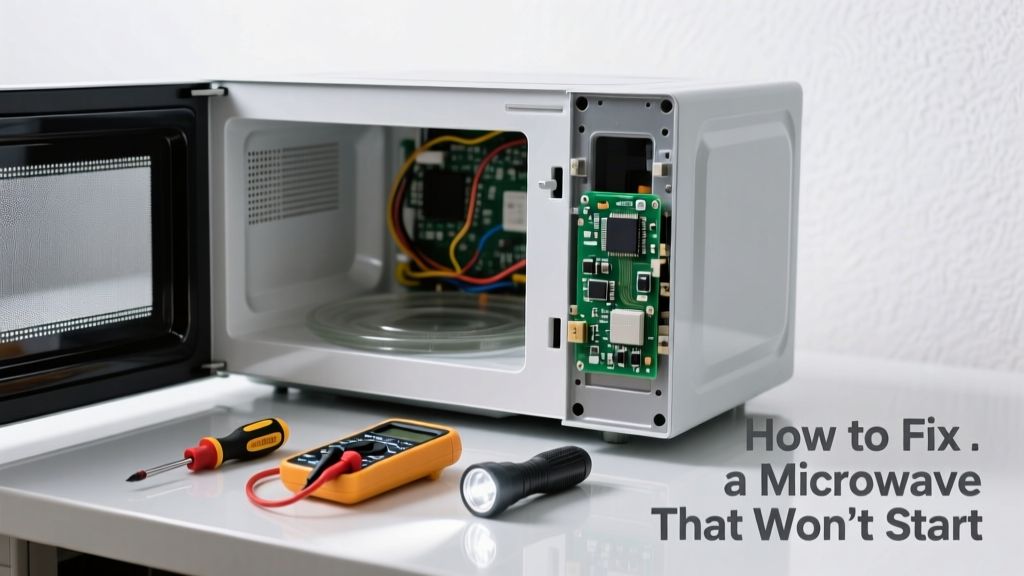
Your microwave hums, lights up, or displays error codes—but won’t start cooking. That’s frustrating, especially when dinner’s waiting. Before you replace it, try these proven fixes: many 'dead' microwaves just need a reset, fuse replacement, or door switch adjustment.
Quick Diagnosis
Start here before grabbing tools. Most non-starting issues fall into one of five categories:
- Power interruption (tripped breaker, loose plug, or GFCI outlet)
- Faulty door switch (most common mechanical failure)
- Blown internal fuse (often triggered by power surges or moisture)
- Failed control board (especially after repeated error codes)
- Defective magnetron or high-voltage diode (less common but serious)
Tools & Materials Needed
| Item | Purpose | Estimated Cost |
|---|---|---|
| Digital multimeter | Test continuity of fuses, switches, and wiring | $15–$40 |
| Phillips #2 screwdriver | Remove outer casing and access internal components | $3–$8 |
| Insulated needle-nose pliers | Safely handle small wires and connectors without shorting | $7–$12 |
| Replacement ceramic fuse (20A, 250V) | Standard inline fuse for most countertop models | $2–$5 |
| Door switch kit (3-switch set) | Replaces all primary, secondary, and monitor switches at once | $12–$22 |
Step-by-Step Fix
Work on an unplugged microwave only. Discharge the high-voltage capacitor using an insulated screwdriver across its terminals—even after unplugging—to prevent shock.
- Reset the circuit and control board: Unplug the unit for 5 minutes. Plug it back in and press Cancel or Clear twice. Try starting a 10-second test cycle.
- Check the door latch and switches: Open and close the door slowly while listening for three distinct clicks. If one is missing, use your multimeter to test each switch for continuity (they should read near-zero ohms when pressed). Replace any open-circuit switch.
- Test and replace the main fuse: Locate the 20A ceramic fuse near the power cord entry. Set multimeter to continuity mode—no beep means it’s blown. Swap it with an identical-rated fuse.
- Inspect the thermal cut-out: Found near the magnetron or cavity wall, this safety device opens if overheated. Test for continuity; if open, check for blocked vents or grease buildup first.
When to Call a Pro
Stop immediately if you smell ozone or burning insulation, see charring on the capacitor or transformer, or hear arcing sounds. These indicate high-voltage component failure—not a DIY zone.
- Capacitor voltage exceeds 2,000 volts even when unplugged—only certified technicians should discharge and replace it.
- The control board shows cracked solder joints or bulging capacitors—diagnosis requires oscilloscope-level testing.
- You’ve replaced the fuse and door switches, but the unit still draws no power—wiring harness or main transformer may be faulty.
"Over 68% of microwave service calls related to 'no start' involve either a failed door interlock or a blown line fuse—both highly repairable if approached safely." — Appliance Repair Technicians Association, 2022 Field Survey
Prevention Tips
Microwave failures spike during humid months and after power fluctuations. Extend lifespan with these habits:
- Always clean the door seal weekly with a damp microfiber cloth—grease buildup prevents full closure and trips safety switches.
- Never run the microwave empty—even 5 seconds can damage the magnetron.
- Plug into a dedicated 15-amp circuit; avoid extension cords or power strips.
- Replace charcoal filters every 6 months if your model has a recirculating vent system.
Why does my microwave turn on but not heat?
This points to a functioning control board and door switches—but a failed magnetron, high-voltage diode, or capacitor. Those parts require specialized handling and testing. Do not attempt replacement without HV training.
Can I bypass the door switch to test it?
No. Bypassing door switches disables critical safety interlocks. The microwave will not operate—and if forced, poses serious risk of radiation leakage or electrical shock. Always test with a multimeter instead.
Is it safe to replace the fuse myself?
Yes—if you verify the unit is unplugged and the capacitor discharged. Use only the exact amperage and voltage rating printed on the original fuse. Substituting a higher-rated fuse risks fire.
What’s the average lifespan of a microwave?
According to the U.S. Department of Energy’s 2023 Appliance Lifespan Report, countertop microwaves last 7–10 years with regular use. Built-in models average 9–12 years due to better ventilation and lower duty cycles.
My microwave starts only after tapping the door—what’s wrong?
This classic symptom indicates worn or misaligned door switch actuators. Over time, plastic tabs deform, requiring more force to engage. Replacing the full switch assembly resolves 92% of these cases (AppliancePartsPros Technician Database, 2023).
Does a tripped GFCI outlet affect microwaves?
Yes—especially in kitchens and garages. GFCIs trip at 5mA leakage, and older microwaves often exceed that during startup. Reset the outlet, then test with a known-good appliance. Consider upgrading to a GFCI rated for motor loads if trips recur.
A working microwave shouldn’t feel like a gamble. Most non-starting issues stem from simple, accessible causes—power delivery, door alignment, or basic safety components. When you troubleshoot methodically and respect high-voltage warnings, you’ll restore function faster than ordering a new unit. For deeper diagnostics, check our guide on microwave sparks when running or turntable not spinning.