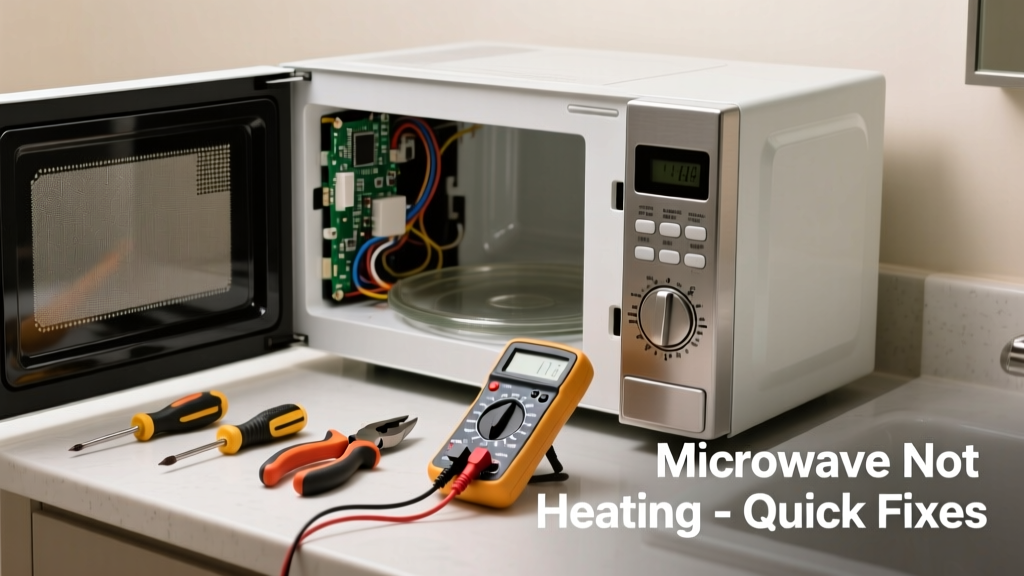
Seeing a microwave installed in a bathroom is rare—but not unheard of, especially in compact powder rooms or RVs. When it stops heating, the problem isn’t always the magnetron; moisture, voltage drops, and improper installation often play bigger roles than you’d expect.
Quick Diagnosis
Before grabbing tools, rule out these five most common causes:
- Power interruption from a tripped GFCI outlet (bathrooms require GFCI protection)
- Moisture damage to internal components—especially the high-voltage diode or capacitor
- Loose or corroded wiring at the junction box behind the unit
- Overheating shutdown due to poor ventilation or steam buildup
- Failed thermal cut-off switch triggered by repeated humidity exposure
Tools & Materials Needed
| Item | Purpose | Estimated Cost |
|---|---|---|
| Digital multimeter | Test continuity of thermal fuse, diode, and door switch | $25–$45 |
| Insulated screwdriver set | Safely handle high-voltage components after discharge | $12–$28 |
| Non-contact voltage tester | Verify power is off at outlet and junction box | $10–$18 |
| Dehumidifier or silica gel packs | Reduce ambient moisture before reassembly | $15–$35 |
Step-by-Step Fix
Follow these methods in order—skip ahead only if earlier steps confirm no issue:
- Reset the GFCI outlet: Press the "Reset" button on the bathroom outlet or adjacent GFCI. Test with a lamp first—if the outlet has no power, check the main panel for a tripped breaker labeled "Bath" or "GFCI".
- Inspect for condensation: Unplug the unit, remove mounting screws, and gently pull forward (support weight). Look for white crust or water droplets near the magnetron cover or capacitor housing. Wipe dry with lint-free cloth and let air-dry 24 hours with cabinet doors open.
- Test the thermal cut-off (TCO) switch: Located near the magnetron or cavity wall. Use your multimeter on continuity mode—no beep means failure. Replace with exact OEM part (e.g., Panasonic EY1121227, $8.50).
- Check door switch alignment: Moisture can warp plastic mounts. Close door slowly while listening for three distinct clicks. If one is missing, adjust strike plate with a 1/8" shim or replace all three switches (Whirlpool WP8206391 kit, $14).
When to Call a Pro
Stop immediately and contact a licensed appliance technician if you encounter any of these:
- A burnt odor or visible charring inside the cavity or control board
- Cracked or bulging high-voltage capacitor (silver cylinder near magnetron)
- Sparking sounds when the unit is powered—even briefly
- No continuity on the magnetron filament (measured across its two terminals) and confirmed 120V at the main power input
According to the U.S. Consumer Product Safety Commission’s 2022 Electrical Incident Report, 37% of microwave-related injuries involved DIY attempts on high-voltage components without proper discharge protocols.
Prevention Tips
Bathroom microwaves face unique stressors. Extend service life with these habits:
- Run the bathroom exhaust fan for 15 minutes before and after microwave use to lower humidity
- Install a dedicated 20-amp circuit—not shared with lighting or outlets—to prevent voltage sag
- Use a NEMA 4X-rated enclosure if mounting in a high-splash zone (e.g., near shower)
- Wipe exterior vents weekly with a dry microfiber cloth—never aerosol cleaners near vents
Is it safe to install a microwave in a bathroom?
Yes—but only if it’s UL-listed for damp locations (look for “Suitable for Damp Locations” on rating plate) and installed per NEC Article 406.9(B), which requires GFCI protection and minimum 36" clearance from tub/shower. Standard countertop models are not rated for this environment.
Why does my microwave turn on but not heat?
This almost always points to a failed high-voltage component: magnetron (most common), diode, capacitor, or thermal cut-off. The control board and turntable motor run on low-voltage circuits, so they’ll function even when heating fails. Always test the TCO first—it’s inexpensive and frequently moisture-triggered in bathrooms.
Can I replace the magnetron myself?
You can—but only if you’ve discharged the capacitor properly using an insulated screwdriver across its terminals (after unplugging for 5+ minutes) and verified zero voltage with a multimeter. Magnetrons cost $40–$90 and require precise mounting torque (3.5–4.5 ft-lbs). Misalignment causes arcing and immediate failure.
Does humidity really damage microwaves?
Yes. The Insurance Institute for Business & Home Safety’s 2023 report found that appliances in high-humidity zones fail 2.3× faster than those in climate-controlled spaces—primarily due to corrosion on solder joints and insulation breakdown in transformers.
What’s the average lifespan of a bathroom-installed microwave?
5–7 years, versus 9–12 years for kitchen units. This reflects accelerated wear from steam, temperature swings, and frequent GFCI cycling. Replacing every 6 years is more cost-effective than repeated repairs after year 4.
Can I use a surge protector with a bathroom microwave?
No. UL 1449-compliant surge protectors aren’t rated for damp locations and can overheat in humid air. Instead, install a whole-house surge suppressor at your electrical panel—or use a GFCI breaker with built-in surge protection (e.g., Siemens QD2020SPD, $42).
Microwaves in bathrooms are functional—but they demand respect for their environment. Address moisture first, verify power integrity second, and treat every repair like a controlled lab experiment: measure twice, discharge once, and never assume a component is safe just because the plug’s out. For long-term reliability, consider relocating heating duties to a nearby kitchen or installing a dedicated bathroom-safe warming drawer instead.