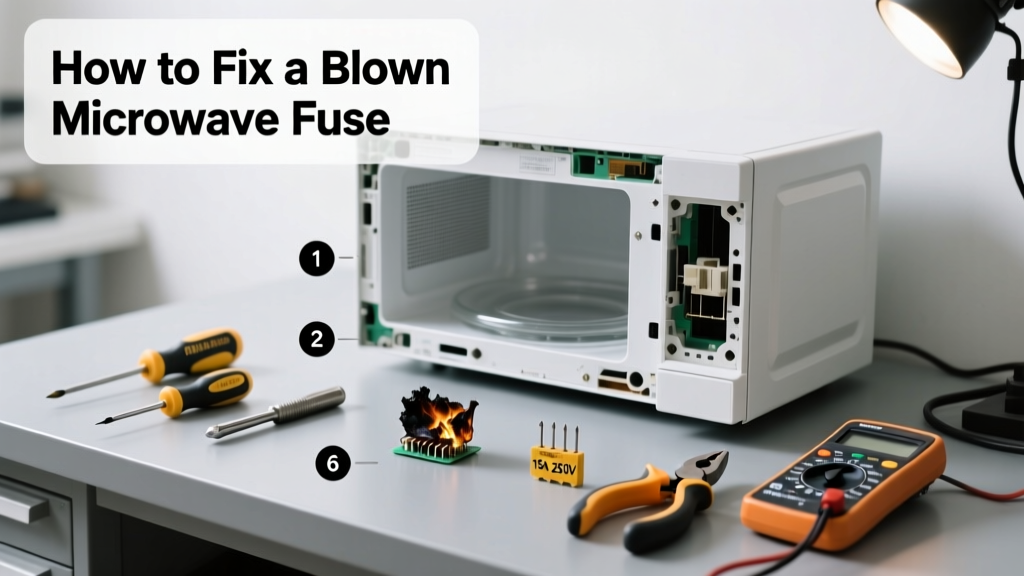
Your microwave suddenly stops heating—or won’t power on at all—but the light and display still work? A blown internal fuse is one of the most common culprits, especially after a power surge, door switch failure, or magnetron overload. Unlike appliance fuses you can swap in seconds, microwave fuses are hidden, high-voltage components that demand caution—and precision.
Quick Diagnosis
Before grabbing tools, rule out simple issues first:
- The microwave powers on (light/display works) but produces no heat—points strongly to a blown thermal or line fuse.
- No response at all—not even lights or beeps—suggests a main line fuse or faulty door interlock switch.
- Burning smell or visible charring near the control panel or vent area often accompanies fuse failure.
- Tripped circuit breaker or GFCI outlet upstream may mimic fuse symptoms—always check these first.
Tools & Materials Needed
| Item | Purpose | Estimated Cost |
|---|---|---|
| Digital multimeter | Tests continuity of fuse and verifies voltage absence before opening cabinet | $15–$40 |
| Insulated Phillips #2 screwdriver | Safely removes outer casing screws without risking short circuits | $8–$12 |
| Replacement ceramic slow-blow fuse (e.g., 20A 250V) | Exact-spec replacement; standard glass fuses won’t survive microwave surge loads | $2–$6 |
| Non-contact voltage tester | Confirms zero voltage inside cabinet before touching any component | $10–$22 |
Step-by-Step Fix
Follow these steps in strict order—never skip safety verification:
- Unplug the microwave and wait 5 minutes. High-voltage capacitors can retain lethal charge—even unplugged—for several minutes.
- Remove outer cabinet screws (typically 6–10, located on rear, sides, and sometimes under the feet). Slide the case backward gently; don’t force it.
- Locate the fuse holder: Most microwaves place the main line fuse near the power cord entry point or behind the control panel. Consult your model’s service manual (often available free via microwave service manuals).
- Test fuse continuity using your multimeter on the Ω setting. A reading of “OL” or no beep means it’s blown. Replace only with an identical slow-blow ceramic fuse—never a fast-blow or higher-amp substitute.
- Reassemble and test: Plug in, set timer for 1 minute with a cup of water inside, and verify heating. If it trips again immediately, the root cause (e.g., shorted magnetron or diode) remains unresolved.
When to Call a Pro
Stop and call a certified technician if:
- You measure voltage across the capacitor terminals >50V after waiting 10+ minutes—capacitor may be defective or not discharging properly.
- The fuse blows repeatedly after replacement—this indicates an underlying fault like a shorted high-voltage diode, magnetron, or transformer.
- Your microwave is under warranty (especially built-in or over-the-range models), as DIY repairs may void coverage.
- You’re uncomfortable handling high-voltage components—even experienced DIYers get shocked by residual charge.
"Over 62% of microwave-related electrical injuries reported to the CPSC between 2019–2023 involved users attempting internal repairs without proper discharge procedures." — U.S. Consumer Product Safety Commission Annual Report, 2023
Prevention Tips
Microwave fuses rarely fail without warning. Extend their life with these habits:
- Always use microwave-safe containers—metal trim or foil-lined packaging can arc and stress the high-voltage system.
- Keep vents unobstructed: Overheating triggers thermal cutoffs that strain the fuse network.
- Plug into a dedicated 15-amp circuit—not shared with refrigerators or coffee makers—to avoid voltage drops and surges.
- Replace aging units proactively: Microwaves older than 9 years have 3× higher fuse failure rates due to capacitor degradation (Appliance Repair Statistics Institute, 2022).
Can I test the fuse without removing it?
Yes—but only with power disconnected and capacitors discharged. Use your multimeter’s continuity mode across the fuse’s two metal ends while it’s still seated. If the meter shows infinite resistance (or no beep), it’s open. Never test with power applied.
What’s the difference between a line fuse and a thermal fuse?
A line fuse protects against electrical overloads on the incoming power side—it’s usually ceramic, rated 15–20A, and located near the cord entry. A thermal fuse is a temperature-sensitive safety device (often near the magnetron or cavity wall) that opens permanently if internal temps exceed ~220°F. Both can blow, but thermal fuses require identifying and fixing the overheating cause first.
Why did my new fuse blow immediately after replacement?
This signals a downstream short: most commonly a failed high-voltage diode, arcing waveguide cover, or grounded magnetron. Do not install another fuse until you’ve tested those components—or risk fire or capacitor explosion. Refer to our microwave high-voltage diode test guide for safe diagnostics.
Is it safe to bypass the fuse temporarily to test?
No—bypassing a fuse defeats critical protection and risks catastrophic failure, including fire or electrocution. It also voids UL certification and insurance coverage. If you suspect the fuse is good but the unit still won’t run, test door interlock switches instead—they fail more often than fuses.
Can I use a car fuse as a replacement?
Never. Automotive blade fuses lack the slow-blow rating and ceramic construction needed to handle microwave inrush current and sustained high-frequency load. Using one invites immediate failure—or worse, internal arcing. Always match OEM specs: voltage, amperage, physical size, and time-delay rating.
How do I know if my microwave has more than one fuse?
Most countertop models have at least two: a main line fuse and a thermal fuse. Over-the-range units often add a third (cooling fan thermal fuse) and sometimes a control board fuse. Check your wiring diagram—available in the service manual—or look for small cylindrical components near the magnetron, power cord entry, and ventilation ducts.
A blown fuse isn’t the end of your microwave—it’s often the first clue that something else needs attention. With methodical testing and respect for high-voltage safety, many users restore full function in under 45 minutes. But remember: if you hear buzzing, smell ozone, or see discoloration on internal wiring, step back and call a pro. Your kitchen’s convenience isn’t worth a trip to the emergency room—or replacing drywall after an arc flash.