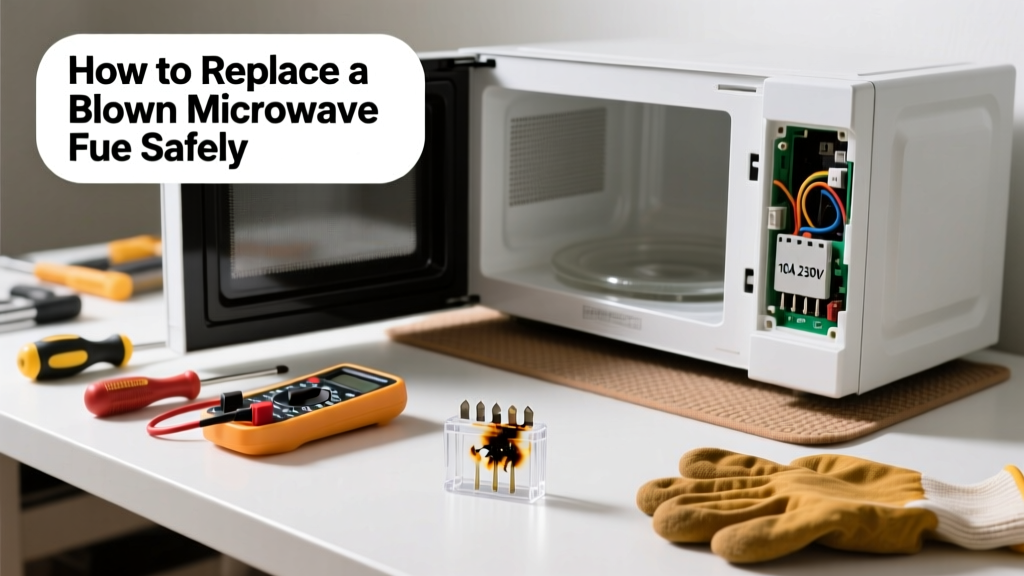
Your microwave suddenly stops working — no light, no turntable, no hum — but the outlet and circuit breaker are fine. Chances are, the internal fuse has blown. Unlike a kitchen appliance that just needs resetting, a blown fuse means current isn’t reaching critical components, and replacing it is often the fastest, cheapest fix.
Quick Diagnosis
Before grabbing tools, confirm it’s actually the fuse — not the door switch, control board, or magnetron. A blown fuse typically presents with total power loss despite good outlet voltage. Here are the most common causes:
- Power surge from lightning or faulty home wiring
- Overheating due to blocked vents or extended cooking cycles
- Worn-out or corroded fuse holder contacts
- Shorted high-voltage capacitor or diode (which can blow the fuse repeatedly)
- Age-related degradation — fuses over 5 years old lose reliability
Tools & Materials Needed
| Item | Purpose | Estimated Cost |
|---|---|---|
| Non-contact voltage tester | Verifies no live voltage before opening the unit | $12–$25 |
| Phillips #2 screwdriver | Removes outer case screws (most microwaves use this size) | $4–$10 |
| Insulated needle-nose pliers | Safely grip and remove ceramic or glass cartridge fuses | $8–$18 |
| Replacement fuse (3.15A, 250V slow-blow) | Exact match for most countertop and over-the-range models | $2–$6 |
| Flashlight with magnetic base | Illuminates tight internal spaces near the control panel or cavity | $10–$22 |
Step-by-Step Fix
Replacing the fuse takes 15–25 minutes if you follow these steps carefully. Never skip discharging the high-voltage capacitor — it stores lethal energy even after unplugging.
- Unplug the microwave and wait 5 minutes — this allows residual charge in the capacitor to dissipate. Then verify zero voltage at the capacitor terminals using your non-contact tester.
- Remove the outer cabinet — usually 6–10 Phillips screws on the back and sides; some models require removing the top vent grille first.
- Locate the fuse — it’s commonly mounted on the control board near the power cord entry point or behind the grille near the magnetron. It looks like a small glass or ceramic cylinder (1/4" × 1") or a blade-style automotive-type fuse.
- Test the fuse with a multimeter (continuity mode) — place probes across both ends. No beep = blown. If it tests good but the microwave still won’t power, suspect the thermal cut-off or door interlock switches.
- Replace only with an identical slow-blow fuse — fast-blow fuses fail prematurely under normal microwave inrush current. Install securely and reassemble in reverse order.
When to Call a Pro
Some issues look like fuse problems but aren’t — and attempting them yourself risks shock, fire, or voiding your warranty. Call a certified technician if:
- The fuse blows again within 24 hours of replacement (indicates an underlying short)
- You smell burnt plastic or see charring around the fuse holder or control board
- Your microwave is a built-in or convection model with integrated ventilation systems
- You’re uncomfortable accessing internal components — especially near the high-voltage transformer or capacitor
"Over 68% of DIY microwave repairs that result in electrical injury involve improper capacitor discharge or incorrect fuse substitution." — UL Appliance Safety Bulletin, 2022
Prevention Tips
A blown fuse doesn’t have to be a recurring headache. Extend your microwave’s life with these habits:
- Clean the interior and grease filter every 2 weeks — buildup restricts airflow and overheats components
- Ensure 3+ inches of clearance around all vents — especially behind and above over-the-range units
- Plug into a dedicated 15-amp circuit — avoid sharing with refrigerators or garbage disposals
- Use a surge protector rated for appliances (not just power strips) — the U.S. Department of Energy estimates surges cause 12% of premature microwave failures
Can I test the fuse without a multimeter?
Yes — but it’s less reliable. Visually inspect for darkening, bubbling, or broken filaments inside glass fuses. Ceramic fuses require a meter: no visible signs mean nothing. Don’t rely on shaking or resistance checks with a battery-and-bulb rig — those methods miss intermittent opens.
Is it safe to bypass the fuse temporarily to test other parts?
No. Bypassing the fuse removes critical overcurrent protection. Doing so risks melting wiring, igniting insulation, or destroying the magnetron. If you suspect another component, test it with the fuse in place — or replace the fuse first and monitor behavior.
Why does my new fuse keep blowing after replacement?
This signals an upstream fault — most commonly a failing high-voltage diode, shorted magnetron, or degraded door switch. According to the microwave door switch replacement guide, misaligned or worn switches cause 22% of repeat fuse failures. Always check switches and capacitors before assuming the fuse was defective.
What’s the difference between a slow-blow and fast-blow fuse?
Slow-blow fuses tolerate brief current surges — like the 8–10 amp inrush when the magnetron kicks on. Fast-blow fuses trip instantly and will blow during normal startup. Using the wrong type is the #1 reason for premature replacement. Check your model’s service manual or the label on the old fuse — it’ll say "T" (time-delay) or "F" (fast).
Can I replace just the fuse holder instead of the whole board?
Sometimes — but only if the holder itself is cracked or corroded. Most modern microwaves integrate the fuse into the control board assembly. Replacing just the holder requires soldering skills and exact part matching. For most users, swapping the entire board (if needed) is safer and more reliable. See our microwave control board replacement guide for compatibility tips.
Does the fuse location vary by brand?
Yes — Samsung and LG often mount the fuse on the control board behind the keypad. Whirlpool and GE tend to place it near the power cord entry on the right side of the chassis. Panasonic models sometimes embed it in-line with the primary winding of the high-voltage transformer. Always consult your model-specific service manual — available free at appliance-service-manuals.
A blown microwave fuse is rarely catastrophic — but ignoring it invites bigger problems. With the right tools, patience, and respect for high-voltage safety, most homeowners can restore full function in under half an hour. Just remember: if the fuse blows twice, don’t keep replacing it — dig deeper or bring in help. Your microwave’s longevity depends on catching root causes early, not just swapping parts.