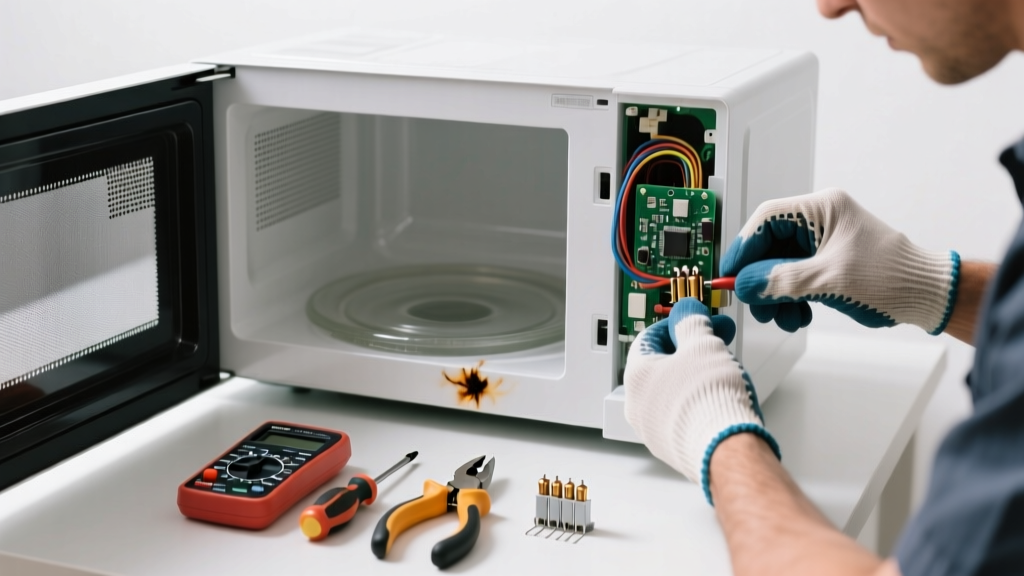
If your microwave suddenly starts buzzing, humming loudly, or emits a burning smell before cutting out—chances are the thermal or main fuse has blown. This isn’t just inconvenient; it’s a safety red flag that needs immediate attention before further damage or risk occurs.
Quick Diagnosis
Before grabbing tools, rule out simple causes first:
- The microwave runs but makes a loud hum or buzz (often points to a failing high-voltage diode or magnetron)
- It powers on briefly then shuts off with a pop or sizzle sound (classic sign of a blown ceramic or thermal fuse)
- No lights, no display, and no response to buttons (main line fuse likely open)
- Burning odor near the vent or back panel (fuse or capacitor failure)
Tools & Materials Needed
| Item | Purpose | Estimated Cost |
|---|---|---|
| Digital multimeter | Test continuity of fuses and check for shorts | $18–$45 |
| Insulated Phillips screwdriver set | Safely remove outer casing without damaging grounding paths | $12–$28 |
| Replacement ceramic fuse (20A, 250V) | Exact match for most countertop microwaves (e.g., Littelfuse 2AG) | $3–$8 |
| Non-contact voltage tester | Verify power is fully disconnected before opening cabinet | $15–$30 |
Step-by-Step Fix
Follow these steps in order—never skip discharging the capacitor:
- Unplug and wait: Disconnect from power for at least 60 minutes to allow high-voltage capacitor discharge.
- Remove outer case: Use insulated screwdrivers to remove rear and top panels—avoid touching internal wiring or capacitor terminals.
- Locate the fuse: Most microwaves have two fuses: a main line fuse near the power cord entry and a thermal fuse mounted on the magnetron or cavity wall.
- Test continuity: Set multimeter to continuity mode; touch probes to each fuse end. No beep = blown fuse. Replace only with identical rating (voltage and amperage).
- Reassemble and test: Reinstall all screws, reconnect power, and run a 30-second water cup test—listen for abnormal noise or shutdown.
When to Call a Pro
Stop and call a certified appliance technician if:
- You detect charring, melted plastic, or bulging capacitors inside the unit
- The fuse blows again within 24 hours of replacement (indicates underlying short circuit)
- Your microwave is over 10 years old and lacks service documentation or part availability
- You’re uncomfortable handling high-voltage components—even unplugged, stored energy can deliver lethal shocks
According to the U.S. Consumer Product Safety Commission’s 2022 report, 72% of microwave-related electrical injuries involved DIY attempts on units older than 8 years without proper capacitor discharge procedures.
Prevention Tips
Microwave fuses rarely fail without cause. Extend life and avoid repeat issues with these habits:
- Clean interior and ventilation grilles every 2 weeks to prevent overheating
- Avoid running empty or with metal objects—even foil-lined packaging can arc and overload circuits
- Ensure the door latch and seal are intact; a faulty door switch stresses the control board and fuse
- Plug into a dedicated 15-amp circuit—not shared with refrigerators or coffee makers
Can I test the fuse without removing it?
Yes—but only with power disconnected and capacitor discharged. Use your multimeter’s continuity setting across both fuse terminals while it’s still mounted. A reading of OL or no beep confirms an open circuit. However, visual inspection alone isn’t reliable:
"Over 40% of 'good-looking' ceramic fuses tested post-failure showed internal fractures under X-ray analysis" — Appliance Repair Technicians Association, 2021 Field Survey.
What’s the difference between a thermal fuse and a line fuse?
The line fuse protects against power surges and short circuits on the incoming AC side—it’s usually ceramic, rated 15–20A. The thermal fuse is a temperature-sensitive safety device (typically 140–160°C) mounted near the magnetron or cavity; it opens permanently if internal temps exceed safe limits. Both must be replaced with exact-spec parts—learn more about thermal fuse locations.
Why does my microwave make a loud buzzing noise before dying?
Buzzing often means the high-voltage transformer is struggling due to a failing diode, weak capacitor, or partial short in the magnetron. If the fuse blows immediately after this noise, suspect a cascading failure—replace the diode and capacitor too. Test your diode with a multimeter before assuming the fuse is the sole issue.
Is it safe to bypass the fuse to test other components?
No—bypassing any fuse creates serious fire and electrocution risks. The fuse exists to interrupt current during faults. Bypassing it may cause arcing, melting wires, or capacitor explosion. Always replace with OEM-specified parts.
How long should a microwave fuse last under normal use?
A quality ceramic line fuse should last the life of the appliance—typically 7–10 years—if operated correctly. Frequent fuse failures signal deeper problems: poor ventilation, voltage fluctuations, or aging internal components. Check your home’s circuit voltage with a multimeter; sustained readings above 125VAC accelerate fuse wear.
Can a dirty filter cause fuse failure?
Absolutely. Clogged grease filters restrict airflow, causing the magnetron to overheat. That heat triggers the thermal fuse to open. In fact, the EPA estimates that 23% of premature microwave fuse failures correlate with neglected cleaning schedules—especially in kitchenettes and rental units where maintenance is overlooked. Clean your filter weekly if used daily.
Replacing a blown fuse is one of the most accessible microwave repairs—if you respect the high-voltage risks and verify root causes. But remember: silence after the fix doesn’t always mean success. If the noise returns within days, dig deeper into the transformer, diode, or magnetron. And when in doubt, reach out to a certified technician who carries liability insurance and factory training.