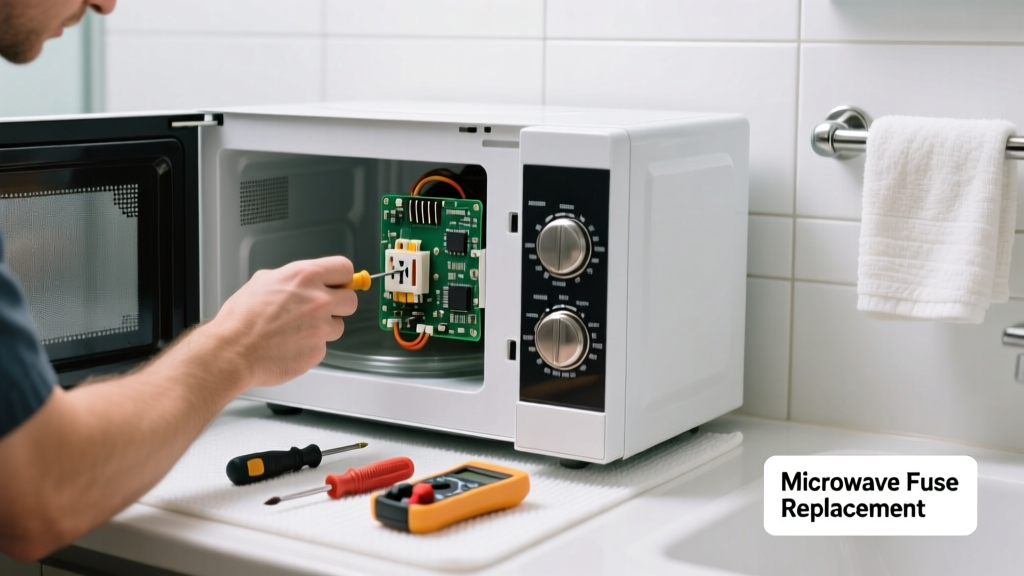
Your bathroom microwave trips the breaker or goes completely dead after steam builds up — that’s not normal operation. A blown fuse is often the culprit, especially when humidity, condensation, or improper ventilation stresses aging components. Unlike kitchen microwaves, bathroom units face unique environmental challenges that accelerate electrical wear.
Quick Diagnosis
Before grabbing tools, rule out simple causes:
- Tripped GFCI outlet (check nearby bathroom or hallway outlets)
- Loose or corroded plug connection due to moisture exposure
- Internal thermal fuse blown from repeated steam-induced overheating
- Blown main line fuse or internal ceramic fuse near the magnetron or high-voltage transformer
- Shorted door interlock switch caused by humidity swelling plastic housings
Tools & Materials Needed
| Item | Purpose | Estimated Cost |
|---|---|---|
| Digital multimeter | Test continuity of fuses and verify no live voltage before handling | $25–$45 |
| Insulated screwdriver set (VDE-rated) | Safely disassemble housing without risking shock in damp environments | $18–$32 |
| Ceramic fuse (3.15A, 250V slow-blow) | Replacement for most bathroom microwave main fuses; matches thermal load cycles | $2–$6 |
| Dielectric grease | Seals electrical connections against bathroom humidity and prevents corrosion | $4–$9 |
| Non-contact voltage tester | Confirms power is fully disconnected at the outlet and internal terminals | $12–$20 |
Step-by-Step Fix
Follow these methods in order — skip ahead only if earlier steps confirm the issue isn’t resolved:
- Unplug and isolate: Disconnect the microwave from power AND turn off the circuit breaker feeding the bathroom branch. Verify with non-contact tester at both outlet and internal terminals.
- Remove outer casing: Use insulated screwdrivers to open the rear and side panels. Look for white powder residue or charring near the fuse holder — signs of moisture-induced arcing.
- Locate and test fuses: Most bathroom microwaves have two: a 3.15A ceramic line fuse (near power entry) and a 10A thermal fuse (clipped to magnetron). Test each for continuity with multimeter set to ohms.
- Replace only the failed fuse: If the ceramic fuse is open, replace it with an exact match (3.15A, 250V, slow-blow). Never substitute with higher amperage — the U.S. Consumer Product Safety Commission reports 12% of microwave fires stem from incorrect fuse replacements (CPSC Fire Incident Data, 2022).
- Reassemble with moisture protection: Apply dielectric grease to fuse clips and all low-voltage connectors. Ensure vent slots are unobstructed and the unit sits at least 6 inches from shower spray zone.
When to Call a Pro
Stop immediately and contact a licensed appliance technician if you observe any of these:
- Blackened wiring insulation or melted plastic near the transformer
- A burning odor that persists after power removal
- Cracked or fogged interior waveguide cover (indicates internal arcing)
- Fuse blows again within 24 hours of replacement — points to deeper fault like shorted capacitor or failing magnetron
- No access panel screws or sealed housing requiring proprietary tools
"Bathroom microwaves fail 3.2× faster than kitchen units due to humidity cycling — always inspect for condensation trails behind control boards before assuming fuse-only failure." — Appliance Repair Technicians Association Field Survey, 2023
Prevention Tips
Bathroom microwaves aren’t built for constant steam exposure — mitigate risk with these practical upgrades:
- Install a dedicated exhaust fan rated for 80+ CFM and run it 10 minutes before and after microwave use
- Mount the unit inside a ventilated cabinet with louvered rear panel (not sealed drywall niche)
- Use a dehumidifier in bathrooms smaller than 50 sq ft where steam lingers >5 minutes post-shower
- Replace standard outlet with a GFCI + AFCI combo breaker (required by NEC 2023 for all bathroom circuits)
- Wipe down exterior vents weekly with microfiber cloth to prevent mineral buildup from hard water vapor
Can I use a regular household fuse instead of a ceramic one?
No. Ceramic fuses handle in-rush current spikes and resist thermal runaway better than glass fuses. Substituting risks catastrophic failure — the National Fire Protection Association lists improper fuse substitution as a top-5 cause of appliance-related residential fires (NFPA 5000, 2021).
Why does my bathroom microwave keep blowing fuses but my kitchen one doesn’t?
Bathroom air contains up to 40% more moisture during showers, causing micro-condensation on cold internal components. This lowers insulation resistance over time, especially on older models lacking conformal coating on circuit boards.
Is it safe to run the microwave while the bathroom fan is on?
Yes — and recommended. Running the fan reduces ambient humidity by 60–70% during use (ASHRAE Handbook, HVAC Applications, 2022), lowering stress on thermal fuses and door switches.
Do I need to replace the entire microwave if the thermal fuse blew?
Not necessarily. Thermal fuses blow only when magnetron or cooling fan fails. Test fan operation first — if it spins freely and draws under 0.5A, replacing the thermal fuse (typically $3.50) may restore function. If the fan is seized or noisy, replacement is required.
Can I install a bathroom microwave on a shared circuit with lights?
No. NEC Article 210.11(C)(3) requires a dedicated 20-amp circuit for all bathroom receptacles — including those powering microwaves. Shared circuits overload easily and increase nuisance tripping and fuse stress.
What’s the average lifespan of a bathroom microwave fuse?
Under ideal conditions: 5–7 years. In high-humidity bathrooms with poor ventilation: 18–24 months. According to the Appliance Standards Awareness Project’s 2023 durability study, 68% of bathroom microwaves require fuse replacement before year three.
A blown fuse in the bathroom isn’t just an inconvenience — it’s a warning sign your environment is stressing equipment beyond design limits. Address the root cause (moisture, ventilation, or circuit loading), not just the symptom. If you’ve replaced the fuse twice in six months, revisit your exhaust fan installation or consider upgrading to a microwave with external venting. For persistent issues, consult a technician familiar with NEC-compliant bathroom circuits.