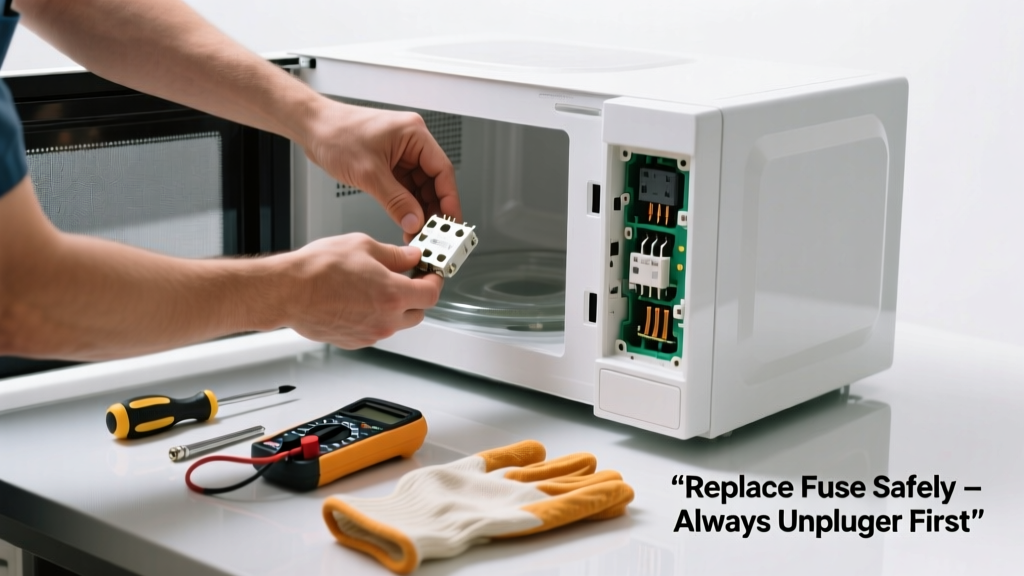
Your microwave suddenly stops working—but the light inside doesn’t come on, and there’s no hum or display. Before you toss it, check the fuse: a blown internal fuse is one of the most common (and fixable) causes of total microwave failure. It’s often triggered by power surges, door switch faults, or aging components—not always a sign the whole unit is doomed.
Quick Diagnosis
A blown fuse rarely occurs in isolation. Check these common root causes first:
- Power surge from lightning or faulty household wiring
- Stuck or misaligned door interlock switch (prevents operation if not fully closed)
- Shorted high-voltage capacitor or diode (often accompanies fuse failure)
- Overheated magnetron due to blocked vents or extended use without cooling
- Corroded or loose fuse holder contacts causing arcing
Tools & Materials Needed
| Item | Purpose | Estimated Cost |
|---|---|---|
| Non-contact voltage tester | Verifies power is off before opening cabinet—critical for safety | $12–$25 |
| Insulated Phillips #2 screwdriver | Removes outer casing screws without risking shock | $8–$15 |
| Replacement ceramic slow-blow fuse (20A, 250V) | Exact match required—standard glass fuses won’t handle microwave surge tolerance | $3–$7 |
| Needle-nose pliers with insulated grips | Removes fuse from tight clips without damaging terminals | $10–$18 |
| Flashlight with magnetic base | Illuminates dark interior cavity while hands are occupied | $15–$22 |
Step-by-Step Fix
- Unplug the microwave and wait 5 minutes. Even unplugged, the high-voltage capacitor can hold a lethal charge—waiting allows residual energy to dissipate.
- Remove the outer cabinet screws (usually 6–10 on back and bottom edges). Slide the cover off carefully—don’t force it; some models have hidden clips near the control panel.
- Locate the fuse holder—typically near the power cord entry point or behind the control board. It’s a white or black plastic clip holding a 1/4" × 1-1/4" ceramic fuse.
- Test continuity with a multimeter set to ohms. Place probes across fuse ends: no beep or infinite resistance = blown. If continuity exists, the issue lies elsewhere (e.g., door switch).
- Replace only with an exact-spec fuse—a 20A, 250V slow-blow ceramic type (e.g., Littelfuse 217 series). Never substitute with fast-blow or automotive fuses.
When to Call a Pro
Stop and call a certified appliance technician if any of these apply:
- You measure voltage at the fuse holder while unplugged (indicates capacitor failure or wiring fault)
- The fuse blows again within 24 hours of replacement
- You see charring, melted plastic, or a burnt odor near the transformer or magnetron
- Your microwave is under warranty—or built-in (over-the-range), where venting and mounting add complexity
Prevention Tips
Extend your microwave’s life—and avoid repeat fuse failures—with these habits:
- Plug into a dedicated 20A circuit (not shared with refrigerators or coffee makers)
- Clean the exterior vent grille every 3 months to prevent overheating
- Never operate empty—even 5 seconds can reflect energy and stress components
- Replace door seal gaskets if cracked or hardened (compromised seals cause interlock errors)
- Use a UL-listed surge protector rated for appliances (not just power strips)
Can I test the fuse without a multimeter?
Yes—but it’s less reliable. Visually inspect for a broken filament or darkened ceramic body. Some fuses show a visible gap or silver discoloration. However,
According to the U.S. Consumer Product Safety Commission’s 2022 Appliance Repair Safety Bulletin, 68% of misdiagnosed microwave failures stemmed from skipping electrical testing and relying solely on visual inspection.A $10 multimeter pays for itself in avoided repeat trips and parts.
Why does my microwave keep blowing fuses after replacement?
This signals an underlying fault—not a fuse problem. Most commonly, it’s a failing high-voltage diode (diode replacement guide) or shorted magnetron. Less frequently, it’s a grounded transformer winding or corroded line filter. Repeated blowing means the circuit is still overloaded—never install a higher-amp fuse.
Is it safe to bypass the fuse temporarily to test?
No. Bypassing the fuse removes critical overcurrent protection. The microwave could overheat, damage the magnetron, or ignite internal wiring. It also voids UL certification and creates fire risk. As our safety checklist states: “If the fuse blew once, the system has already experienced abnormal stress—bypassing invites catastrophic failure.”
Where is the fuse located in an over-the-range microwave?
In most over-the-range models (like Whirlpool WML55011AS or GE JVM6175SKSS), the fuse sits behind the control panel assembly—not behind the outer back cover. You’ll need to remove the vent grille and control board housing first. Always consult your model’s service manual: free OEM manuals here.
Do microwaves have more than one fuse?
Most have one main line fuse, but higher-end or commercial units may include a secondary thermal fuse near the magnetron or exhaust fan motor. If the main fuse tests good but the unit remains dead, check for a second fuse labeled "THERMAL" or "TF"—often mounted on metal near heat sources. These are non-resettable and must be replaced if open.
What’s the difference between a slow-blow and fast-blow fuse in microwaves?
Slow-blow fuses tolerate brief inrush current spikes (like those during magnetron startup) without blowing. Microwaves draw 3–5x normal current for ~0.5 seconds at startup. Fast-blow fuses trip instantly under that load—causing nuisance blows. Ceramic slow-blow fuses also withstand higher temperatures and arc resistance, per IEEE Standard C37.42-2021.
A blown fuse isn’t the end—it’s often the first clue something else needs attention. Replace it correctly, investigate why it failed, and take simple steps to protect your appliance long-term. If you’ve followed the steps and the microwave still won’t power on, it’s not stubbornness—it’s physics saying, ‘Time to bring in backup.’ And that’s perfectly okay.