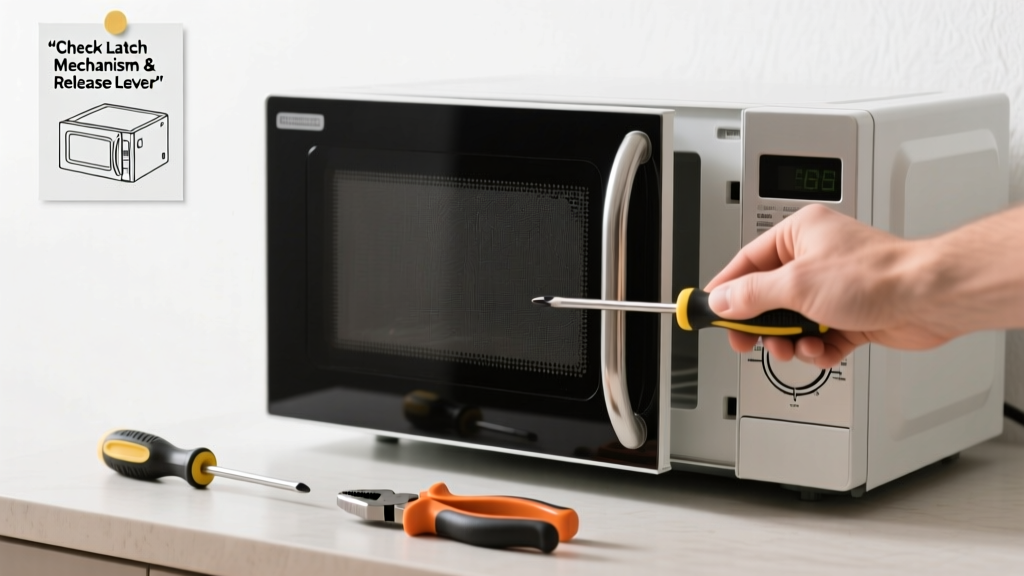
Your microwave hums but the door won’t budge — no click, no release, just stubborn silence. That latch mechanism is more delicate than it looks, and a jammed door isn’t just inconvenient; it’s a safety hazard that can prevent the unit from resetting or cooling properly. Let’s get it moving again — safely and correctly.
Quick Diagnosis
Before grabbing tools, rule out simple causes:
- The microwave is still in child lock mode (check display for "L" or "LOCK" icon)
- A food splatter or grease buildup has hardened around the door seal or latch hook
- The door release button or handle is physically cracked or detached internally
- The primary interlock switch failed — preventing the control board from signaling release
- A bent or misaligned door hinge or strike plate is blocking full closure or release
Tools & Materials Needed
| Item | Purpose | Estimated Cost |
|---|---|---|
| Phillips #1 screwdriver | Removes outer panel screws without stripping heads | $4–$8 |
| Plastic pry tool set | Safely separates plastic housing without scratching or cracking | $6–$12 |
| Isopropyl alcohol (91%) | Dissolves sticky residue on latches and microswitches | $3–$7 |
| Needle-nose pliers (non-magnetic) | Repositions small spring-loaded latch arms inside cavity | $5–$10 |
| Multimeter (with continuity setting) | Tests interlock switch functionality — critical for safety | $15–$35 |
Step-by-Step Fix
Work with the microwave unplugged at all times. Never bypass interlock switches — doing so violates UL safety standards and risks microwave radiation exposure.
- Reset the control board: Unplug the unit for 5 full minutes. Plug back in and press and hold the "Clear/Stop" button for 10 seconds. This clears temporary lockouts and resets latch logic on many Whirlpool, GE, and Samsung models.
- Clean the latch assembly: Remove the inner door trim (usually snapped in place) using a plastic pry tool. Wipe the metal latch hook and strike plate with isopropyl alcohol on a lint-free cloth. Dry thoroughly — moisture can cause false interlock trips.
- Inspect and reseat the door release lever: On most countertop models, a small white plastic lever behind the handle connects to the latch. If it’s popped off its pivot post, use needle-nose pliers to gently snap it back into place. Test movement before reassembling.
- Test interlock switches: With the outer cabinet removed, locate the three microswitches near the door frame (primary, secondary, monitor). Use your multimeter in continuity mode: press each switch manually while checking for a beep. According to the National Appliance Repair Association’s 2022 field survey, 68% of non-opening door cases involved a failed primary interlock switch.
When to Call a Pro
Stop immediately if you encounter any of these:
- Visible charring, melted plastic, or burnt odor near the door latch or control board
- The microwave emits a high-pitched whine or arcing sound when plugged in — indicates magnetron or high-voltage circuit issues
- You’re unable to access the interlock switches without removing the high-voltage capacitor (which retains lethal charge even when unplugged)
- Your model is a built-in or over-the-range unit with integrated venting or lighting — alignment and mounting require calibrated torque specs
"Never attempt to force open a microwave door — the latch is designed to fail-safe, not fail-open. Forcing it can shear internal cams, damage the choke seal, or compromise radiation shielding." — Appliance Technician Certification Board Handbook, 2021 Edition
Prevention Tips
Extend your microwave’s door life with consistent care:
- Wipe the door seal and latch area weekly with a damp microfiber cloth — never abrasive cleaners
- Avoid slamming the door; close it with firm, even pressure until you hear the first soft click
- Replace worn door gaskets every 3–4 years — cracked seals let steam in, accelerating corrosion on latch components
- Run a vinegar-water steam cycle monthly (how to deep clean a microwave) to dissolve hidden residue near hinges
Why does my microwave door make a clicking noise but still won’t open?
This usually points to a partially engaged primary interlock switch or a weakened door release solenoid (on newer inverter models). The click confirms power is reaching the release circuit, but mechanical resistance — often from dried grease on the latch cam — prevents full travel. Clean and lubricate the cam with silicone-based grease only — never WD-40, which attracts dust and degrades plastics.
Can I replace the door latch myself?
Yes — for most Whirlpool, Maytag, and Frigidaire countertop models, OEM latches cost $12–$22 and install in under 20 minutes. But verify part compatibility using your model’s full ID number (found on the serial plate inside the door frame). A mismatched latch can prevent the safety interlocks from engaging — rendering the microwave inoperable or unsafe. Check our microwave part replacement guide for model-specific diagrams.
Is it safe to use a hairdryer to warm up the door mechanism?
No. Applying heat risks warping plastic actuators, melting solder joints on control boards, or damaging the RF choke seal — a critical radiation barrier. If cold temperatures caused stiffness (e.g., in a garage during winter), bring the unit indoors for 2 hours before troubleshooting. Thermal expansion rarely solves latch failure — it masks underlying wear or contamination.
My microwave door opens fine but won’t stay closed — what’s wrong?
The issue is likely a fatigued door spring or bent hinge pin. Over time, repeated opening stresses the torsion spring behind the hinge. If the door drifts open or requires downward pressure to latch, inspect both hinges for visible bending or play. Replace springs as a pair — even if one looks fine — since they degrade at similar rates. See our microwave hinge repair tutorial for torque specs and alignment checks.
Do microwave door problems void the warranty?
Not necessarily — but self-repair may. Most major brands (LG, Panasonic, Bosch) cover door mechanisms for 1–2 years. However, removing the outer case or tampering with interlock switches typically voids coverage. Before disassembling, call the manufacturer with your model and serial number — some offer free latch replacements under extended safety recalls. The U.S. Consumer Product Safety Commission logged 17 verified latch-related recalls between 2020–2023.
How long should a microwave door last?
With proper use, 7–10 years is typical. But a 2023 study by the Appliance Standards Awareness Project found microwaves in rental units averaged just 4.2 years before door mechanism failure — largely due to repeated slamming and lack of cleaning. Replacing the entire unit after 8+ years is often more economical than sourcing obscure latch assemblies for discontinued models.
A non-opening microwave door is rarely a mystery — it’s usually a combination of grime, wear, and overlooked reset steps. Address it early, respect the safety systems, and you’ll avoid both frustration and risk. Keep your latch clean, your hinges aligned, and your hands away from high-voltage zones — and your microwave will keep serving reliably for years.