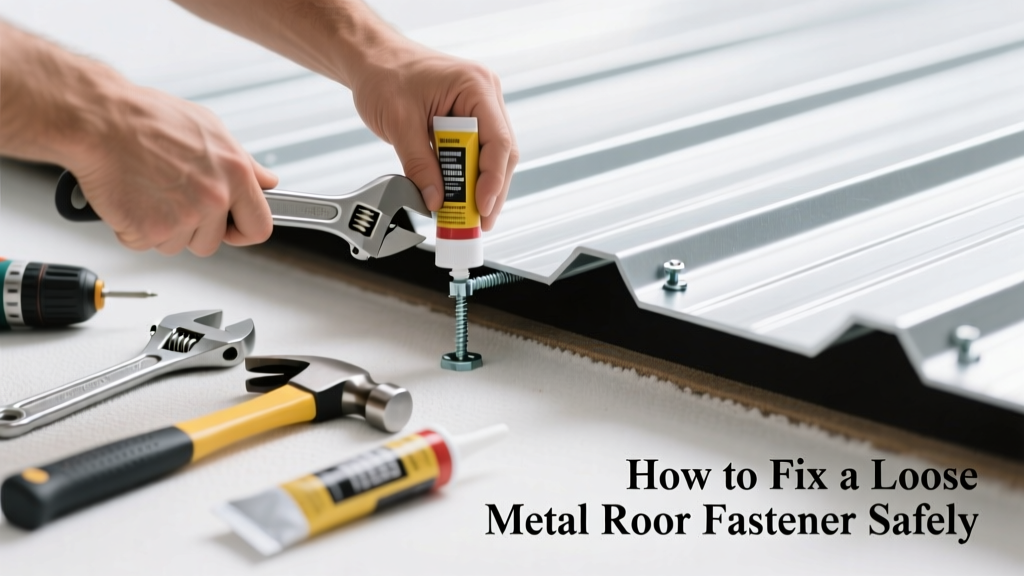
If you hear a faint 'ping' during temperature swings or spot a raised washer or dimpled panel near a screw, your metal roof fastener has likely loosened. Left unaddressed, even one loose fastener can let water seep under the panel, corrode the substrate, and compromise the entire roof system — especially in high-wind zones.
Quick Diagnosis
Loose fasteners rarely appear in isolation. Check for these root causes first:
- Thermal expansion/contraction cycling over 3–5 years (most common)
- Under-torqued installation during original build or repair
- Corrosion of fastener shank or washer due to galvanic mismatch or salt exposure
- Substrate degradation — especially in older OSB or plywood decks where wood fibers compress over time
- Use of non-ASTM-rated fasteners (e.g., drywall screws instead of Class 4 stainless or coated lag screws)
Tools & Materials Needed
| Item | Purpose | Estimated Cost |
|---|---|---|
| 1/4" hex driver bit + cordless impact driver (18V+) | Provides precise torque control without stripping heads; avoids overdriving | $25–$60 |
| Roofing-specific neoprene-washer fasteners (1/4" x 1.5") | Replaces corroded or deformed fasteners; neoprene seals against thermal movement | $0.35–$0.85 each |
| Magnetic pickup tool | Retrieves dropped fasteners from steep or ribbed panels — critical for safety and efficiency | $8–$15 |
| Roofing chalk line & tape measure | Ensures replacement fasteners align with original framing (typically 24" o.c. on purlins) | $12–$22 |
| Butyl sealant (e.g., OSI Quad Max) | Seals around new fastener base — required by most manufacturers for warranty compliance | $12–$18/tube |
Step-by-Step Fix
Always work in dry, calm conditions — never on wet or icy metal. Wear non-slip shoes and a harness if pitch exceeds 4:12.
- Mark and isolate: Circle each loose fastener with chalk. Note whether it’s in a flat pan area or near a rib — location affects torque specs and sealant application.
- Remove the old fastener: Use the hex driver at low speed. If stripped, try a #3 Phillips with firm downward pressure or extract with locking pliers. Never hammer or pry — this distorts the panel flange.
- Clean the hole: Brush out debris with a stiff nylon brush. Inspect the substrate: if soft or crumbly, drill a pilot hole 1/8" larger and insert a 2" wood screw with epoxy anchor (e.g., Simpson SET-XP) before reinstalling.
- Install the replacement: Apply a 3/8" bead of butyl sealant beneath the neoprene washer. Drive until the washer compresses evenly — stop when resistance increases sharply (typically 12–15 ft-lbs). Over-torqueing cracks the washer and voids warranties.
- Verify alignment: Check adjacent fasteners. If more than 3 within 10 linear feet are loose, suspect systemic issues — refer to metal roof maintenance checklist or consult a pro.
When to Call a Pro
DIY is unsafe or ineffective in these cases:
- You’re working on a roof with pitch > 8:12 or height > 15 feet without fall protection anchorage
- More than 10% of visible fasteners (e.g., 12+ on a 20-ft panel) are loose or corroded
- You find rust bleeding through seams or fastener holes — indicates substrate corrosion beyond surface repair
- The roof is under active manufacturer warranty (e.g., standing seam systems often require certified installers for any penetrations)
- Local building code requires licensed contractors for roof repairs — verify with your municipal inspections office
Prevention Tips
Extend your roof’s service life with proactive habits:
- Inspect fasteners twice yearly — spring and fall — using binoculars from ground level first
- Retorque all fasteners every 3 years using a calibrated torque wrench set to manufacturer specs (e.g., 12 ft-lbs for most R-panel systems)
- Avoid walking directly on panels between ribs — use roof ladders or bridging boards to distribute weight
- Replace standard zinc-coated fasteners with ASTM A153 Class D hot-dip galvanized or 304 stainless steel in coastal or high-humidity areas
- Keep gutters clean — clogged gutters cause ice dams and ponding that accelerate fastener corrosion
"Over 68% of premature metal roof failures traced to fastener issues stem from improper initial installation or lack of scheduled retorquing — not material defects." — Metal Construction Association Roofing Systems Manual, 2022
Can I reuse the old fastener if it’s not corroded?
No. Even undamaged fasteners lose clamping force after removal due to stretched threads and compressed washers. Always replace with new ASTM-compliant fasteners featuring integrated neoprene or EPDM washers — they’re engineered for thermal cycling.
What torque setting should I use for my R-panel roof?
Most R-panel systems require 12–14 ft-lbs, but always confirm with your panel manufacturer’s spec sheet. For example, McElroy’s R-Panel Installation Guide (Rev. 9, 2023) specifies 13 ft-lbs ± 1 ft-lb for 1/4" Type 304 stainless fasteners. Using a torque-limiting driver prevents overtightening — a leading cause of washer failure.
Will tightening the fastener stop an existing leak?
Tightening alone rarely stops leaks once water has penetrated. You must remove the fastener, clean the hole, apply fresh butyl sealant beneath a new washer, and reseat. If water staining appears on the ceiling below, inspect attic decking for rot — see our guide on roof leak detection inside the attic.
Is it safe to walk on my metal roof to reach the fastener?
Only if wearing soft-soled, non-marking shoes and stepping only on support ribs or purlins — never on flat pan areas. For roofs steeper than 6:12, use a roof ladder anchored at the ridge and secured with straps. One misstep can dent panels or cause injury.
How long do neoprene washers last on a metal roof?
High-quality neoprene washers last 15–20 years in moderate climates, but degrade faster in UV-intense or high-ozone environments. In Phoenix or Miami, expect 10–12 years. Replace them during any full-panel repair — don’t wait for visible cracking.
Do I need a permit to replace roof fasteners?
Generally no for isolated fastener replacement — it’s considered maintenance, not structural modification. However, if you’re replacing >25 fasteners across multiple panels or adding new penetrations (e.g., for solar mounts), check with your local building department. Some municipalities require permits for any roof work affecting wind uplift ratings.
A single loose fastener is a small problem — but it’s also your roof’s early warning system. Address it promptly, correctly, and with the right materials, and you’ll avoid cascading issues like panel oil-canning, moisture intrusion, or compromised wind resistance. Pair this fix with regular visual checks and seasonal maintenance, and your metal roof will deliver decades of reliable performance — far beyond its 30- to 50-year warranty window.