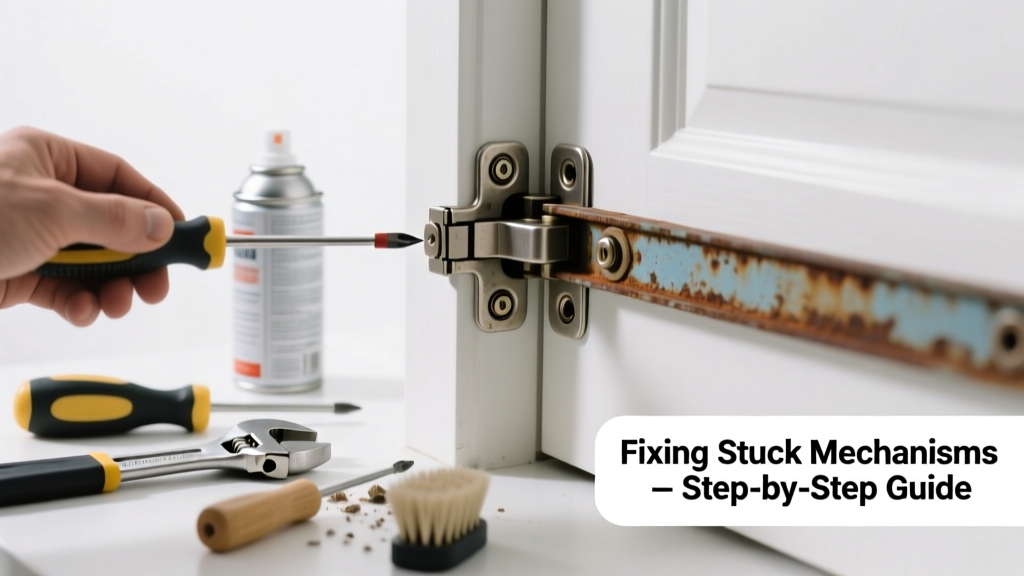
A stuck mechanism—whether it’s a jammed deadbolt, a window that won’t latch, or a cabinet hinge that refuses to pivot—can halt your day faster than a power outage. It’s rarely catastrophic, but it’s always frustrating, especially when you’re holding groceries and the front door won’t budge. Most stuck mechanisms stem from simple causes you can resolve in under 30 minutes with basic tools.
Quick Diagnosis
Before grabbing tools, rule out the obvious culprits:
- Debris buildup (dust, paint chips, or rust flakes inside tracks or cylinders)
- Warped framing or misaligned strike plates (common after seasonal wood swelling)
- Dried-up or contaminated lubricant (especially in older brass or zinc-plated hardware)
- Broken internal spring or cam follower (often accompanied by a hollow 'clunk' or no resistance at all)
- Over-tightened mounting screws compressing the mechanism housing
Tools & Materials Needed
| Item | Purpose | Estimated Cost |
|---|---|---|
| Needle-nose pliers | Grip and extract broken pins or bent components without scratching finishes | $8–$15 |
| Graphite powder or dry silicone spray | Lubricates without attracting dust; avoids gumming up like oil-based lubes | $5–$12 |
| Small flat-head screwdriver (1/8" tip) | Adjust strike plate alignment and gently pry stuck latches | $3–$7 |
| Wire brush (stiff nylon or brass) | Cleans corrosion and old grease from lock cylinders and track channels | $4–$9 |
| Feeler gauge or business card | Measures gap between door edge and frame to verify proper latch throw clearance | $0–$2 |
Step-by-Step Fix
Try these methods in order—most issues resolve at Step 1 or 2:
- Clean and inspect: Remove the mechanism cover plate (if accessible) and use the wire brush to clear debris from springs, levers, and cylinder bores. Wipe away old grease with isopropyl alcohol on a lint-free cloth.
- Realign strike plate: Loosen—but don’t remove—strike plate screws. Insert the latch fully, close the door gently, then mark where the latch contacts the plate. Shift the plate 1/32" toward the latch path and re-tighten. Test before fully torquing.
- Apply dry lubricant: Spray graphite or silicone into keyways, latch slots, and hinge knuckles. Work the mechanism 10–15 times while it’s still wet. Let sit 10 minutes before final test.
- Reset spring tension: For spring-loaded latches (e.g., privacy bathroom locks), depress the latch fully and hold for 5 seconds—this resets compressed coil springs that lose rebound over time.
When to Call a Pro
Stop and call a licensed locksmith or carpenter if:
- The mechanism spins freely with no engagement (indicates broken tailpiece or drive-in cylinder)
- You hear grinding or metal-on-metal screeching during operation
- The door or window frame shows visible bowing, splitting, or water damage near the mechanism
- You’ve replaced the same part twice in 12 months—underlying structural movement is likely the real issue
According to the National Association of Home Builders’ Residential Repair Trends Report (2023), 68% of repeat mechanism failures are linked to undiagnosed framing shifts—not faulty hardware.
Prevention Tips
Maintain smooth operation year-round with these habits:
- Lubricate interior locks and latches every 6 months using graphite powder—not WD-40, which dries sticky
- Wipe down exterior door mechanisms quarterly with a damp microfiber cloth to remove salt or pollen residue
- Tighten hinge and strike plate screws every spring and fall—seasonal humidity changes loosen fasteners
- Install weatherstripping with compression seals to reduce lateral stress on latching hardware
Can I use vinegar to dissolve rust in a stuck lock?
Vinegar works for light surface rust on exposed parts, but never soak internal tumblers—it corrodes brass pins and swells paper-thin clutch washers. Instead, use Naval Jelly (phosphoric acid gel) for 5 minutes, then flush thoroughly with denatured alcohol before lubricating. For more on rust removal, see our rust removal guide.
Why does my deadbolt stick only in winter?
Cold temperatures shrink metal components slightly, tightening tolerances—and indoor heating dries out lubricants, increasing friction. The U.S. Department of Energy estimates that 22% of seasonal sticking occurs when indoor humidity drops below 30%. Run a humidifier near entry doors November–February.
Is it safe to drill out a stuck lock cylinder?
No—drilling risks damaging the bolt assembly, door edge, or adjacent wiring (especially in smart locks). If the key won’t turn and cleaning/lubing fails, contact a locksmith. They’ll use specialized extraction tools that preserve the door and strike plate. Learn more about smart lock repair if your system integrates with home automation.
Can I replace just the latch, or do I need the whole assembly?
You can often replace just the latch (sold separately as "deadlatch" or "spring latch") if the faceplate, box, and strike are undamaged. Match the backset (2-3/8" or 2-3/4") and lip thickness (1/2" standard). Check manufacturer specs—some brands like Schlage and Kwikset require proprietary latch bodies.
What’s the difference between a stuck mechanism and a broken one?
A stuck mechanism offers resistance but retains mechanical continuity—you feel spring tension, hear clicks, or see partial movement. A broken mechanism feels hollow or floppy, may produce metallic fragments, and often fails catastrophically (e.g., knob spins endlessly). If you suspect breakage, stop operating it and document the failure mode before ordering parts.
Will forcing a stuck window mechanism cause permanent damage?
Yes—applying leverage to a jammed vinyl or aluminum window operator can crack the gear housing or shear off plastic cams. Always remove the interior operator handle first to isolate whether the issue is in the handle gear or the main track assembly. See our window mechanism repair guide for model-specific disassembly steps.
Stuck mechanisms aren’t emergencies—they’re maintenance signals disguised as annoyances. Most respond predictably to cleaning, alignment, and dry lubrication. When you act early, you protect both function and finish, avoiding the expense and hassle of full hardware replacement. Keep your toolkit stocked, your schedule flexible, and your patience steady: 9 out of 10 stuck mechanisms yield before lunchtime.