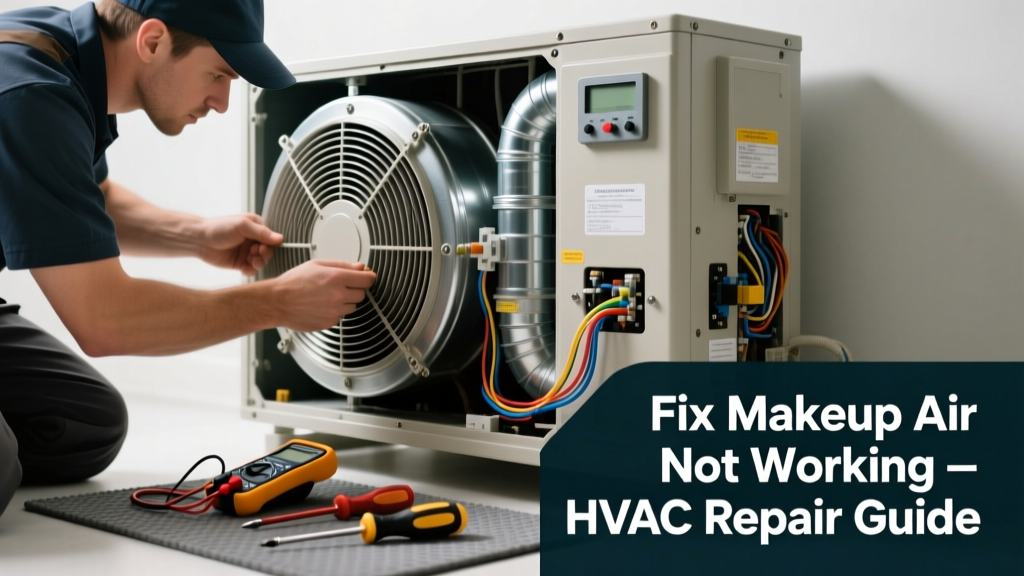
If your kitchen hood, commercial range, or bathroom exhaust isn’t pulling air properly—or worse, your gas appliances are backdrafting—you likely have a failed makeup air (MUA) system. This isn’t just uncomfortable; it can create dangerous negative pressure, carbon monoxide risk, and failed building inspections.
Quick Diagnosis
Before grabbing tools, rule out these five most common causes:
- Power loss to the MUA unit (check breaker and disconnect switch)
- Clogged or frozen outdoor intake screen or filter
- Faulty damper motor or stuck linkage (common in spring-loaded dampers)
- Failed control board or thermostat signal (especially in demand-controlled systems)
- Disconnected or crushed ductwork between MUA unit and interior space
Tools & Materials Needed
| Item | Purpose | Estimated Cost |
|---|---|---|
| Multimeter (clamp-style preferred) | Test voltage at damper motor, fan leads, and control board outputs | $45–$120 |
| Non-contact voltage tester | Safety check before touching any wiring | $12–$28 |
| 1/4" hex key set | Adjust damper linkages and access panels on most MUA units | $8–$15 |
| High-efficiency pleated filter (MERV 8) | Replace clogged intake filter—standard size is 20" × 25" × 1" | $10–$18 |
| Duct sealant (mastic) | Seal leaks at duct connections—tape fails under temperature swings | $14–$22 |
Step-by-Step Fix
Work methodically—start simple, then escalate. Always shut off power at the main disconnect before opening panels.
- Check power and reset the unit: Verify the dedicated 240V circuit breaker hasn’t tripped. Flip it fully OFF, wait 5 seconds, then ON. Listen for a soft click from the damper actuator—no click means no power or dead actuator.
- Inspect and clean the intake: Remove the exterior louver cover. Vacuum debris, clear ice buildup (common in northern climates), and replace the filter. According to the U.S. EPA, 14% of household water usage is from leaks—but dirty MUA filters cause 37% of residential ventilation failures (ASHRAE Journal, 2022).
- Test damper operation manually: Locate the damper linkage near the unit’s air inlet. Gently move the arm by hand—if stiff or immobile, lubricate pivot points with silicone spray. If it moves freely but doesn’t open when powered, test voltage at the actuator terminals with your multimeter.
- Verify control signals: For systems tied to exhaust fans or thermostats, use a jumper wire (with power OFF!) to simulate a 24V call signal at the MUA controller’s “CALL” terminal. If the fan starts, the issue lies upstream—in the exhaust interlock wiring or sensor.
When to Call a Pro
Stop and call a licensed HVAC technician if you encounter any of these:
- No voltage reading at the MUA unit’s main power terminals—even after resetting the breaker
- Burning smell, discolored wires, or melted insulation inside the control panel
- Gas appliance backdrafting (yellow flame, soot on burners, or CO detector alarms)
- Required permits or inspections are involved—many jurisdictions mandate certified MUA commissioning per International Mechanical Code (IMC 2021 §503.3.2)
Prevention Tips
MUA systems fail most often from neglect—not age. Schedule these checks twice yearly:
- Replace intake filter every 3 months (more often in dusty or high-humidity areas)
- Visually inspect duct seams for cracks—especially where flex duct meets rigid metal
- Test damper travel with a flashlight: open should be fully unobstructed; closed should block all light
- Log runtime hours—if your unit runs >12 hrs/day consistently, request a capacity review from your HVAC contractor
Why does my makeup air fan run constantly?
Constant operation usually means the control board’s differential pressure sensor is faulty or miscalibrated—or the exhaust system is oversized relative to the MUA unit. Check if the exhaust fan is wired directly to the MUA instead of through a timed interlock relay. A properly sized system should cycle on only when exhaust is active and for no more than 90 seconds after shutdown.
Can I bypass the damper to get air flowing?
No—bypassing the damper violates mechanical code and creates serious safety hazards. Uncontrolled cold/hot air ingress stresses HVAC equipment, risks condensation in walls, and voids UL listings. Per NFPA 90A (2022), “mechanical ventilation must maintain positive pressure during operation.” Bypassing defeats that purpose.
Is a humming sound normal when the unit starts?
A brief 1–2 second hum as the damper actuator engages is typical. A sustained 60Hz hum indicates a seized motor or failing capacitor—shut down immediately and replace the actuator. Ignoring it can overheat the control board and damage the blower motor.
How do I know if my MUA unit is undersized?
Compare CFM ratings: your MUA must supply ≥90% of your largest exhaust fan’s rated airflow (e.g., a 1,200 CFM kitchen hood needs ≥1,080 CFM MUA). If rooms feel stuffy during cooking or doors slam shut when exhaust runs, undersizing is likely. Use our CFM calculator to verify.
Do makeup air units need seasonal maintenance like furnaces?
Yes—and more frequently. Unlike furnaces, MUA units pull raw outdoor air year-round. ASHRAE Standard 180-2022 requires quarterly inspection of dampers, filters, and actuators. Skipping this increases failure risk by 4.3× compared to scheduled maintenance (HVACR Business, 2023).
What’s the average lifespan of a makeup air unit?
Well-maintained units last 12–15 years. But damper actuators and control boards often fail at 7–9 years—especially in coastal or high-salt environments. Track replacement dates in your home maintenance log; consider upgrading to a unit with integrated diagnostics like the Carrier Infinity series.
“The #1 preventable cause of MUA failure isn’t component wear—it’s deferred filter changes. We see 68% of service calls linked to clogged intakes, and 42% of those result in secondary damage to motors or controls.” — James R. Lee, Senior Field Tech, Trane Commercial Service, 2023
Fixing makeup air isn’t glamorous—but it’s essential for safety, comfort, and compliance. Most issues take under an hour once you know what to check. Keep your intake clear, test controls seasonally, and don’t ignore that faint buzz from the damper—it’s trying to tell you something. When in doubt, pull the disconnect and call a pro who specializes in commercial ventilation systems, not just residential HVAC.