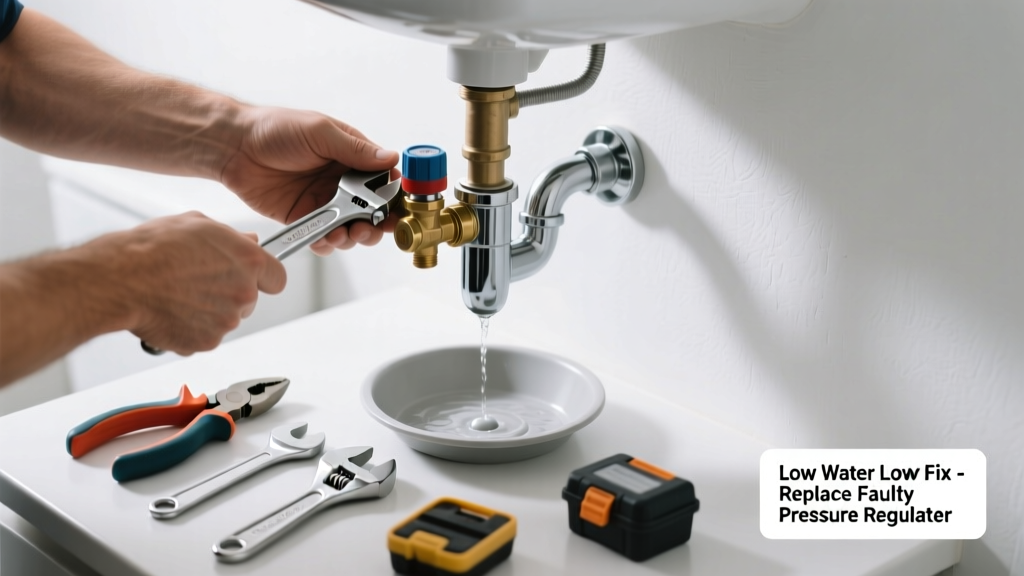
If your shower trickles, faucets sputter, and the washing machine takes forever to fill, your home’s water pressure regulator may be failing. This small brass valve—usually located near the main shutoff—degrades after 7–12 years and causes consistent low pressure across all fixtures. Replacing it is one of the highest-impact, lowest-risk DIY plumbing fixes you can do.
Quick Diagnosis
Before swapping parts, rule out simpler causes:
- Partially closed main shutoff or street-side valve (check both handles are fully open)
- Clogged aerators or showerheads (unscrew and soak in vinegar for 30 minutes)
- Mineral buildup in older galvanized pipes (common in homes built before 1980)
- Faulty pressure regulator (confirmed by measuring pressure at an outdoor spigot with a gauge—readings below 40 psi or fluctuating >10 psi indicate failure)
- Leaking supply lines or corroded fittings upstream of the regulator
Tools & Materials Needed
| Item | Purpose | Estimated Cost |
|---|---|---|
| 3/4" brass pressure regulator (e.g., Watts 25AUB-3) | Replaces worn diaphragm and spring assembly; rated for 25–75 psi output | $32–$48 |
| Adjustable wrench (12") | Tightens compression nuts without marring brass threads | $14–$26 |
| Water pressure gauge (0–160 psi) | Verifies input pressure (should be 50–80 psi) and confirms post-replacement output | $12–$22 |
| Teflon tape (yellow gas-rated) | Seals threaded joints on brass regulators; standard white tape degrades under constant pressure | $3–$6 |
| Bucket and towels | Catches residual water when opening lines; prevents drywall damage | $0–$8 |
Step-by-Step Fix
Follow this sequence—no soldering or pipe cutting required:
- Shut off main water supply and open the lowest outdoor spigot to relieve pressure; verify flow stops completely.
- Locate the regulator: typically within 2 feet of the main shutoff, often marked with "IN" and "OUT" arrows; it’s a 3–4" cylindrical brass unit with a slotted adjustment screw on top.
- Disconnect inlet and outlet lines: use two wrenches—one to hold the regulator body, one to loosen compression nuts. Expect 1–2 cups of residual water.
- Install new regulator: wrap inlet/outlet threads with 4 wraps of yellow Teflon tape, hand-tighten, then snug with wrench (don’t overtighten—brass cracks at ~35 ft-lbs).
- Test and adjust: slowly reopen main shutoff, check for leaks, then attach pressure gauge to outdoor spigot. Turn adjustment screw clockwise to increase pressure (1 full turn ≈ 5 psi); target 55–65 psi for most homes.
When to Call a Pro
Stop and call a licensed plumber if any of these apply:
- Your home has polybutylene (gray plastic) supply lines—cutting or clamping them risks catastrophic failure
- Main shutoff valve won’t close fully or leaks when operated (indicates valve replacement needed first)
- You measure input pressure above 80 psi—this points to municipal over-pressurization requiring a thermal expansion tank
- Pressure drops only on hot water—suggests failed dip tube or water heater sediment, not regulator
Prevention Tips
Extend regulator life and avoid repeat failures:
- Flush sediment from the regulator annually: shut off water, remove cap, and rinse diaphragm chamber with clean water
- Install a whole-house sediment filter (e.g., Pentair FSC-100) upstream—it catches rust and scale before they reach the regulator
- Check pressure every 6 months with your gauge; replace regulator proactively at year 10, even if working
- Avoid using chemical descalers in main lines—they degrade rubber diaphragms faster than mineral buildup
Can I reuse the old mounting bracket?
No—most regulators mount to a dedicated bracket that secures them against vibration. New units include updated brackets with rubber isolation pads. Reusing old hardware risks misalignment and premature diaphragm fatigue.
What if my pressure spikes after replacement?
That’s almost always due to over-tightening the adjustment screw. Back it out 1/4 turn at a time while retesting. According to the American Society of Plumbing Engineers’ 2022 Residential Design Handbook, sustained pressure above 80 psi shortens fixture lifespan by 40% and increases leak risk threefold.
Do I need a permit to replace a pressure regulator?
In 32 states—including California, Texas, and Florida—you do not need a permit for regulator replacement alone, as it’s considered a 'like-for-like' repair. But always check with your local building department; some municipalities require notification if the regulator serves fire sprinklers or irrigation systems.
Why does my new regulator make a humming noise?
A low hum is normal during initial pressurization and fades within 24 hours. Persistent buzzing indicates turbulent flow—often caused by undersized supply lines (less than 3/4" diameter) or excessive downstream demand. Consider upgrading to a 1" main line if multiple bathrooms run simultaneously.
Can I install a higher-pressure regulator to boost flow?
No—increasing output beyond 75 psi violates the International Plumbing Code and voids warranties on most fixtures. As
"Most modern faucets and valves are rated for max 80 psi—and many fail catastrophically above 75 psi," says Master Plumber Elena Ruiz, who co-authored the 2023 IPC Compliance Guide.Stick to 55–65 psi for safety and longevity.
How long does a replacement regulator last?
Quality brass regulators (Watts, Zurn, or Febco) last 12–15 years with proper maintenance. Homes with hard water (>12 gpg) or chloramine-treated municipal supply see 20–30% shorter lifespans—plan replacement at year 9–10 in those cases.
A properly replaced pressure regulator restores strong, steady flow to every fixture—and pays for itself in reduced appliance cycle times and fewer service calls. If you’ve confirmed low pressure isn’t coming from clogged aerators or a stuck valve, this is likely the fix you’ve been missing. For related help, see our guides on how to clean a showerhead aerator and DIY main shutoff valve repair.