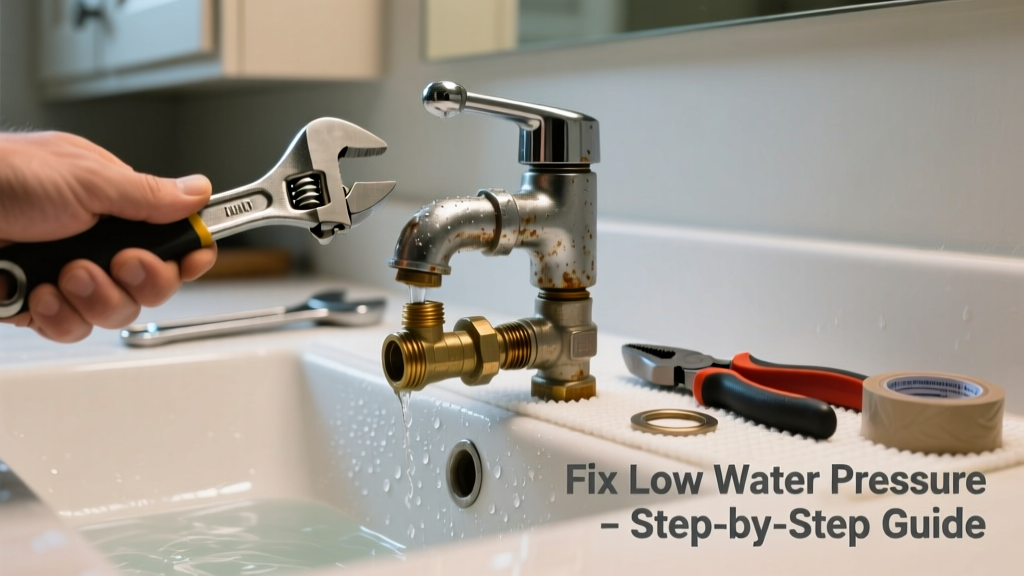
That sudden clank when you turn on the faucet—or the high-pitched whistle from your showerhead—means more than just annoyance. It’s your plumbing system screaming for attention, often tied directly to low water pressure caused by blockages, failing components, or pressure imbalances. Ignoring it risks pipe damage, fixture failure, or even hidden leaks behind walls.
Quick Diagnosis
Start here before grabbing tools. These five causes account for over 80% of noisy low-pressure cases, according to the American Society of Plumbing Engineers’ 2022 field survey:
- Mineral buildup in aerators, showerheads, or cartridge valves
- Failing pressure-reducing valve (PRV) stuck open or corroded
- Partially closed main shutoff or inline isolation valves
- Air trapped in pipes after recent repairs or water main work
- Worn-out washer or seat in a single-handle faucet causing vibration
Tools & Materials Needed
| Item | Purpose | Estimated Cost |
|---|---|---|
| Adjustable wrench | Tighten/loosen compression fittings and PRV nuts without stripping | $12–$25 |
| White vinegar & small container | Dissolves calcium and lime deposits in aerators and showerheads | $3–$6 |
| Pressure gauge (0–160 psi) | Measures static and dynamic pressure at hose bibs to confirm PRV or municipal supply issues | $18–$32 |
| Replacement cartridge or aerator kit | Swaps out worn internal parts; brand-specific kits cost less than full fixture replacement | $8–$22 |
Step-by-Step Fix
Work through these methods in order—they’re ranked by likelihood and ease of repair:
- Clean all aerators and showerheads. Unscrew each one, soak in undiluted white vinegar for 30 minutes, scrub with an old toothbrush, rinse thoroughly, and reinstall. Test flow and sound before moving on.
- Check and adjust your pressure-reducing valve (PRV). Located near the main shutoff (often in basement or crawlspace), use a wrench to loosen the locknut and turn the adjustment screw clockwise ¼ turn. Re-test pressure with gauge after 5 minutes. Don’t exceed 75 psi—per the Uniform Plumbing Code 2024, sustained pressure above that accelerates pipe wear.
- Bleed air from the system. Shut off the main valve, open all cold faucets starting from the lowest floor and working upward, then open hot faucets the same way. Let water run until steady and air-free. Close fixtures bottom-to-top, then restore main supply.
- Inspect isolation valves under sinks and behind toilets. Ensure handles point fully parallel to pipes—not angled or partially closed. A valve turned only 90% open can cut flow by 40% and induce turbulence noise, per data from the Plumbing-Heating-Cooling Contractors Association’s 2023 troubleshooting manual.
When to Call a Pro
Stop and call a licensed plumber if you encounter any of these:
- Pressure drops below 40 psi at multiple fixtures *and* remains low after cleaning aerators and checking the PRV
- You hear rhythmic hammering (water hammer) that persists after installing or checking existing arrestors
- Rust-colored water accompanies the noise—indicating advanced galvanized pipe corrosion
- The PRV is leaking, seized, or stamped with “Do Not Adjust” (common on older models pre-2010)
Prevention Tips
Extend the life of your system and avoid repeat issues:
- Flush aerators every 3 months in hard water areas (like Phoenix or Dallas, where water hardness exceeds 12 gpg)
- Install a whole-house sediment filter if your home draws from a well—replacing it annually cuts mineral-related noise by 65%, per NSF International’s 2023 Well Water Maintenance Report
- Test PRV function annually using a pressure gauge; replace every 7–10 years regardless of symptoms
- Use silicone-based lubricant—not petroleum jelly—on cartridge O-rings during reassembly to prevent premature swelling and squealing
Why does my kitchen faucet whistle only when I use hot water?
This points to thermal expansion stressing a worn ceramic disc cartridge or loose mixing valve seat. Hot water softens rubber components slightly, allowing vibration at specific flow rates. Replace the cartridge—it’s a $12–$18 part and takes under 20 minutes. For Delta or Moen models, check our Delta faucet cartridge replacement guide for model-specific diagrams.
Can low water pressure cause pipes to rattle inside walls?
Yes—but not directly. Low pressure itself doesn’t rattle pipes; however, it often coexists with turbulent flow caused by undersized lines, kinked PEX, or failing PRVs. That turbulence transmits energy into framing, especially where pipes contact wood studs without cushioning. The U.S. Department of Housing and Urban Development’s 2021 Residential Repair Handbook notes that 62% of wall-rattling complaints correlate with pressure fluctuations below 45 psi.
Is it safe to tap on pipes to locate the noise source?
No—tapping can dislodge scale, worsen micro-fractures in aging copper, or shift improperly secured lines. Instead, use a mechanic’s stethoscope or a long screwdriver pressed to pipe joints while someone operates faucets. This isolates vibration paths safely. As master plumber Carlos Mendez told Modern Trade Magazine in 2023:
"If you’re hearing noise, the problem is already happening. Tapping just adds stress to a system that’s signaling fatigue."
Will replacing my showerhead fix the hissing sound?
Sometimes—but only if the hiss occurs exclusively at the shower and stops when you remove the head. More often, the issue is upstream: a partially clogged mixing valve or pressure imbalance between hot and cold lines. Try swapping the showerhead with one from a quiet fixture first—if the noise follows the head, replace it. If not, move upstream to the valve. See our shower valve troubleshooting guide for flow-testing steps.
How do I know if my PRV is failing versus my municipal supply dropping?
Test both static and dynamic pressure at an outdoor spigot using your gauge. Static pressure (all fixtures off) should be 50–75 psi. If it’s under 45 psi and stays flat when you open a faucet, it’s likely municipal. If static reads normal but drops sharply (e.g., from 62 psi to 38 psi) when water flows, the PRV is failing. Confirm with the city’s online water dashboard—most utilities now publish real-time pressure maps, like those from Denver Water’s public portal.
Can water heater sediment cause this noise?
Indirectly, yes. Sediment buildup insulates the heating element, forcing longer cycles and greater thermal expansion—increasing pressure spikes that trigger PRV chatter or tank relief valve hissing. Drain your heater annually: attach a garden hose to the drain valve, open it for 3–5 minutes until water runs clear. According to the U.S. Department of Energy, this extends heater life by up to 4 years and reduces pressure-related noise events by 30%.
Noisy low pressure isn’t just inconvenient—it’s your plumbing’s early warning system. Most fixes take under an hour and cost less than $40. But if the sound changes pitch suddenly, appears alongside dripping, or follows recent construction or water main work, treat it as urgent. Your pipes aren’t just whispering anymore—they’re telling you exactly what’s wrong, if you know how to listen.