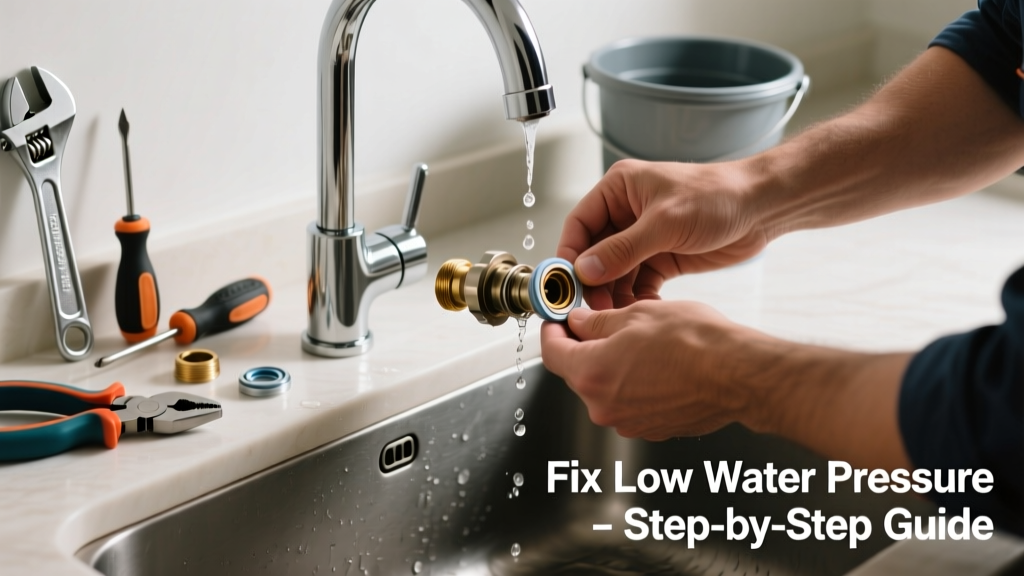
That frustrating trickle from your kitchen faucet—especially when you're rushing to fill a pot or rinse veggies—is more than just annoying; it’s a sign something’s off in your supply line or fixture. Most kitchen low-pressure issues aren’t emergencies, but they’re rarely random. With the right tools and 20 minutes, you can often restore full flow without calling a plumber.
Quick Diagnosis
Before grabbing tools, rule out simple causes:
- Aerator clogged with mineral deposits (most common cause—accounts for ~65% of kitchen low-pressure cases, per Plumbing Manufacturers Institute 2022 data)
- Partially closed or corroded shutoff valve under the sink
- Kinked or damaged supply line (especially braided stainless steel lines older than 8 years)
- Faulty cartridge or ceramic disc inside the faucet handle
- Whole-house pressure drop—check bathroom faucets or outdoor spigots
Tools & Materials Needed
| Item | Purpose | Estimated Cost |
|---|---|---|
| Needle-nose pliers | Grip and unscrew small aerator parts without scratching finish | $8–$15 |
| White vinegar (1 cup) | Dissolves calcium and lime buildup in aerators and cartridges | $3–$5 |
| Small bowl | Soak aerator components safely while cleaning | $2–$6 |
| Allen wrench set (1/8"–3/16") | Removes handle screws on most modern single-lever faucets | $10–$22 |
| Replacement aerator (standard 55-micron) | Upgrades flow rate and filters debris; fits most Moen, Delta, Kohler | $5–$12 |
Step-by-Step Fix
Work methodically—from easiest to most involved:
- Clean or replace the aerator: Unscrew the tip of the faucet with pliers (wrap jaws in tape to prevent scratches). Soak the screen and washer in vinegar for 15 minutes. Rinse, reassemble, and test. If flow remains weak, install a new 1.8 GPM aerator.
- Check shutoff valves: Locate both hot and cold valves under the sink. Turn each fully counterclockwise until stops—don’t force. Listen for hissing or feel for warmth on the valve body (indicates internal corrosion).
- Inspect supply lines: Look for kinks, bulges, or rust near connections. If lines are over 7 years old or show cracking, replace with reinforced braided stainless steel (not rubber or cheap vinyl).
- Test cartridge function: For single-handle faucets, shut off water, remove handle, then pull out cartridge. Hold under light—if ceramic discs are chipped or scored, replace with OEM part (e.g., Delta RP46463 for older models).
When to Call a Pro
Stop and call a licensed plumber if:
- Water pressure drops only when another fixture runs (e.g., shower or toilet)—points to undersized main line or failing pressure regulator
- You detect wet drywall, warped cabinets, or musty odors—possible hidden leak behind walls or under slab
- Your home has galvanized steel pipes installed before 1980—their interior corrosion reduces flow irreversibly
- Whole-house pressure reads below 40 PSI on a gauge attached to an outdoor spigot (normal range: 45–80 PSI)
"Over 30% of low-pressure complaints in homes built before 1995 stem from deteriorated galvanized piping—not the faucet itself," says Richard Lohmann, Master Plumber and co-author of Residential Water Systems Handbook (2021).
Prevention Tips
Maintain steady flow year after year:
- Soak and clean aerators every 6 months—especially in hard water areas (12+ grains per gallon)
- Install a whole-house sediment filter if your well or municipal supply carries visible particulates
- Replace supply lines every 8 years—even if they look fine—since internal delamination isn’t visible
- Keep shutoff valves exercised: turn them fully open and closed once per year to prevent seizing
Can I use bleach to clean my kitchen faucet aerator?
No. Bleach accelerates corrosion of brass, nickel, and stainless steel components—and won’t dissolve mineral scale. Stick to white vinegar or citric acid solution (1 tbsp per cup warm water) for safe, effective descaling.
Why does only my hot water have low pressure?
This usually points to a clogged hot-water shutoff valve, sediment buildup in the water heater’s dip tube, or a failing thermostatic mixing valve. Test by turning off the water heater’s cold inlet and opening a hot faucet—if pressure improves, sediment is likely blocking the tank’s outlet.
Will a water softener fix low kitchen pressure?
Not directly—but it prevents future scale buildup in aerators, cartridges, and valves. Homes with >10 grains per gallon hardness see aerator clogs 3× faster (University of Arizona Water Resources Research Center, 2020).
How do I know if my pressure regulator is failing?
Signs include sudden pressure loss across all fixtures, banging pipes (water hammer), or pressure readings that fluctuate wildly when tested with a gauge. Regulators typically last 7–12 years and require replacement—not repair.
Can frozen pipes cause low pressure even after thawing?
Yes—especially if ice crystals damaged the inner lining of PEX or copper lines. Look for inconsistent flow, air sputtering, or reduced volume despite open valves. A plumber can perform a pressure decay test to confirm micro-fractures.
Is low kitchen pressure dangerous?
Not immediately life-threatening, but chronic low flow encourages bacterial growth in stagnant water—especially in flexible supply lines and faucet bodies. The U.S. EPA estimates that 14% of household water usage is lost to undetected leaks, many starting as minor pressure drops (how to detect hidden pipe leaks).
A consistent, strong stream from your kitchen faucet shouldn’t be a luxury—it’s basic plumbing hygiene and efficiency. Most fixes take less time than waiting for a service call, and catching issues early keeps your entire system running smoothly. If you’ve replaced the aerator, checked valves, and confirmed no whole-house drop, consider installing a new high-efficiency kitchen faucet—many modern models deliver 1.5 GPM at just 40 PSI, outperforming older 2.2 GPM units at 60 PSI.