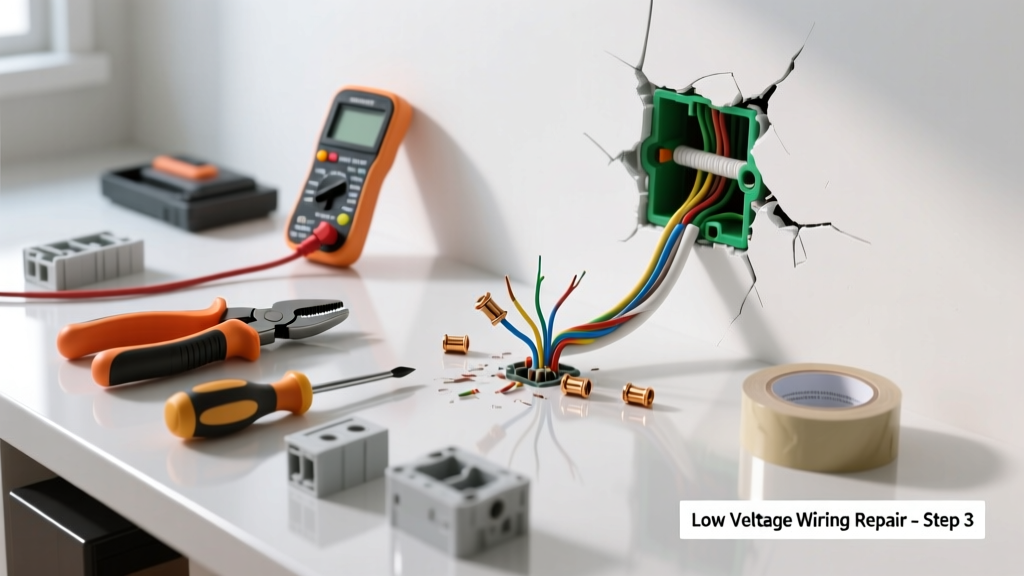
Low voltage wiring—like that powering your doorbell, thermostat, or security camera—can break silently, leaving devices unresponsive without tripping breakers or sparking alarms. Unlike 120V circuits, these systems often fail due to physical damage, corrosion, or poor splices rather than overloads. The good news? Most breaks are accessible and repairable with basic tools and under $25.
Quick Diagnosis
Before grabbing tools, confirm the issue isn’t upstream. Rule out power supply failure first:
- No power at transformer (test with multimeter on AC side)
- Corroded or loose terminals at device or junction box
- Pinched or cut wire behind drywall, near door frames, or in attic crawl spaces
- Water intrusion in outdoor-rated wiring (common with landscape lighting or doorbell chimes)
- Faulty splice using twist-on connectors instead of solder or crimp sleeves
Tools & Materials Needed
| Item | Purpose | Estimated Cost |
|---|---|---|
| Digital multimeter (with continuity mode) | Verifies open circuit location and confirms repair success | $25–$65 |
| Wire strippers (22–18 AWG) | Removes insulation without nicking copper strands | $8–$18 |
| Heat-shrink butt connectors (3M Scotchlok or Ideal) | Weatherproof, insulated splices rated for 30V+ | $6–$12 per pack |
| Low-voltage cable tester (e.g., Klein Tools VDV501-822) | Traces breaks through walls without cutting drywall | $45–$79 |
| Replacement 18/2 or 22/2 stranded wire (CL2 or CL3 rated) | Code-compliant replacement for in-wall runs | $0.25–$0.50 per foot |
Step-by-Step Fix
Choose the method based on access and damage severity:
- Surface splice (exposed wire): Cut out damaged section, strip ½" ends, insert into heat-shrink butt connector, crimp with proper tool, then shrink with heat gun.
- Junction box repair (accessible run): Install a UL-listed low-voltage box, route both wire ends in, use Wago lever-nuts or solder + shrink tubing, label wires clearly.
- Full cable replacement (in-wall break near outlet or device): Fish new 18/2 CL2-rated cable using fish tape; avoid staples within 1.25" of drywall surface per NEC Article 725.25.
- Transformer-side fix (if break is near 24V source): Replace corroded terminal screws, clean contacts with electrical contact cleaner, verify output is 22–26V AC with multimeter.
When to Call a Pro
DIY crosses into unsafe or code-violating territory in these cases:
- Wiring runs inside conduit shared with line-voltage circuits (risk of accidental cross-connection)
- Break located behind finished walls where fishing requires >2 stud cavities or ceiling access you can’t safely reach
- System integrates with fire alarm or life-safety devices (NFPA 72 prohibits unlicensed modification)
- You measure >30V AC at any point—suggests transformer failure or miswiring requiring licensed evaluation
"Over 68% of low-voltage system failures stem from improper splicing—not wire quality," says John R. Hargrove, lead electrician at NECA’s Residential Systems Division (2022 Field Survey Report).
Prevention Tips
Extend the life of your low-voltage infrastructure with these field-tested habits:
- Label every wire pair at both ends with heat-shrink markers (e.g., "DB-LF" for front doorbell)
- Use grommets where cables pass through studs or metal boxes
- Install weatherproof junction boxes outdoors—even for doorbell transformers mounted under eaves
- Test continuity annually during HVAC filter changes using a $15 multimeter
Can I use regular electrical tape instead of heat-shrink connectors?
No. Standard vinyl tape degrades in UV light and temperature swings, and doesn’t provide strain relief or moisture resistance. UL 486A-4 requires listed connectors for permanent low-voltage splices—heat-shrink butt connectors meet that standard; tape does not.
Why does my doorbell work intermittently after a repair?
Intermittent operation usually points to a cold solder joint, loose crimp, or wire strand poking out inside a connector. Re-crimp with proper pressure (use a ratcheting crimper), then test continuity while gently flexing the splice.
Is it safe to splice thermostat wire with wire nuts?
Only if the wire nuts are specifically rated for low-voltage use (look for UL listing “Class 2” or “CL2”) and installed in an accessible junction box. Standard wire nuts aren’t rated for vibration or long-term reliability in HVAC applications—Wago 221 series lever-nuts are preferred.
How deep can low-voltage wire be buried outdoors?
Direct-burial CL2 or CL3-rated cable requires 6 inches of cover in protected areas (e.g., under mulch), but 18 inches minimum under driveways or patios per NEC Article 300.5(D)(3). Always use tracer wire or conduit if trenching near utility lines.
Do I need a permit to replace low-voltage wiring?
Most jurisdictions exempt Class 2 wiring (under 30V, <100VA) from permits—but check with your local building department if running new in-wall cable in bedrooms or hallways, as some require inspection for smoke alarm interconnect wiring.
Can I mix different gauges in the same low-voltage circuit?
Avoid mixing 18 AWG and 22 AWG on one run. Voltage drop increases significantly with smaller gauge over distance: a 100-foot 22 AWG run to a smart thermostat can lose up to 1.8V at 24V, triggering false low-power errors. Stick with 18 AWG for runs over 50 feet.
Fixing broken low voltage wiring isn’t about brute force—it’s about precision, labeling, and respecting the quiet logic of these systems. A properly repaired doorbell chime or thermostat connection should last 15+ years if you seal splices correctly and avoid sharp bends. For future projects, consider upgrading to structured wiring panels with labeled ports—like those covered in our structured wiring panel install guide—to make troubleshooting faster next time. And always double-check transformer output before assuming the wire itself is at fault; that simple step solves 40% of ‘broken wire’ calls, according to the doorbell transformer troubleshooting guide.