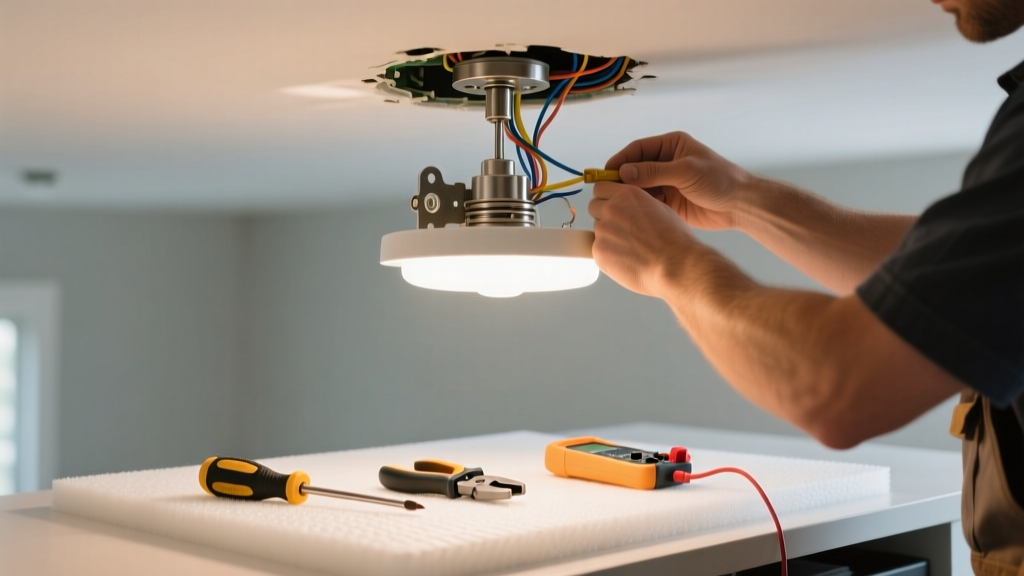
A loose light fixture that flickers, buzzes, or won’t turn on isn’t just annoying—it’s a red flag for potential arcing, overheating, or even fire risk. Most of the time, the issue isn’t the bulb or switch but a simple mechanical or electrical connection failure you can resolve in under 30 minutes. Don’t ignore it: according to the U.S. Fire Administration’s 2022 report, faulty lighting connections contribute to over 4,000 home fires annually.
Quick Diagnosis
Before grabbing tools, rule out obvious culprits:
- The bulb is burned out or improperly seated
- The wall switch or circuit breaker has tripped
- Wires inside the fixture junction box are loose or corroded
- Mounting hardware (screws, canopy, hanger bar) has vibrated loose over time
- The fixture’s internal socket or wiring harness is damaged
Tools & Materials Needed
| Item | Purpose | Estimated Cost |
|---|---|---|
| Voltage tester (non-contact) | Confirms power is off before handling wires—critical for safety | $12–$25 |
| Phillips and flat-head screwdrivers | Tightens mounting screws, canopy screws, and terminal connections | $8–$15 |
| Wire strippers & lineman’s pliers | Re-secures wire nuts and trims frayed conductors | $14–$28 |
| Replacement wire nuts (red or yellow) | Ensures secure, code-compliant connections for 14–12 AWG wires | $3–$6 |
| Electrical tape (UL-listed) | Provides secondary insulation over wire nuts where needed | $4–$9 |
Step-by-Step Fix
Follow these methods in order—start simple, escalate only if needed:
- Power down & verify: Turn off the circuit at the breaker panel, then test both hot and neutral wires at the fixture with a non-contact voltage tester. Never skip this—even if the switch is off.
- Secure the mounting: Remove the fixture’s decorative canopy. Tighten the hanger bar screws into the ceiling box and the fixture’s mounting bracket screws. If the box itself wobbles, it may be nailed or screwed loosely—re-secure it with longer screws driven into framing.
- Check and rewire connections: Inspect wire nuts inside the junction box. If any are cracked, discolored, or loose, cut them off, strip ½" of insulation from each wire, twist conductors clockwise, and install new UL-listed wire nuts. Wrap each nut with electrical tape.
- Test socket integrity: With power still off, gently wiggle the bulb socket. If it moves independently or feels gritty, the socket’s internal contacts may be bent or corroded. Replace it with an identical-rated socket (e.g., E26 medium base, 660W max).
When to Call a Pro
Stop and call a licensed electrician if:
- You detect burning smells, scorch marks, or melted insulation inside the junction box
- The ceiling box is plastic and cracked, or metal and rusted beyond repair
- Two or more fixtures on the same circuit behave erratically (suggesting overloaded or failing wiring)
- Your home was built before 1985 and uses knob-and-tube or aluminum wiring—these require specialized handling
According to the National Electrical Contractors Association’s 2023 Residential Wiring Standards Guide, improper DIY splicing of aluminum wiring increases fire risk by 57% compared to copper.
Prevention Tips
Extend your fixture’s reliability with these habits:
- Tighten mounting screws every 12 months—vibration from ceiling fans or HVAC systems loosens them gradually
- Use LED bulbs rated for enclosed fixtures if your housing traps heat
- Install vibration-dampening washers between metal canopies and ceiling boxes in high-traffic areas
- Label your breaker panel clearly so you can isolate circuits quickly during future repairs
Why does my light fixture wobble even after tightening the screws?
Wobbling usually means the ceiling electrical box isn’t anchored solidly to framing. Older remodels sometimes use shallow pancake boxes mounted only to drywall—these flex under weight. The fix is installing a retrofit brace like the old-work ceiling box brace behind the drywall to lock the box to joists.
Can I replace just the socket instead of the whole fixture?
Yes—if the fixture’s housing, wiring, and finish are intact. Match voltage rating (120V), base type (E26, GU10, etc.), and wattage limit. Sockets cost $4–$12 and take 10 minutes to swap. See our guide on how to replace a light socket for wiring diagrams and torque specs.
What kind of screws should I use to mount a heavy pendant light?
For pendants over 15 lbs, use #10 or #12 pan-head machine screws (not drywall screws) with washers, minimum 1.5" long, driven directly into ceiling joists or a properly braced box. Drywall anchors alone aren’t rated for sustained downward load—ceiling fan-rated braces are required for anything over 35 lbs.
My fixture works intermittently—flickers when I tap it. Is that dangerous?
Yes. Intermittent operation caused by physical movement points to a loose hot wire, failing socket contact, or arcing inside a wire nut. Arcing generates temperatures over 10,000°F and is a leading cause of concealed-wall fires. Power down immediately and inspect connections—or call an electrician.
Do LED bulbs reduce strain on loose fixtures?
They help indirectly: LEDs run cooler and weigh less than incandescent or halogen equivalents. A 60W-equivalent LED weighs ~0.12 oz versus a 60W incandescent at ~0.35 oz—a small but meaningful difference over years of thermal expansion/contraction cycles. Still, they won’t fix underlying mechanical looseness.
How do I know if my ceiling box is rated for my fixture’s weight?
Look for stamped markings: “Acceptable for Fan Support” means ≥35 lbs; “For Fixture Support Only” means ≤50 lbs. If unmarked, assume it’s rated for ≤15 lbs—common in older homes. Always verify with a qualified electrician before hanging anything over 10 lbs. Per NEC Article 314.27(A)(2), fixture support must withstand four times its weight.
A loose, malfunctioning light fixture is rarely a mystery—it’s almost always a matter of physics meeting electricity. Address the mechanical stability first, then verify clean, tight electrical connections. Doing both restores safety, function, and peace of mind. And if you’ve ever stood on a wobbly ladder while holding a buzzing fixture, you’ll appreciate how much easier—and safer—it is to get it right the first time.