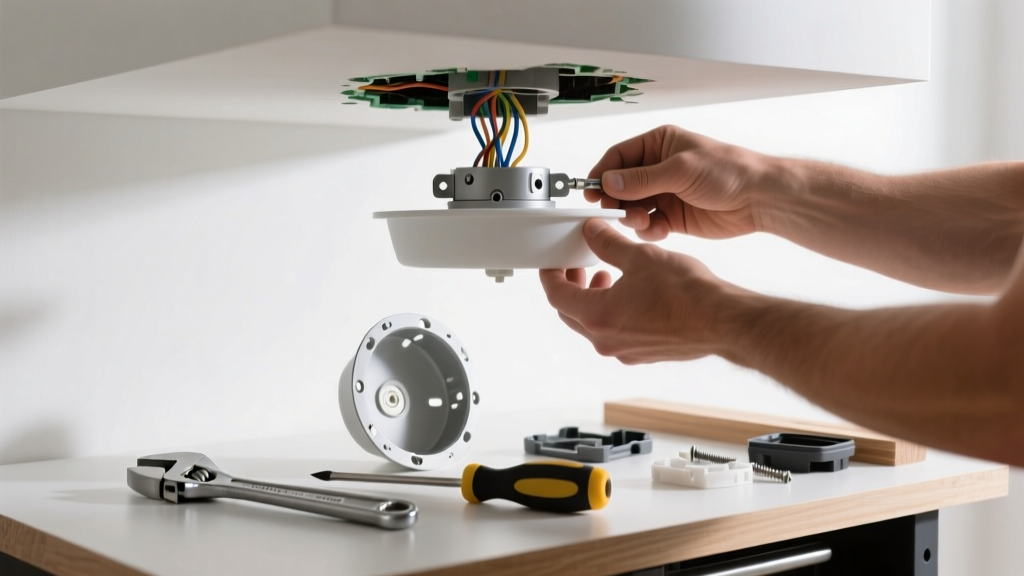
If your ceiling light fixture sways when touched—or worse, tilts at an odd angle—it’s not just annoying; it’s a sign of structural or electrical compromise. Most loose fixtures stem from one failed part, not full replacement, and fixing it takes under 30 minutes with basic tools. Ignoring it risks cracked plaster, damaged wiring, or even falling glass.
Quick Diagnosis
Before grabbing tools, confirm which component has failed. A loose fixture rarely means the whole unit is junk—more often, it’s one of these:
- The mounting bracket (metal strap screwed into the electrical box) has bent or stripped
- The canopy (decorative cover hiding the junction box) is warped or missing screws
- The threaded nipple or hanger ball has corroded or sheared
- The fixture’s internal socket yoke or crossbar is cracked or stripped
- The ceiling electrical box itself is loose or undersized (common in older homes)
Tools & Materials Needed
| Item | Purpose | Estimated Cost |
|---|---|---|
| Non-contact voltage tester | Confirms power is off before touching wires—critical safety step | $12–$25 |
| Phillips and flat-head screwdrivers (insulated handles) | Removes canopy screws, adjusts mounting hardware, and secures connections | $8–$18 |
| Replacement mounting bracket (e.g., 4" round or octagonal) | Replaces bent or rusted brackets; must match box type and weight rating | $3–$12 |
| 10-32 or 8-32 machine screws (1/2"–3/4") | Secures bracket or canopy where original screws stripped or vanished | $2–$5 |
| Wire nuts (red or yellow, UL-listed) | Reconnects wires safely if leads were disturbed during inspection | $4–$7 |
Step-by-Step Fix
Work only after turning off the circuit breaker and verifying no voltage with your tester. Never assume the wall switch cuts power to the fixture.
- Remove the fixture canopy: Unscrew all visible screws—usually 2–4 hidden under decorative caps or behind finials. Gently lower the fixture just enough to access the junction box.
- Inspect the mounting bracket: If it’s bent, cracked, or has stripped screw holes, remove it by unscrewing from the box. Note its shape (round, octagonal, pancake) and weight rating (e.g., "Rated for 50 lbs").
- Install the new bracket: Align pre-drilled holes with the box’s tapped holes. Use new 10-32 screws tightened snug—but don’t overtighten, or you’ll strip the box. The bracket should sit flush and rigid.
- Reattach canopy and fixture: Thread wires through the new bracket’s center hole, reconnect with fresh wire nuts, then secure canopy with matching screws. Tighten evenly to avoid warping.
- Test stability: Gently apply lateral pressure—no movement should occur. If it still shifts, the electrical box may be loose or non-load-rated (see 'When to Call a Pro').
When to Call a Pro
Stop immediately and call a licensed electrician if you encounter any of these:
- The ceiling electrical box rocks or moves when you tug it—even slightly
- You see brittle, frayed, or cloth-wrapped wiring (common in pre-1960 homes)
- The fixture weighs over 35 lbs and the box isn’t labeled "For Fan Support" or "Load Rated"
- You’re installing in a cathedral ceiling or suspended ceiling without attic access
According to the National Electrical Code (NEC 2023), non-load-rated boxes cannot support fixtures over 6 lbs unless reinforced—and 42% of fixture failures in remodels trace back to improper box support (NFPA Electrical Safety Foundation, 2022).
Prevention Tips
Extend the life of your fixture hardware with these habits:
- Tighten canopy screws every 12–18 months—vibration gradually loosens them
- Use thread-locker (Loctite Blue 242) on mounting screws in high-vibration areas like garages or near HVAC ducts
- Replace plastic or zinc-plated brackets with solid steel or stainless steel versions for damp locations (bathrooms, porches)
- Always verify box weight rating matches fixture specs—check manufacturer labels on both box and fixture
Can I reuse the old screws when replacing the bracket?
No—stripped threads are usually why the fixture went loose in the first place. Reusing old screws defeats the purpose. Always install new 10-32 or 8-32 machine screws rated for electrical use. If the box threads are damaged, use a thread repair kit or replace the entire box.
What’s the difference between a retrofit bracket and a standard mounting bracket?
A retrofit bracket (like the Westinghouse BRKT-RETRO) includes adjustable arms and extra anchors to stabilize fixtures in shallow or offset boxes—ideal for older homes with plaster lath ceilings. Standard brackets assume a centered, securely anchored box. Retrofit models cost $15–$28 but prevent drywall patching.
How do I know if my electrical box is load-rated?
Look for stamped text on the metal box: "Acceptable for Fan Support", "Rated for 35 lb Load", or "UL Listed for Ceiling Fans". If it’s blank, painted over, or made of thin-gauge steel (<0.050" thick), assume it’s not load-rated. When in doubt, replace it with a UL-listed 35-lb rated box.
Can I install a heavier fixture using the same bracket?
Only if the bracket and box are both rated for the new fixture’s weight. A 20-lb chandelier requires a bracket rated ≥25 lbs and a box rated ≥35 lbs (per NEC 314.27(A)(2)). Overloading causes slow metal fatigue—often invisible until failure. Check both ratings before upgrading.
Why does my fixture loosen again within 3 months?
Most recurring looseness comes from thermal cycling (heat expansion/cooling contraction) combined with insufficient torque. Use a torque screwdriver set to 12–15 in-lbs for canopy screws, and always pair steel brackets with steel screws—not zinc-coated or aluminum. Also inspect for ceiling joist movement, especially in homes built on expansive clay soil.
Do LED fixtures need different mounting hardware?
Not inherently—but many LED fixtures are lighter, so they tempt homeowners to reuse outdated hardware. That’s risky: older brackets may have hidden corrosion or fatigue cracks. Even lightweight LEDs can vibrate at high frequencies due to driver electronics, accelerating wear. Always inspect and replace suspect parts.
A loose light fixture isn’t just an eyesore—it’s a quiet warning that something critical has given way. Replacing the right part restores safety, function, and peace of mind, often for under $20 and less time than ordering takeout. Keep your voltage tester handy, double-check those box ratings, and remember: when hardware fails, precision beats force every time.