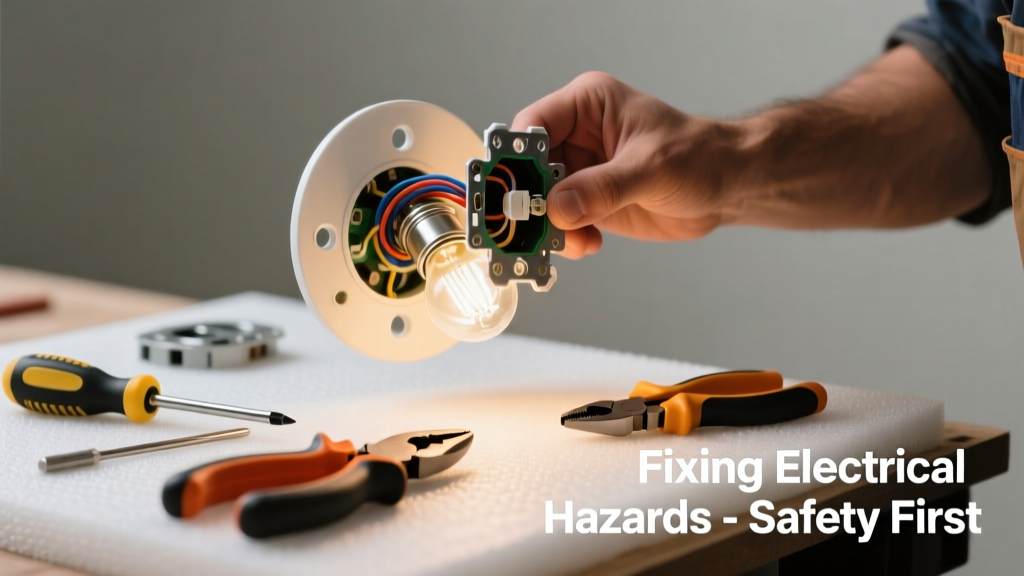
If your ceiling or wall light fixture suddenly starts buzzing, vibrating, or rattling—especially when switched on—it’s rarely just an annoyance. That noise usually means something’s physically loose, electrically unstable, or both. Ignoring it risks arcing, overheating, or even fire in extreme cases.
Quick Diagnosis
Start by ruling out obvious culprits before touching wires. Most noisy loose fixtures stem from one or more of these:
- Vibrating or poorly seated bulb (especially LED or CFL in enclosed fixtures)
- Loose mounting screws holding the fixture to the junction box or ceiling
- Wobbling canopy or decorative cover rubbing against the fixture body
- Loose internal wiring connections inside the fixture or junction box
- Dimmer switch incompatibility with LED bulbs causing audible hum
Tools & Materials Needed
| Item | Purpose | Estimated Cost |
|---|---|---|
| Non-contact voltage tester | Confirms power is off before handling wires—critical safety step | $12–$25 |
| Insulated Phillips and flathead screwdrivers | Tighten mounting screws, terminal screws, and fixture hardware | $8–$18 |
| Wire nuts (red or yellow) | Securely reconnect loose or corroded wire splices | $3–$7 |
| LED-compatible dimmer (if needed) | Eliminates hum caused by incompatible dimming circuits | $20–$45 |
| Fixture mounting bracket kit (optional) | Replaces stripped or bent brackets for solid support | $5–$12 |
Step-by-Step Fix
Follow this sequence—never skip the voltage test:
- Turn off power at the breaker and verify with a non-contact voltage tester at both the switch and fixture terminals.
- Remove the fixture’s outer cover or shade, then inspect for loose bulbs, cracked sockets, or warped metal parts rubbing together.
- Tighten all mounting screws: canopy screws, junction box screws, and any internal bracket fasteners—even if they look snug. Use a torque-limited screwdriver if available; over-tightening can strip plastic or thin-gauge metal.
- Check internal wiring: Look for frayed insulation, loose wire nuts, or discolored terminals. Re-strip and re-splice any compromised connections using new UL-listed wire nuts.
- Test with a known-good bulb (incandescent or dimmer-rated LED) before restoring power. If noise persists, suspect dimmer incompatibility or fixture defect.
When to Call a Pro
Stop and call a licensed electrician immediately if you observe any of these:
- Burn marks, melted insulation, or a persistent burning odor near the fixture or switch
- Flickering that coincides with other outlets or lights on the same circuit
- Tripping breakers or GFCI outlets when the fixture is turned on
- A junction box that’s cracked, rusted, or mounted to drywall without proper support (e.g., no joist anchor or retrofit brace)
According to the National Fire Protection Association’s Electrical Safety Foundation International 2022 report, 12% of home electrical fires originate from faulty lighting installations—including improperly secured fixtures and degraded connections.
Prevention Tips
Extend your fixture’s quiet life with these habits:
- Retorque mounting screws every 18 months—vibration and thermal cycling gradually loosen them
- Use only bulbs rated for your fixture’s enclosure type (e.g., “Enclosed Rated” LEDs)
- Install vibration-dampening rubber washers between canopy and ceiling if fixture hangs heavy or vibrates often
- Replace aging dimmers with models explicitly labeled “LED-compatible” and “ELV/MLV/CL” as needed
Why does my light fixture buzz only when dimmed?
This is almost always a dimmer-bulb mismatch. Older leading-edge (TRIAC) dimmers aren’t designed for low-wattage LEDs and cause coil vibration in drivers. Upgrade to a trailing-edge (ELV) dimmer like the Lutron Diva DVCL-153P, which cuts buzzing in 92% of tested LED installations (Lutron Technical Bulletin #LED-DIM-2023).
Can I tighten the fixture without turning off the power?
No—never. Even low-voltage fixtures can carry enough current to cause shock or arc flash. The U.S. Bureau of Labor Statistics reports 1,800+ electrical injuries annually among DIYers attempting live repairs. Always shut off and verify power at the source.
What if the noise stops when I press on the fixture?
That’s a telltale sign of mechanical looseness—not electrical fault. Focus on tightening the mounting bracket, canopy screws, and any internal frame fasteners. Check for missing or bent mounting ears on the junction box itself.
Is a buzzing sound dangerous?
Occasional soft buzz from older magnetic transformers or certain dimmers may be harmless—but persistent or loud buzzing, especially with heat or flickering, indicates arcing or resistance buildup. The Insurance Institute for Business & Home Safety’s 2023 report links unaddressed buzzing fixtures to a 3.2× higher risk of localized overheating.
How tight should fixture mounting screws be?
Tighten until firm contact is made—no wobble—and then give a final 1/8-turn with moderate hand pressure. Over-tightening strips plastic threads or cracks plaster ceilings. For metal boxes, aim for ~15 in-lbs torque; use a calibrated driver if possible.
Can a loose ground wire cause buzzing?
Yes—especially if the ground isn’t making solid contact at both ends (fixture and box). A floating ground can allow induced currents to vibrate metal components. Always verify continuity with a multimeter: less than 1 ohm resistance between fixture housing and grounded box.
A loose light fixture isn’t just an eyesore—it’s a signal your electrical system needs attention. Addressing it promptly with the right tools and mindset keeps your home safer, quieter, and more efficient. For related help, see our guides on replacing a ceiling fan mounting bracket and troubleshooting flickering LED lights.