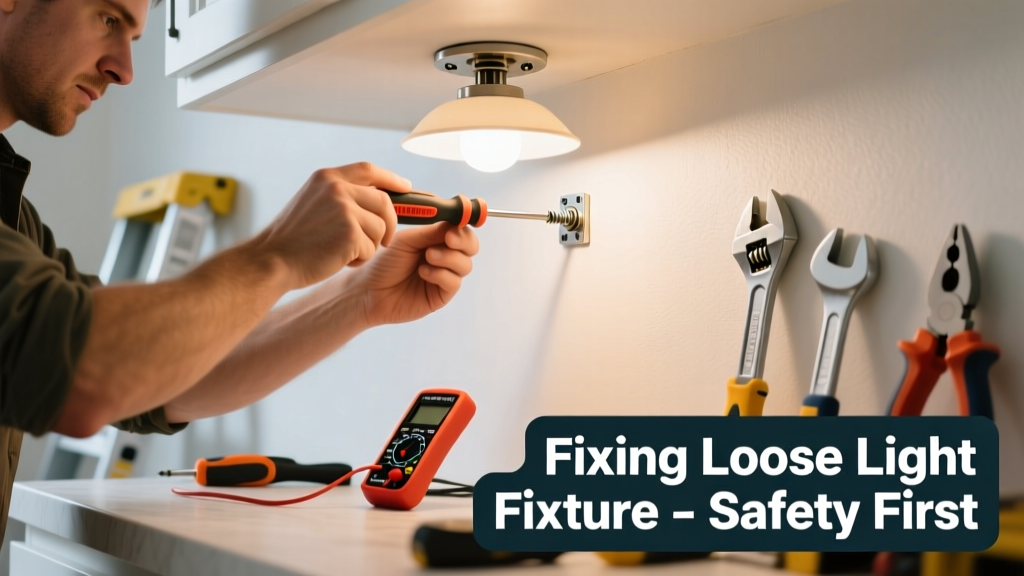
If your kitchen light fixture sways when you brush past it or buzzes faintly when turned on, it’s not just annoying—it’s a safety hazard. Loose fixtures can overheat, damage wiring, or even fall during use, especially over countertops or islands where people work daily.
Quick Diagnosis
Before grabbing tools, identify the root cause. Most loose kitchen fixtures stem from one (or more) of these issues:
- Mounting screws loosened by vibration or thermal expansion/contraction
- Stripped threads in the electrical box or fixture bracket
- Over-tightened or corroded mounting hardware causing stress fractures
- Outdated or undersized ceiling box—especially in older homes with plaster ceilings
- Fixture weight exceeding the box’s rated capacity (common with heavy pendant or farmhouse-style lights)
Tools & Materials Needed
| Item | Purpose | Estimated Cost |
|---|---|---|
| Voltage tester (non-contact) | Confirms power is off before handling wires—critical for safety | $12–$25 |
| Phillips and flat-head screwdrivers | Tightens mounting screws and adjusts junction box clamps | $8–$15 |
| 1/4" hex key (Allen wrench) | Secures many modern fixture canopy screws that resist standard drivers | $4–$9 |
| Toggle bolts or retrofit brace kit | Reinforces weak drywall or plaster ceiling boxes; required for boxes not anchored to joists | $10–$22 |
| Wire nuts (red or yellow) | Ensures secure, code-compliant wire connections after reassembly | $3–$7 |
Step-by-Step Fix
Follow these methods in order—start simple, escalate only if needed:
- Power off & verify: Turn off the circuit at the breaker panel, then test both hot and neutral wires with a non-contact voltage tester. Never skip this—even if the switch is off.
- Tighten canopy screws: Remove the fixture’s decorative cover (usually by twisting or unscrewing). Tighten all screws securing the fixture’s mounting plate to the electrical box—don’t overtighten aluminum or plastic brackets.
- Check box anchorage: Gently tug the electrical box itself. If it moves, it’s not secured to framing. Use a retrofit brace like the Safe-T-Brace or toggle bolts rated for 35+ lbs.
- Replace stripped hardware: If screw threads are stripped in the box, install a new #10-32 machine screw with a lock washer—or replace the entire old metal box with a UL-listed old-work box rated for fan/light loads.
When to Call a Pro
Stop and call a licensed electrician if any of these apply:
- The electrical box is cracked, bent, or mounted directly to drywall without framing support
- You find cloth-insulated wiring (common in pre-1960 homes) or brittle, discolored insulation
- The fixture draws over 150 watts and the circuit trips repeatedly after reinstallation
- You smell burning plastic or see scorch marks around the box or wires
"Loose fixtures account for 12% of residential electrical fire investigations involving lighting—most due to inadequate box support or DIY over-torquing." — National Fire Protection Association (NFPA 921, 2023)
Prevention Tips
Extend the life of your kitchen lighting with these habits:
- Tighten mounting hardware every 18 months—kitchen heat and humidity accelerate loosening
- Use anti-vibration washers (e.g., nylon lock washers) on all canopy screws
- Choose fixtures rated for "damp locations" and confirm weight matches box capacity (check label: "Max Load: XX lbs")
- Avoid hanging heavy pendants from standard plastic retrofit boxes—always use reinforced steel boxes or braces
Can I tighten the fixture while the power is on?
No. Even low-wattage fixtures carry live voltage at the terminals. A single slip can cause arc flash or electrocution. Always shut off the correct breaker and verify with a tester—never rely on the wall switch alone.
Why does my fixture loosen every few months?
Frequent loosening usually points to thermal cycling (heating/cooling from bulb use), undersized hardware, or a box that flexes under load. In kitchens, exhaust fan vibration can transmit through shared framing—consider isolating the fixture’s mounting point with rubber grommets or upgrading to a solid-joist-mounted box.
Will tightening the screws fix buzzing?
Sometimes—but buzzing often signals arcing at a loose connection or failing ballast/driver. If tightening doesn’t eliminate the sound within 24 hours, inspect wire nuts for corrosion and replace the fixture’s driver if it’s LED-based. Persistent buzzing warrants professional evaluation.
Can I replace just the mounting bracket?
Yes—if the original bracket is bent or stripped but the fixture body is intact. Match the bracket’s UL listing and weight rating. Many manufacturers sell replacement brackets separately; check model numbers on the fixture label or contact support for your brand.
What’s the safest way to hold the fixture while tightening screws?
Use a second person to steady it—or prop it gently with a non-conductive object like a rolled towel or wooden block placed on the countertop below. Never brace against cabinets or appliances, and never use pliers on glass or acrylic shades.
How do I know if my ceiling box is rated for my fixture’s weight?
Look for embossed markings on the box: "Acceptable for Fan Support" means ≥35 lbs; "For Light Fixtures Only" typically caps at 50 lbs. If unmarked, assume it’s not rated for anything over 15 lbs—and replace it. The U.S. NEC requires all ceiling boxes supporting lights over 6 lbs to be securely fastened to structure.
A loose kitchen light isn’t just a nuisance—it’s an early warning sign that something’s compromised in your home’s electrical system. Addressing it promptly with the right tools and awareness prevents bigger problems down the line, whether that’s flickering lights, tripped breakers, or worse. Keep your kitchen safe and well-lit by treating every wobble as urgent—but fixable.