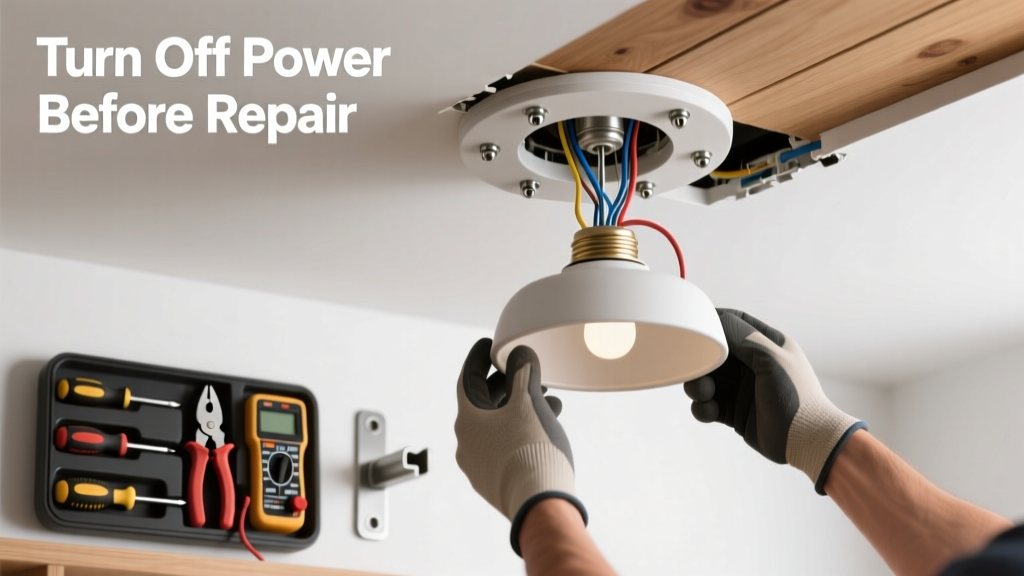
A wobbling ceiling light isn’t just annoying—it’s a red flag for potential electrical hazards or structural weakness. If your fixture shifts when touched, buzzes faintly, or leaves marks on the ceiling, don’t ignore it. Most cases are simple to resolve in under 30 minutes with basic tools and power turned off.
Quick Diagnosis
Before grabbing tools, identify the root cause. A loose fixture rarely stems from one issue alone—here are the five most common culprits:
- Loose mounting screws holding the fixture base to the electrical box
- Rusted or stripped threads in the ceiling electrical box
- Over-torqued or undersized hanger bar (especially in older homes with metal boxes)
- Worn-out or cracked plastic or metal canopy
- Improperly secured junction box—often mounted only to drywall or plaster, not framing
Tools & Materials Needed
| Item | Purpose | Estimated Cost |
|---|---|---|
| Voltage tester (non-contact) | Confirms power is off at the fixture before handling wires | $12–$25 |
| Phillips and flat-head screwdrivers | Tightens mounting hardware and adjusts canopy alignment | $8–$18 |
| Adjustable wrench or socket set | Secures hex nuts on threaded rods or hanger bars | $15–$40 |
| Replacement mounting screws (6-32 or 8-32) | Replaces stripped or corroded fasteners; stainless steel recommended | $3–$7 |
| Old-work electrical box brace kit | Reinforces a sagging box mounted only to drywall | $14–$22 |
Step-by-Step Fix
Follow these methods in order—start simple, escalate only if needed:
- Power down and verify: Turn off the circuit breaker, then test both hot and neutral wires at the fixture with a non-contact voltage tester.
- Tighten canopy screws: Remove the decorative canopy and tighten all screws securing the fixture body to the electrical box. Use a torque of 12–15 in-lbs—overtightening cracks plastic canopies.
- Check hanger bar tension: For pendant or semi-flush mounts, ensure the threaded rod is fully seated and the locknut is snug against the box. Add a second locknut if vibration persists.
- Reinforce the electrical box: If the box flexes or pulls away from the ceiling when pressure is applied, install an old-work brace kit behind the drywall to anchor it to joists.
- Replace corroded hardware: Swap out rusted screws, washers, or mounting straps. According to the National Electrical Code (NEC 2023), all fixture support hardware must be rated for the installed weight—never reuse compromised parts.
When to Call a Pro
Stop and call a licensed electrician if any of these apply:
- The electrical box moves more than ¼ inch when gently pushed sideways
- You find brittle, cracked, or aluminum wiring (common in homes built 1965–1973)
- The fixture weighs over 50 lbs and lacks a dedicated ceiling joist anchor
- There’s scorching, melting, or a burnt odor near the wires or box
- Your home has knob-and-tube wiring or ungrounded circuits
According to the U.S. Consumer Product Safety Commission’s 2022 Electrical Fire Report, 22% of residential lighting-related fires involved improperly supported fixtures or degraded mounting hardware.
"A loose fixture isn’t just about aesthetics—it’s often the first sign of failing support integrity. Never assume ‘tight enough’ is safe. When in doubt, use a torque screwdriver and verify anchorage into solid framing." — Mike R., Master Electrician, IBEW Local 25, 2023
Prevention Tips
Extend the life of your fixtures with these proactive steps:
- Retorque mounting hardware every 18 months—vibration gradually loosens connections
- Use thread-locking compound (Loctite 222) on small fixture screws exposed to frequent on/off cycling
- Install rubber grommets between metal canopies and boxes to dampen vibration in high-traffic rooms
- Label circuit breakers clearly so future power-downs are fast and accurate
Can a loose light fixture cause a fire?
Yes—loose connections increase resistance, leading to heat buildup at terminals. The NFPA reports that 11% of electrical fires linked to lighting involved arcing from poorly secured fixtures (NFPA Electrical Fire Analysis, 2021).
Why does my light fixture loosen after just a few months?
Frequent thermal cycling (heating/cooling from bulb operation), low-quality screws, or an under-sized electrical box are top causes. LED retrofits reduce heat but don’t eliminate mechanical stress—check for micro-vibrations from HVAC ducts or ceiling fans nearby.
Can I use drywall anchors to secure a loose fixture?
No. Drywall anchors aren’t rated for sustained downward load or vibration. They’re designed for static picture-hanging—not dynamic loads like light fixtures. Always anchor into wood or metal framing, or use a reinforced old-work box.
Do LED fixtures loosen less than incandescent ones?
Not inherently—but because LEDs run cooler, thermal expansion/contraction is reduced. That means fewer cycles stressing mounting points. However, lightweight LED fixtures may sway more if undersupported, making looseness more noticeable.
What’s the maximum weight a standard ceiling box can hold?
Per NEC 314.27(A)(1), standard residential ceiling boxes must support at least 50 lbs. But many older plastic or shallow metal boxes—especially those nailed only to lath—fail well below that. Always verify box rating stamped inside the housing.
Should I replace the entire electrical box if it’s loose?
Only if it’s cracked, warped, or missing mounting ears. In most cases, reinforcing with an adjustable fan brace or retrofit bracket solves the problem without rewiring. Replacement requires cutting drywall and verifying joist access.
A properly secured light fixture should feel solid—not silent, but still. If you’ve followed the steps and still notice movement, revisit the box anchorage or consult an electrician before adding heavier bulbs or shades. Regular maintenance beats emergency repairs—and keeps your ceiling intact.