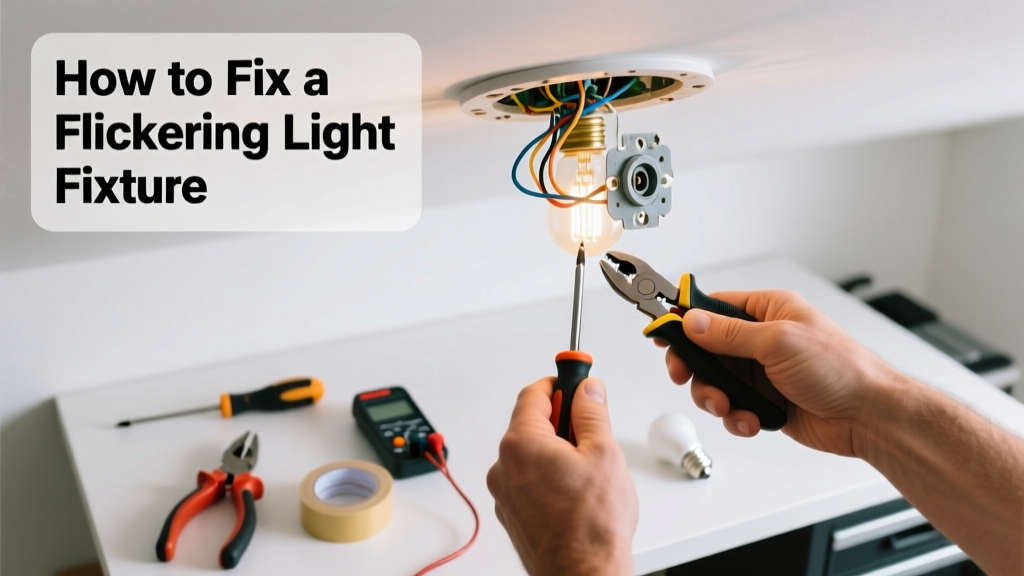
Flickering lights aren’t just annoying—they’re often the first sign of a loose connection, failing bulb, or deeper electrical issue. Left unaddressed, intermittent flickering can escalate into arcing, overheating, or even fire hazards. Most cases are simple fixes you can handle in under 30 minutes with basic tools.
Quick Diagnosis
Before grabbing tools, rule out the obvious causes:
- A dying or incompatible LED or CFL bulb (especially with dimmers)
- Loose bulb seating in the socket
- Worn or corroded socket contacts
- Loose wire connections at the fixture, switch, or junction box
- Overloaded circuit or voltage fluctuations from large appliances cycling on
Tools & Materials Needed
| Item | Purpose | Estimated Cost |
|---|---|---|
| Non-contact voltage tester | Verifies power is off before working—critical safety step | $12–$25 |
| Insulated screwdrivers (flat & Phillips) | Tighten terminal screws and remove fixture hardware safely | $8–$18 |
| Wire strippers/cutters | Cleanly trim and strip insulation if reconnecting wires | $10–$22 |
| Replacement socket or LED-compatible dimmer (if needed) | Fixes worn sockets or resolves dimmer-bulb incompatibility | $5–$45 |
| LED bulbs rated for dimming (if using dimmer) | Eliminates flicker caused by non-dimmable LEDs on dimmer circuits | $3–$12 each |
Step-by-Step Fix
Work only after turning off power at the breaker and verifying with your voltage tester. Never skip this.
- Replace the bulb: Try a known-good bulb of the correct type and wattage. For dimmer circuits, use only bulbs labeled "dimmable" and verify compatibility with your dimmer model (e.g., Lutron Caséta requires specific LED drivers).
- Tighten the bulb and socket: Gently snug the bulb—not overtightened. Then, with power OFF, remove the fixture cover and inspect the socket. Use needle-nose pliers to carefully lift the center contact tab if it’s flattened (common in older porcelain sockets).
- Check and tighten all wire connections: At the fixture’s wire nuts, the wall switch terminals, and the ceiling junction box. Look for signs of arcing (blackening), corrosion, or frayed strands. Re-strip ½" of insulation and re-make connections with fresh UL-listed wire nuts.
- Test the wall switch: If flickering occurs only when the switch is in a certain position (e.g., mid-dim), replace it with an LED-rated dimmer. According to the National Electrical Manufacturers Association (NEMA) 2022 Dimmer Compatibility Guide, over 60% of LED flicker complaints stem from outdated or incompatible dimmers.
When to Call a Pro
Stop and call a licensed electrician immediately if you observe any of these:
- Flickering affects multiple fixtures on different circuits
- You smell burning plastic or ozone near the switch or fixture
- Breaker trips repeatedly when the light is turned on
- Wall plates or outlets feel warm to the touch
- Aluminum wiring is present (common in homes built 1965–1973) — splicing requires COPALUM crimps and special training
"Flickering across more than one room often points to service panel issues or utility-side voltage instability — both outside DIY scope." — Mike Knauf, Master Electrician & NEC Code Trainer, IAEI Journal 2023
Prevention Tips
Extend fixture life and reduce flicker risk with these habits:
- Use only bulbs rated for enclosed fixtures if installing in recessed or covered housings
- Label dimmer switches with compatible bulb types and max wattage
- Inspect fixture wiring every 2 years during seasonal cleaning
- Install whole-house surge protection—per the U.S. Department of Energy, voltage spikes cause ~18% of premature lighting failures
Why does my LED light flicker only when it's cold?
Cold temperatures slow down driver electronics in cheaper LED bulbs, causing inconsistent current delivery. Upgrade to bulbs rated for outdoor or low-temp use (look for "-25°C operating range" on packaging). Also check for condensation inside enclosed fixtures—it can disrupt thermal management.
Can a loose neutral wire cause flickering?
Yes—and it’s dangerous. A loose or corroded neutral in your panel or meter base creates voltage imbalance across circuits. This often manifests as lights brightening/dimming in tandem with appliance use (e.g., fridge compressor kicking on). This requires immediate professional diagnosis per NEC Article 210.4(B).
Will tightening the bulb really stop flickering?
It often does—especially in older fixtures where thermal expansion loosens the bulb over time. But if tightening provides only temporary relief, the socket’s internal spring contact has fatigued and needs replacement. Don’t force bulbs; excessive torque cracks ceramic sockets.
Do smart bulbs flicker more than regular LEDs?
They can—particularly during firmware updates or when paired with incompatible hubs or dimmers. Always use smart bulbs on dedicated, non-dimming circuits unless the manufacturer explicitly certifies dimmer compatibility. See our guide on smart bulb troubleshooting for reset sequences and Zigbee channel fixes.
Is flickering worse at night a sign of utility problems?
Possibly. Voltage sags during peak evening demand can trigger flicker in marginal circuits. Contact your utility with timestamps—if neighbors report similar issues, it’s likely grid-related. The IEEE Standard 1459-2010 defines acceptable flicker limits (Pst < 1.0); utilities must investigate if Pst exceeds 0.8 consistently.
Can a bad ground cause light flickering?
Rarely as a direct cause—but an open ground increases shock risk and can interfere with electronic drivers’ noise filtering. Test grounding with a plug-in outlet tester. If the fixture lacks a ground wire (common in pre-1960s knob-and-tube), consult an electrician before adding modern components—retrofitting grounds improperly violates NEC 250.130(C).
Flickering lights rarely resolve themselves—and ignoring them invites bigger problems. Most single-fixture issues respond well to methodical, safety-first troubleshooting. When in doubt about wire integrity, panel access, or aluminum wiring, invest in a pro’s time: according to the Electrical Safety Foundation International’s 2023 incident report, 52% of residential electrical fires involved DIY repairs gone wrong. Your patience and caution today keeps your home—and family—safe tonight.