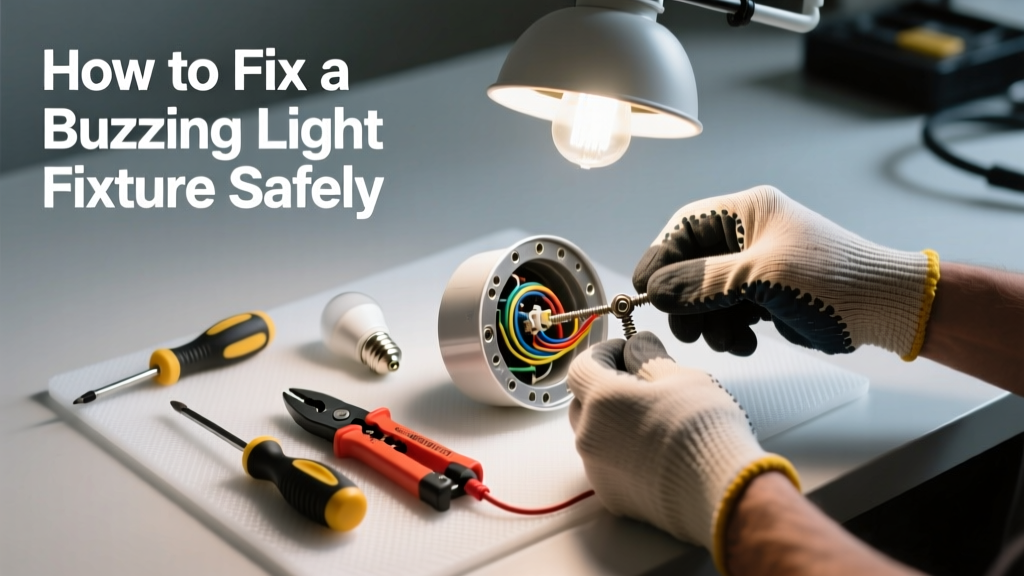
That low hum or sharp buzz from your ceiling light isn’t just annoying—it’s often a warning sign of loose wiring, failing components, or voltage issues. Ignoring it can lead to flickering, premature bulb failure, or even overheating. Most buzzing fixes take under 30 minutes and require only basic tools—but knowing when *not* to DIY is just as critical.
Quick Diagnosis
Buzzing rarely happens without cause. Start here before grabbing tools:
- Loose bulb—especially in dimmable or enclosed fixtures
- Incompatible dimmer switch (e.g., non-LED-rated dimmer with LED bulbs)
- Failing ballast in fluorescent fixtures (common in older kitchens or garages)
- Loose wire connections at the fixture, switch, or junction box
- Overloaded circuit or voltage fluctuations (check if buzzing coincides with appliance use)
Tools & Materials Needed
| Item | Purpose | Estimated Cost |
|---|---|---|
| Voltage tester (non-contact) | Confirms power is off before handling wires—critical for safety | $12–$25 |
| Insulated screwdrivers (Phillips & flathead) | Tightens terminal screws and adjusts mounting hardware without shock risk | $8–$18 |
| LED-compatible dimmer switch (if replacing) | Eliminates buzz caused by incompatible controls—required for modern LEDs | $22–$45 |
| Wire nuts (UL-listed, red or yellow) | Secures spliced connections; prevents arcing and vibration-induced noise | $3–$7 |
| Replacement ballast (for fluorescents) | Fixes 90% of persistent buzzing in older tube fixtures | $15–$30 |
Step-by-Step Fix
Work methodically—and always shut off power at the breaker and verify with your voltage tester first.
- Reseat the bulb: Turn off power, remove the bulb, inspect the base for darkening or pitting, clean socket contacts with a dry cloth, then reinstall firmly. For recessed or track lights, ensure bulbs are rated for enclosed use.
- Check dimmer compatibility: If buzzing occurs only when dimmed, confirm your dimmer is labeled "LED-compatible" and supports your bulb’s wattage range. Replace if outdated—Lutron and Leviton publish compatibility charts online.
- Tighten all connections: At the fixture, switch, and junction box, check wire nuts and terminal screws. Gently tug each wire to confirm no looseness; re-torque screws to manufacturer specs (usually 18–22 in-lbs).
- Replace magnetic ballasts: In fluorescent fixtures built before 2010, swap old magnetic ballasts for electronic ones—they run cooler, quieter, and use 25% less energy (U.S. DOE, 2022).
When to Call a Pro
Some buzzing signals deeper trouble that’s unsafe to tackle alone:
- You detect burning smells, discoloration on wires or the fixture housing, or warm outlets/switch plates
- The buzz persists after all DIY steps—and occurs across multiple fixtures on the same circuit
- Your home has aluminum wiring (common in homes built 1965–1973), which requires special connectors and training
- You measure voltage fluctuations above ±5% using a multimeter (e.g., 110V–125V on a 120V circuit)
"Over 40% of residential electrical fires begin at lighting fixtures—often preceded by buzzing or flickering." — National Fire Protection Association, Electrical Fire Causes Report 2023
Prevention Tips
Extend fixture life and prevent recurrence with these habits:
- Always match bulb type, base, and wattage to fixture ratings—never exceed max wattage, even with low-wattage LEDs
- Use only dimmers certified for your bulb technology (e.g., ELV for trailing-edge, MLV for magnetic low-voltage)
- Install whole-house surge protection—voltage spikes degrade drivers and ballasts over time
- Inspect fixture mounting hardware annually; vibration loosens screws faster than you’d expect
Why does my LED light buzz only when dimmed?
This almost always points to dimmer incompatibility. Older incandescent-only dimmers chop voltage in ways that cause LED drivers to vibrate audibly. Upgrade to an LED-specific dimmer like the Lutron Diva DVCL-153P, and verify your bulbs are listed on the dimmer’s compatibility sheet.
Can a buzzing light fixture cause a fire?
Yes—loose connections create arcing, which generates intense localized heat. According to the U.S. Fire Administration, faulty wiring accounts for nearly 19,000 home fires annually. Persistent buzzing + warmth or discoloration demands immediate professional attention.
Will tightening the fixture’s mounting screws stop the buzz?
Sometimes—but only if the buzz originates from mechanical vibration transferring through loose hardware. It won’t fix electrical causes like bad ballasts or dimmer mismatch. Always rule out wiring and component issues first.
Do fluorescent tubes buzz more as they age?
Absolutely. As the phosphor coating degrades and the ballast weakens, both electromagnetic interference and acoustic vibration increase. Replace tubes every 2–3 years and ballasts every 10–15 years—even if they still light.
Is buzzing normal for smart bulbs?
No. Quality smart bulbs (like Philips Hue or Nanoleaf) shouldn’t buzz. If yours does, check for firmware updates, avoid using them on dimmers unless explicitly rated for it, and ensure your home’s neutral wire is properly connected at the switch—missing neutrals cause driver instability.
Can I replace a buzzing ceiling fan light kit myself?
Yes—if the fan itself runs quietly and only the light module buzzes. Confirm voltage matches (most kits are 120V), disconnect power, and swap the entire kit—not just bulbs. Avoid third-party kits not UL-listed for your fan model; mismatched drivers cause harmonic noise.
A buzzing light fixture is rarely random—it’s feedback from your electrical system telling you something’s off-balance. Address it early, methodically, and safely, and you’ll avoid bigger headaches down the line. For ongoing peace of mind, consider scheduling a professional electrical safety inspection every 5–7 years—or sooner if your home was built before 1990. And if you’re swapping out old fixtures, check out our guide on LED recessed light installation for quiet, efficient upgrades.