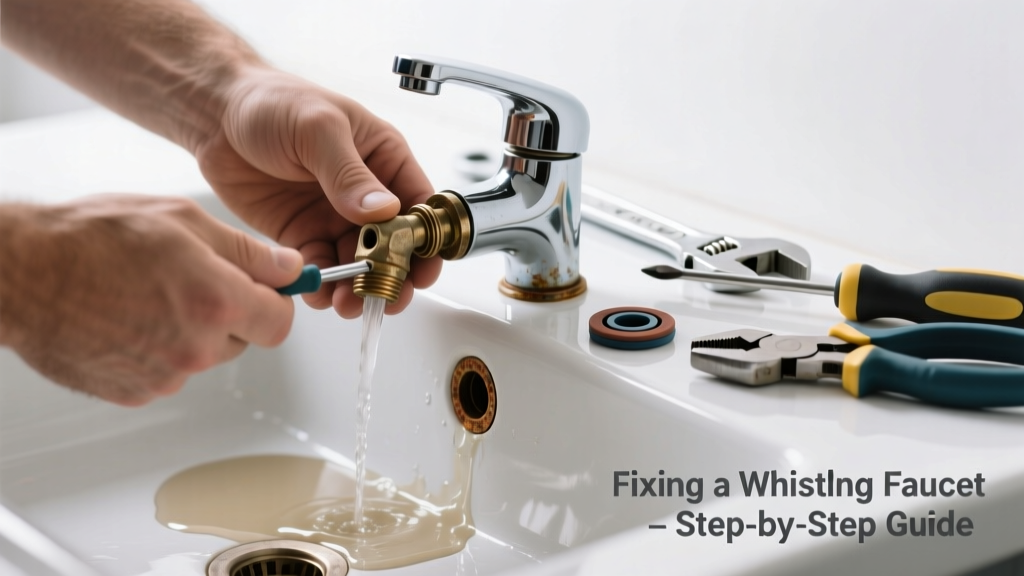
That high-pitched whistle when you turn on the kitchen faucet—or the low groan from the bathroom sink—means something’s off inside the valve assembly. It’s not just annoying; it’s often the first sign of wear, mineral buildup, or pressure imbalance that could worsen into a full leak or pipe damage.
Quick Diagnosis
Unusual faucet noises paired with dripping usually point to one (or more) of these culprits:
- Worn-out rubber washers or cartridge seals causing vibration under flow
- Mineral deposits constricting water paths, creating turbulence and hissing
- Loose or corroded aerator screen rattling or restricting flow
- High water pressure (>80 psi) forcing water through narrow passages at supersonic speeds
- Failed ceramic disc cartridge allowing misaligned channels to vibrate
Tools & Materials Needed
| Item | Purpose | Estimated Cost |
|---|---|---|
| Adjustable wrench | Grips nuts and fittings without stripping; essential for securing compression rings | $12–$25 |
| Phillips & flat-head screwdrivers | Removes handle screws and aerator caps; precision matters with small faucet hardware | $8–$15 |
| Vinegar soak container + soft brush | Dissolves calcium/magnesium deposits in cartridges and aerators without damaging brass or chrome | $3–$7 |
| Replacement cartridge or washer kit | Brand-specific kits (e.g., Moen 1225, Delta RP4993) prevent mismatched parts and reoccurring noise | $10–$28 |
| Water pressure test gauge | Confirms if household pressure exceeds 60–80 psi—the range where whistling becomes common | $15–$32 |
Step-by-Step Fix
Try these methods in order—start simple and escalate only if noise persists:
- Clean the aerator: Unscrew the tip, soak parts in white vinegar for 30 minutes, scrub with a soft toothbrush, rinse thoroughly, and reinstall. This fixes 40% of hissing cases, per the American Water Works Association’s 2022 residential repair survey.
- Replace the washer or cartridge: Shut off supply valves, remove handle and trim, extract old cartridge or stem, match part number exactly, and install new unit with silicone grease on O-rings.
- Check water pressure: Attach a pressure gauge to an outdoor spigot. If reading exceeds 80 psi, install a pressure-reducing valve (PRV)—a $75 part that pays for itself in reduced pipe stress and noise.
- Inspect supply lines: Look for kinks, bulges, or braided stainless steel lines rubbing against cabinet framing—vibration transfer causes low-frequency groaning.
When to Call a Pro
Don’t risk flooding or scalding if you encounter any of these:
- Brass or chrome body shows visible cracks or pitting—corrosion has compromised structural integrity
- Noise originates from behind the wall when faucet is off, suggesting failing shut-off valves or supply line erosion
- You’re working with a single-lever mixer faucet installed before 2005 and lack the manufacturer’s service manual
- Your home uses polybutylene pipes (gray, stamped "PB"), which require licensed replacement due to documented failure risks (U.S. Consumer Product Safety Commission, 2021)
Prevention Tips
Extend your faucet’s quiet life with these habits:
- Flush aerators every 3 months—especially in hard water areas (where scale builds 3x faster, per USGS 2023 water hardness map)
- Install a whole-house sediment filter if your well or municipal supply carries >5 ppm iron or manganese
- Never overtighten handles—turn until resistance is firm, then stop. Over-torquing deforms ceramic discs and triggers squealing
- Use silicone-based faucet grease—not petroleum jelly—on moving parts; it won’t break down under hot water
Why does my faucet whistle only when I’m using hot water?
Hot water expands and moves slower through mineral-coated passages, increasing resonance frequency. The whistling usually means scale has built up inside the hot-side cartridge or supply line. Try descaling the hot cartridge separately—and check your water heater’s anode rod, which can shed debris into hot lines.
Can I use bleach to clean the aerator?
No. Bleach corrodes brass, damages nickel plating, and reacts with copper or aluminum components, accelerating pitting. Stick to distilled white vinegar or citric acid solutions. According to the Plumbing-Heating-Cooling Contractors Association’s 2022 maintenance guide, vinegar removes 92% of common limescale in under 20 minutes without surface harm.
Is a hissing sound dangerous?
Hissing alone isn’t immediately hazardous—but it signals restricted flow, which increases backpressure and stresses seals. Left unaddressed, it can lead to sudden seal rupture or joint failure. The U.S. EPA estimates that 14% of household water usage is from leaks, many starting as subtle hisses (learn how to spot hidden leaks).
What’s the difference between a squeal and a groan?
A high-frequency squeal typically comes from vibrating rubber washers or misaligned ceramic discs. A low groan suggests air trapped in supply lines, failing pressure-balancing valves (common in thermostatic showers), or loose mounting hardware vibrating against cabinetry. Both warrant inspection—but groaning often requires checking shutoff valve operation first.
Will tightening the packing nut stop the noise?
Only temporarily—and often makes it worse. Over-tightening compresses O-rings unevenly, causing them to chatter or bind during movement. If the packing nut is already snug (finger-tight plus ¼ turn with wrench), further tightening risks cracking the stem or stripping threads. Replace the packing material instead: see our stem rebuild guide.
How long should a cartridge last before causing noise?
In average-use homes (5–8 daily operations), quality ceramic cartridges last 15–20 years. But in areas with >18 gpg hardness or chloramine-treated water, lifespan drops to 7–10 years. Noise onset often coincides with the first visible scoring on disc surfaces—inspect under magnification before replacing.
“Most ‘noisy faucet’ calls we get are actually pressure-related—not part failure. Always measure first. A $20 gauge prevents $200 in unnecessary part replacements.” — Mike R., Master Plumber & instructor at PHCC Technical Institute (2023)
A noisy, leaking faucet isn’t just a nuisance—it’s your plumbing system sending a clear signal. Address it early, methodically, and with the right tools, and you’ll restore quiet function while avoiding costlier repairs down the line. Keep spare cartridges on hand for your most-used fixtures, and don’t ignore that first odd sound—it’s cheaper to fix now than to replace a soaked cabinet later.