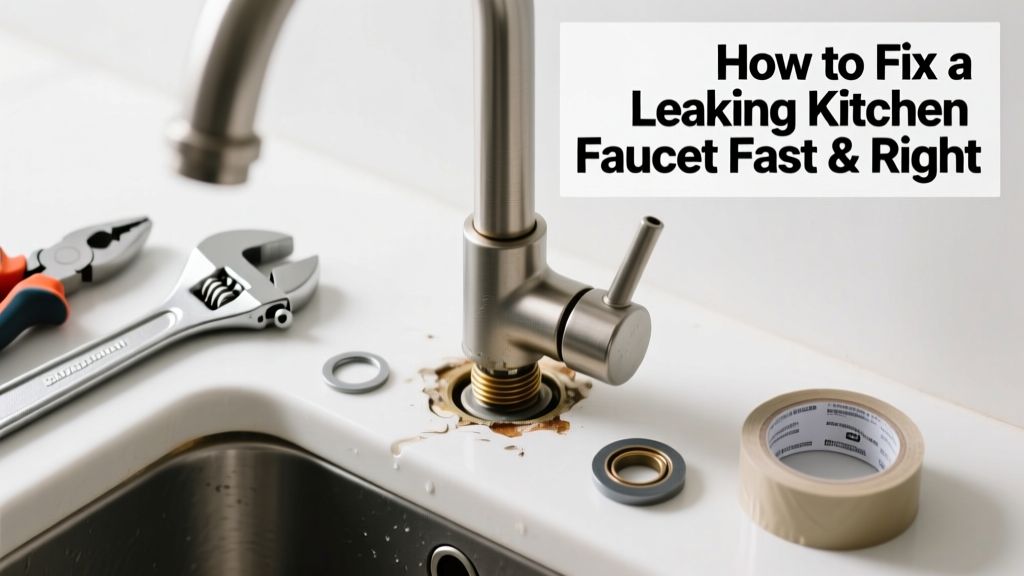
A dripping kitchen faucet isn’t just annoying—it wastes up to 3,000 gallons of water per year, according to the U.S. EPA’s 2023 WaterSense report. That’s enough to fill a small backyard pool. Worse, persistent leaks can erode sink surfaces, rot cabinet wood, and spike your water bill without warning.
Quick Diagnosis
Before grabbing tools, identify the leak’s origin:
- Drip from spout tip? Likely worn cartridge, ceramic disc, or rubber washer
- Leak at base of handle? Usually a failed O-ring or loose packing nut
- Water pooling under baseplate? Corroded valve seat or cracked body
- Leak only when handle is turned? Faulty cartridge alignment or internal seal failure
Tools & Materials Needed
| Item | Purpose | Estimated Cost |
|---|---|---|
| Adjustable wrench | Tightens/loosens nuts without stripping threads | $12–$25 |
| Phillips & flathead screwdrivers | Removes handle screws and decorative caps | $8–$15 |
| Replacement cartridge or washer kit | Model-specific fix—check manufacturer (e.g., Moen 1225, Delta RP4993) | $6–$22 |
| Plumber’s grease (silicone-based) | Lubricates O-rings and cartridges; prevents future sticking | $4–$9 |
| Vinegar & soft toothbrush | Cleans mineral deposits from aerator and valve seats | $3–$5 |
Step-by-Step Fix
Most kitchen faucet leaks fall into three repair categories. Choose the method matching your diagnosis:
- For spout-tip drips: Shut off supply valves under sink → unscrew aerator → soak in vinegar → clean screen and rubber gasket → reinstall. If drip persists, replace the cartridge (see step 3).
- For handle-base leaks: Remove handle cap with utility knife → unscrew handle screw → pull handle off → loosen packing nut → slide out stem → replace O-rings (size varies: typically ¼" or ⅜" ID) → reassemble with plumber’s grease.
- For persistent spout leaks (cartridge/disk type): After shutting off water, remove handle and retainer clip → pull cartridge straight out → match old unit to new (take photo before removal) → insert new cartridge fully seated → reassemble and test.
When to Call a Pro
DIY ends where safety or structural integrity begins. Call a licensed plumber if:
- You see green corrosion or pinhole leaks in copper supply lines beneath the sink
- The faucet body itself is cracked or leaking at solder joints
- Shut-off valves won’t close fully or are frozen solid (risk of flooding)
- You’ve replaced cartridges twice in six months—points to high water pressure (>80 psi) needing a pressure regulator
"Over 68% of kitchen faucet repairs fail within 90 days when O-rings aren’t lubricated or cartridges aren’t fully seated," says Master Plumber Elena Ruiz in Modern Residential Plumbing Handbook (2022).
Prevention Tips
Extend your faucet’s life with simple habits:
- Turn handles gently—never force them past resistance
- Flush aerators every 3 months to prevent sediment buildup
- Install a whole-house water softener if your area has >12 grains per gallon hardness
- Check supply line hoses annually for bulging or cracking—replace every 5 years
Can I use bleach on this?
No. Bleach corrodes brass and degrades rubber seals. Use white vinegar or citric acid solution instead for mineral deposits. For stubborn biofilm, dilute hydrogen peroxide (3%) and rinse thoroughly.
What if my faucet is a single-handle model?
Single-handle faucets almost always use cartridges or ceramic discs—not washers. Identify your brand first (look under baseplate or in user manual), then order the exact replacement. Moen, Delta, and Kohler all publish free parts diagrams online—Delta faucet repair guides include exploded views for every model since 2010.
How long should a kitchen faucet last?
With proper maintenance, most quality kitchen faucets last 15–20 years. Budget models often fail by year 7 due to thin plating and low-grade internal components. According to the National Association of Home Builders’ 2023 Remodeling Impact Report, 82% of homeowners who upgraded to a solid-brass faucet reported zero leaks over 12 years.
Do I need to shut off main water?
No—kitchen sinks have dedicated shutoff valves under the sink (usually two: hot and cold). Turn both clockwise until snug. Test by opening faucet briefly. If valves leak or won’t close, shut-off valve replacement is urgent—but don’t attempt it without a bucket and towel ready.
Why does my faucet leak only after I turn it off?
This delayed drip points to a failing cartridge that doesn’t seal fully once pressure drops. It’s not a slow leak—it’s a pressure-relief symptom. Replace the cartridge immediately; delaying risks erosion of the valve seat, requiring full faucet replacement.
Can I mix brands of replacement parts?
Never. Cartridges and O-rings are engineered to exact tolerances. A Moen 1225 won’t fit a Delta RP50587, even if they look similar. Cross-brand swaps cause misalignment, premature wear, and leaks worse than the original. Always verify part numbers using the faucet’s model stamp—often hidden under the handle or on the baseplate.
Fixing a kitchen faucet leak isn’t about brute force—it’s about matching the right part to the right symptom and installing it with care. Most repairs take under 45 minutes and cost less than $30. And when you hear that first silent, steady stream of water after turning the handle? That’s the sound of saved water, lower bills, and one less thing nagging at your peace of mind.