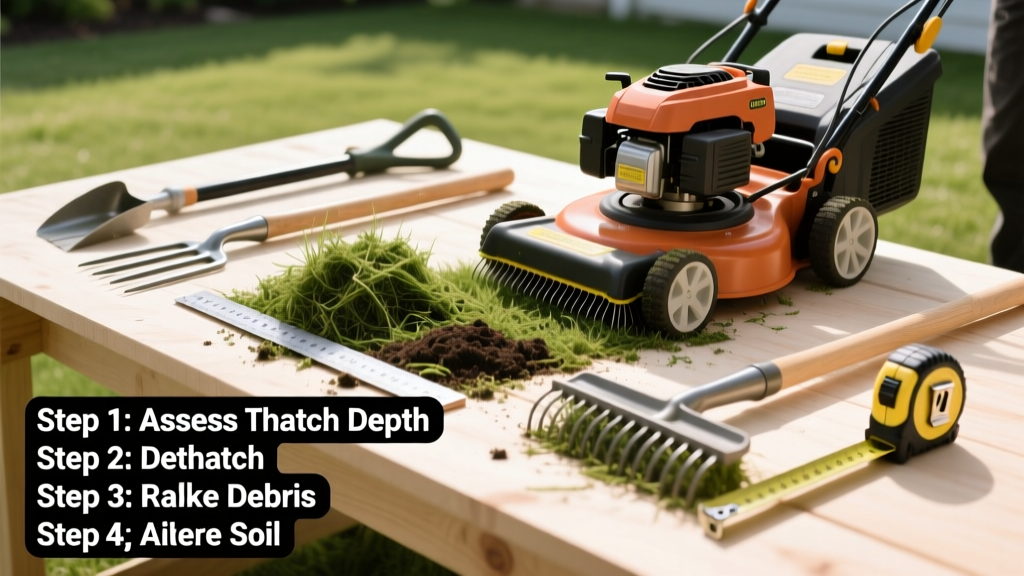
That spongy, brownish layer between your grass and soil isn’t just unsightly—it’s suffocating your lawn. If your turf feels springy underfoot or resists water penetration, you’ve likely got more than half an inch of thatch, and it’s time to act before disease and pests move in.
Quick Diagnosis
Thatch forms when organic matter accumulates faster than microbes can break it down. Here are the most common causes:
- Over-fertilizing with quick-release nitrogen (especially synthetic types)
- Frequent shallow watering that discourages deep root growth
- Heavy clay soils with poor microbial activity
- Using dull mower blades that tear rather than cut grass cleanly
- Grass species prone to thatch—like Kentucky bluegrass and creeping bentgrass
Tools & Materials Needed
| Item | Purpose | Estimated Cost |
|---|---|---|
| Power rake (vertical mower) | Physically lifts and removes thick thatch layers | $120–$250 (rental: $45–$75/day) |
| Core aerator | Relieves compaction and introduces oxygen to speed decomposition | $180–$320 (rental: $65–$95/day) |
| Soil pH test kit | Identifies acidic conditions that slow microbial breakdown of thatch | $12–$25 |
| Organic topdressing mix (compost + sand) | Introduces beneficial microbes and improves soil structure | $25–$45 per cubic yard |
| Sharp rotary mower blade | Clean cuts reduce plant stress and minimize excess debris | $8–$22 |
Step-by-Step Fix
Choose the right method based on thatch depth and lawn condition:
- For light thatch (¼–½ inch): Mow low (set blade to 1.5 inches), bag clippings for 2–3 weeks, then apply a microbial dethatcher like Thatch-X (contains Bacillus licheniformis) and water deeply.
- For moderate thatch (½–¾ inch): Rent a power rake in early fall (cool-season lawns) or late spring (warm-season). Set tines to penetrate ¼ inch into soil, make two perpendicular passes, and remove debris with a leaf rake or vacuum.
- For severe thatch (>¾ inch): Combine power raking with core aeration 7–10 days later. Then spread ¼-inch compost topdressing and water daily for 5 days to jumpstart microbial activity.
When to Call a Pro
DIY dethatching becomes risky or ineffective in these situations:
- Your lawn has more than 1 inch of thatch—power raking may scalp roots and expose bare soil to erosion
- You have extensive grub or chinch bug infestation (visible as patchy die-off); treating pests must precede dethatching
- Soil tests reveal pH below 5.5 or above 7.5—adjusting chemistry requires calibrated lime/sulfur applications
- Your property slopes over 15%—equipment slippage risks injury and turf damage
According to the University of Minnesota Extension’s 2022 Turfgrass Management Handbook, “Mechanical dethatching on slopes exceeding 12% should be performed only by certified applicators using anchored equipment.”
Prevention Tips
Long-term thatch control is about balance—not elimination:
- Mow weekly at proper height: 2.5–3.5 inches for tall fescue, 1–2 inches for Bermuda
- Apply slow-release organic fertilizer (e.g., Milorganite or alfalfa pellets) no more than twice yearly
- Water deeply but infrequently—1 inch per week total, delivered in 1–2 sessions
- Aerate every 1–2 years, especially if soil compaction is evident (water puddles >30 min after rain)
- Test soil pH every 2 years; keep it between 6.0–6.8 for optimal microbial function
Can I use a regular leaf rake to remove thatch?
No—standard leaf rakes lack the tine strength or spacing to lift dense, matted thatch. You’ll only scratch the surface and risk tearing live stolons. A stiff-tined bamboo rake helps *lightly* groom thin layers (<¼ inch), but anything thicker demands mechanical action.
Does leaving grass clippings cause thatch?
No—grass clippings decompose rapidly (within 1–2 weeks) and rarely contribute to thatch. That myth persists because people confuse visible clippings with actual thatch (dead stems, rhizomes, and roots). In fact, returning clippings adds nitrogen and supports microbial health.
How often should I dethatch my lawn?
Only when thatch exceeds ½ inch—typically every 2–5 years depending on grass type and maintenance. Cool-season lawns benefit from fall dethatching; warm-season lawns do best in late spring after green-up but before summer heat stress.
Will dethatching kill my lawn?
Not if done correctly—but aggressive timing or depth can stress turf. Avoid dethatching during drought, extreme heat (>85°F), or dormancy. Always follow up with watering, light feeding, and shade protection if needed. Recovery takes 2–4 weeks for healthy lawns.
Can I overseed immediately after dethatching?
Yes—and it’s recommended. Dethatching opens soil contact for seed-to-soil contact. Use a slit seeder or broadcast spreader, then cover seed with ⅛-inch compost. Keep soil consistently moist until germination (7–21 days depending on species).
Is liquid dethatcher safe for pets and kids?
Most enzyme- or microbe-based liquid dethatchers (e.g., Ringer Lawn Restore, Espoma Bio-Tone) are non-toxic once dry. However, avoid foot traffic for 24 hours post-application and rinse paws if pets walk on treated areas before drying. Always check the EPA registration number on the label—EPA Reg. No. 70123-12 indicates full residential safety clearance.
A healthy lawn breathes through its soil—not over it. Consistent mowing, smart watering, and periodic microbial support keep thatch in check without drastic intervention. If your lawn still feels spongy after two seasons of proper care, revisit your soil test results and consider a professional soil biology analysis—it might not be thatch at all, but poor drainage or fungal imbalance. For related guidance, see our guides on lawn aeration and soil pH testing.