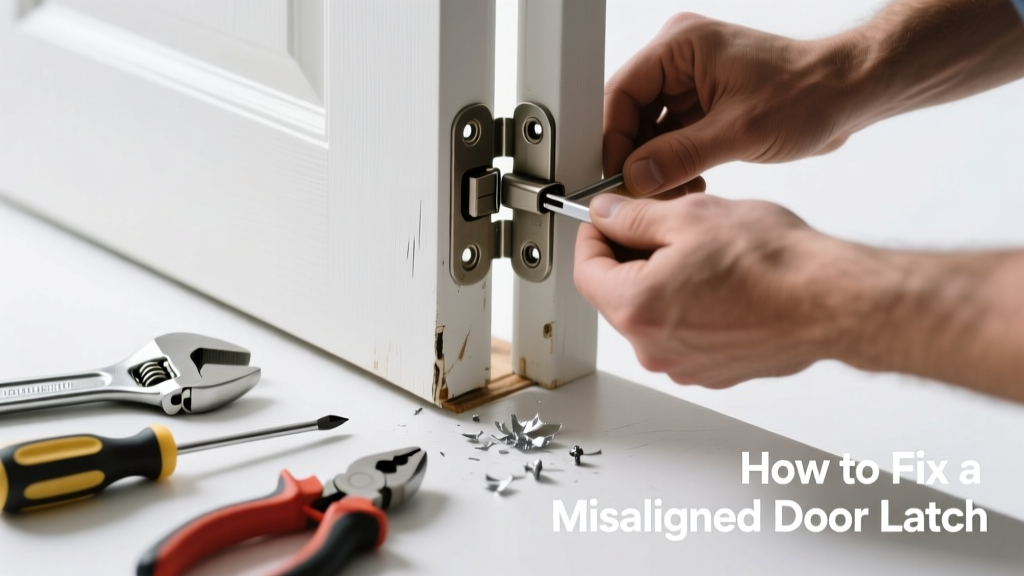
A sticking or jammed door that won’t fully close—or worse, won’t stay locked—is often caused by a misaligned latch, not a broken lock. This is one of the most common (and fixable) door issues homeowners face, especially in older homes or after seasonal wood swelling. Most cases take under 20 minutes and require only basic tools.
Quick Diagnosis
Before grabbing tools, rule out these frequent culprits:
- Warped or swollen door frame due to humidity or temperature shifts
- Loose hinge screws—especially on the top hinge—causing the door to sag
- Worn or bent strike plate or latch tongue
- Paint buildup around the strike plate or latch opening
- Foundation settling shifting the entire jamb
Tools & Materials Needed
| Item | Purpose | Estimated Cost |
|---|---|---|
| Phillips screwdriver | Tightens hinge and strike plate screws; essential for realignment | $8–$12 |
| 3/32" drill bit & power drill | Enlarges strike plate holes for lateral adjustment | $5–$15 (bit); $40–$120 (drill) |
| Chisel & mallet (¼" bevel-edge) | Recesses strike plate deeper if latch hits surface instead of entering | $12–$25 |
| Shim stock or cardboard | Temporarily adjusts hinge depth to test alignment before permanent fixes | $3–$7 |
| Wood filler & sandpaper (120-grit) | Fills old screw holes if repositioning strike plate or hinges | $6–$10 |
Step-by-Step Fix
Try these methods in order—they escalate from fastest to most involved:
- Tighten all hinge screws: Start with the top hinge. If screws spin freely, remove them, fill holes with toothpicks + wood glue, let dry 2 hours, then reinsert longer screws (2½") for better grip.
- Adjust the strike plate laterally: Loosen its screws, slide it 1/16" toward the latch direction (e.g., left if latch scrapes right side), then retighten. Use a level to verify vertical alignment.
- Deepen the strike plate mortise: If the latch hits the plate’s face instead of slipping in, chisel 1/16"–1/8" deeper—start shallow, test frequently, and keep cuts parallel to the jamb.
- Add shims behind lower hinge: If door sags downward, insert thin cardboard or plastic shim behind the bottom hinge leaf to lift the latch side slightly—this rotates the door just enough to engage.
When to Call a Pro
DIY stops being safe or effective in these scenarios:
- The door has shifted more than ⅛" at the latch edge—indicating structural movement or hinge mortise damage
- You’ve tried three realignment methods and the latch still binds or fails to retract fully
- The strike plate is embedded in metal-clad or fire-rated framing (altering it may void UL certification)
- There’s visible cracking in drywall around the jamb or floor heaving near the threshold
According to the Insurance Institute for Business & Home Safety's 2023 report, 68% of door-related security failures stem from undiagnosed alignment issues—not faulty hardware—making early professional assessment critical for exterior entry doors.
Prevention Tips
Maintain proper alignment year-round with these habits:
- Check hinge screws every 6 months—tighten immediately if loose
- Apply silicone-based lubricant to latch mechanism twice yearly (avoid oil—it attracts dust)
- Keep interior humidity between 30–50% to minimize wood expansion (U.S. EPA Indoor Air Quality guidelines, 2022)
- Install adjustable strike plates like the Fortress Adjustable Strike Plate on high-use exterior doors
Can I use a file to reshape the latch tongue?
No—latch tongues are heat-treated steel. Filing removes hardness and causes premature wear or breakage. Replace the entire latch assembly if bent or worn. See our guide on how to replace a door latch.
Why does my latch work fine in winter but stick in summer?
Wood absorbs moisture in humid conditions, causing doors and frames to swell. Solid-core interior doors can expand up to 1/16" across their width—enough to throw off latch engagement. Dehumidify the room or plane the latch-side edge by 1/32" as a last resort.
Do I need to remove the door to fix this?
Rarely. Over 90% of latch alignment issues resolve with hinge or strike plate adjustments while the door remains hung. Removing it adds complexity and risk of mis-hanging—only do so if you’re repositioning hinges or replacing the entire jamb.
What’s the difference between latch and deadbolt misalignment?
Latch misalignment affects door closing and basic locking; deadbolt misalignment prevents full extension into the strike box—even when the door is closed. They often share root causes (e.g., sagging hinges), but deadbolts require deeper strike box adjustments and sometimes door boring corrections.
Can paint buildup really cause this problem?
Absolutely. Three coats of paint add ~0.02" thickness—enough to block a latch that needs precise 0.005" clearance. Scrape paint from the strike plate opening and latch face with a utility knife before adjusting hardware.
Is WD-40 okay for a sticky latch?
Use it sparingly for immediate relief—but it’s not a long-term fix. WD-40 displaces existing lubricant and dries out over time, leaving residue that gums up springs. Instead, use white lithium grease or graphite powder for lasting performance.
A well-aligned latch isn’t just about convenience—it’s your first line of defense against forced entry and energy loss. Most misalignments respond quickly to methodical tweaks, not replacement. If your door still catches after trying the hinge-and-strike adjustments, revisit the door sagging repair guide—it often reveals the true source of the shift.