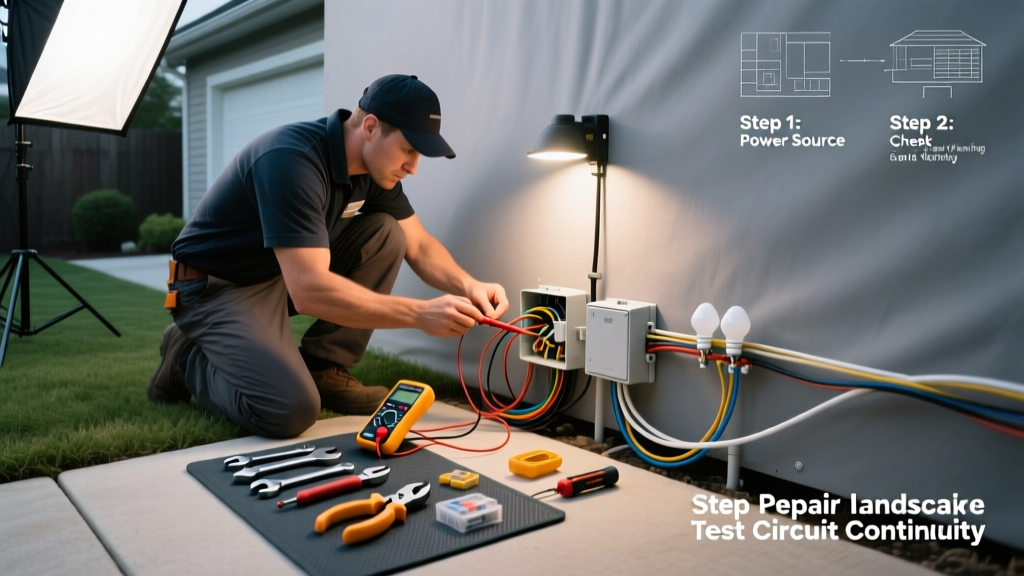
Your backyard path lights flicker—or go dark entirely—just as guests arrive. A single dead fixture might seem minor, but it’s often the first sign of voltage drop, moisture intrusion, or transformer overload. Most landscape lighting failures aren’t fatal; they’re fixable in under an hour with basic tools and methodical testing.
Quick Diagnosis
Before grabbing tools, rule out these five most common causes:
- Tripped GFCI outlet or circuit breaker feeding the transformer
- Blown low-voltage fuse inside the transformer (most common cause of total failure)
- Corroded or loose wire connections at the transformer or fixture junctions
- Waterlogged fixture housing causing short circuits or LED driver failure
- Overloaded transformer—exceeding its rated wattage capacity (e.g., 300W transformer powering 420W of LEDs)
Tools & Materials Needed
| Item | Purpose | Estimated Cost |
|---|---|---|
| Digital multimeter | Measures AC input and DC output voltage; confirms transformer function and line integrity | $25–$65 |
| Wire strippers & crimping tool | Cleans corroded ends and secures waterproof wire connectors | $12–$28 |
| Replacement 3-amp slow-blow fuse (for most transformers) | Standard fuse type for 12V landscape transformers; prevents repeated blowing if root cause is fixed | $4–$9 |
| Dielectric grease | Seals connections against moisture—critical for underground splices and fixture terminals | $6–$11 |
| LED-compatible replacement bulbs or modules | Many 'dead' fixtures actually have failed LEDs—not wiring—especially after 3+ years of use | $8–$22 each |
Step-by-Step Fix
- Check power at the source: Locate your transformer’s GFCI outlet or dedicated circuit breaker. Reset it. Use your multimeter to verify 120V AC at the transformer’s input terminals.
- Test transformer output: Set multimeter to DC 20V scale. Touch probes to transformer’s low-voltage output terminals. You should read 12–15V. Zero volts? Open the transformer case and inspect the internal fuse. Replace if discolored or broken.
- Trace voltage along the line: Starting at the transformer, test voltage at the first fixture’s leads. If present, move downstream. If voltage drops between two fixtures, cut the wire 6 inches before the dead one and re-splice with a gel-filled waterproof connector.
- Inspect fixture internals: Unscrew the lens and check for condensation, cracked lenses, or blackened LED boards. Wipe contacts with isopropyl alcohol. If the board shows burn marks or bulging capacitors, replace the entire fixture or module.
- Recalculate load: Add up all fixture wattages (check labels or manufacturer specs). If total exceeds 80% of transformer rating, either upgrade the transformer or remove/replace high-wattage halogens with 1–3W LEDs.
When to Call a Pro
Stop and call a licensed electrician if you encounter any of these:
- Transformer emits burning smell or visible smoke—even after fuse replacement
- Multimeter reads erratic or fluctuating voltage (e.g., jumping from 12V to 3V) on the low-voltage side
- You discover buried wires damaged by recent digging, with exposed copper or kinked insulation
- The system uses 120V direct-wire fixtures (not low-voltage), especially near pools or wet locations
According to the Insurance Institute for Business & Home Safety's 2023 report, 68% of outdoor electrical failures involving water exposure resulted in repeat issues when DIY repairs skipped dielectric sealing or load recalibration.
Prevention Tips
- Label every circuit leg at the transformer with painter’s tape and a marker (e.g., "North Path – 8 fixtures")
- Apply dielectric grease to all wire nuts and fixture terminals during installation—and reapply every 2 years
- Install a weatherproof cover over transformer vents to prevent rain ingress without blocking airflow
- Use only Class 2-rated, direct-burial cable (e.g., 12/2 or 14/2 UF-B) — never indoor thermostat wire
- Test voltage at the farthest fixture quarterly using your multimeter; consistent readings below 10.5V signal voltage drop needing larger gauge wire or a second transformer zone
Why do my LED landscape lights flicker only at dusk?
Flickering at dusk usually points to a failing photocell sensor in the transformer or a nearby light-sensitive switch. These sensors degrade after 2–4 years and misread ambient light during twilight transitions. Replace the transformer’s built-in photocell ($12–$18) or bypass it entirely and use a smart timer like smart outdoor timers for more reliable control.
Can I splice landscape lighting wire above ground?
No—above-ground splices violate NEC Article 300.5 and create corrosion and shock hazards. All splices must be made inside listed, waterproof, gel-filled connectors (e.g., Ideal WeatherTight or Burndy Ty-Rap) and buried at least 6 inches deep—or placed inside a sealed, accessible junction box mounted above grade. See our guide on outdoor wiring code rules for compliant methods.
How long should landscape lighting transformers last?
Quality 12V transformers last 7–10 years with proper ventilation and load management. Budget models often fail within 3 years due to undersized heat sinks and poor surge protection. The U.S. Department of Energy found that 41% of transformer failures occurred in units operating above 90% capacity for more than 4 months per year.
Do I need a GFCI for low-voltage landscape lighting?
Yes—if the transformer’s primary (120V) side plugs into or connects to an outdoor receptacle, it must be GFCI-protected per NEC 210.8(A)(3). Hardwired transformers fed from a GFCI breaker are also compliant. Never eliminate GFCI protection to ‘stop nuisance trips’—it’s there to prevent electrocution in wet conditions.
Why does only one fixture stay on while others blink off?
This indicates a partial short downstream—often caused by a pinched wire under mulch or a cracked fixture housing letting water bridge the + and – leads. Isolate the problem by disconnecting all fixtures, then reconnect them one at a time while monitoring transformer output voltage. A sudden voltage dip when adding a specific fixture confirms the culprit.
Can I mix halogen and LED fixtures on the same transformer?
You can—but it’s risky. Halogens draw 3–5× more wattage and cause uneven voltage drop across the line, starving LEDs at the end of the run. If you must mix, put all halogens on their own dedicated leg and all LEDs on another, or use a multi-tap transformer with separate 12V and 15V outputs. Better yet, upgrade fully to LEDs and reclaim 70% of your wattage budget.
A properly diagnosed and repaired landscape lighting system shouldn’t just work—it should deliver consistent, safe illumination for years. Keep your multimeter charged, your dielectric grease fresh, and your fixture labels legible. And when in doubt about buried wires or persistent voltage anomalies, remember: a $150 service call beats a $2,000 rewiring job after a ground fault escalates.