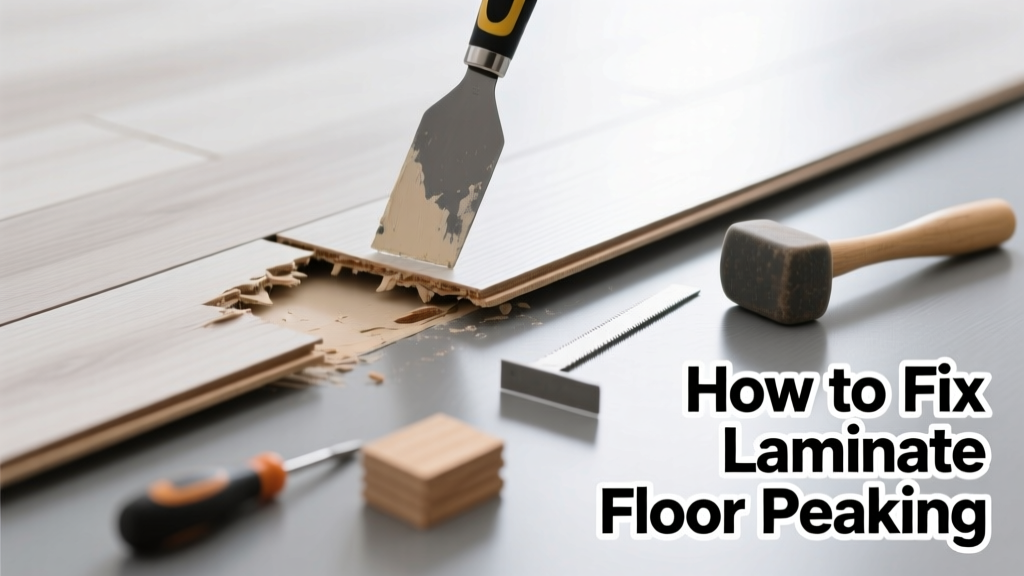
Laminate floor peaking—those unsightly ridges where planks lift at the seams—is more than an eyesore; it’s a red flag that something’s off beneath the surface. Left unaddressed, it worsens quickly, leading to buckling, cracking, or even tripping hazards. The good news? Most cases stem from simple, fixable causes like moisture or improper installation.
Quick Diagnosis
Before grabbing tools, identify the root cause. Peaking rarely happens randomly—it’s almost always tied to one or more of these issues:
- Insufficient expansion gap (less than 3/8" around perimeter walls)
- Moisture intrusion from leaks, high humidity, or damp subfloors
- Subfloor unevenness (more than 3/16" deviation over 10 feet)
- Heavy furniture or appliances compressing edges without proper support
- Improper locking during installation (planks forced instead of snapped)
Tools & Materials Needed
| Item | Purpose | Estimated Cost |
|---|---|---|
| 5-in-1 pry bar | Releases locked planks without damaging tongue/groove | $8–$15 |
| Moisture meter (pin-type) | Measures subfloor and plank moisture content (ideal: <12% for wood subfloors) | $45–$90 |
| Utility knife + fresh blades | Cuts excess underlayment or foam padding causing compression | $3–$7 |
| 3/8" spacers | Ensures correct expansion gap during reinstallation | $2–$5 |
| Shop vacuum + dry towel | Removes dust/debris before relaying; critical for clean locking | $0 (if owned) or $30–$120 |
Step-by-Step Fix
Start with the smallest affected area. If peaking spans more than two rows or crosses doorways, skip ahead to 'When to Call a Pro.' For localized cases, try these methods in order:
- Release & Re-seat the Affected Plank: Use the 5-in-1 bar to gently lift the peaked plank’s long edge. Tap it back down with a rubber mallet while holding the adjacent plank steady. Listen for the audible ‘click’ confirming full lock.
- Trim Excess Underlayment: If the peak occurs near a wall, pull back baseboard and check for compressed or overlapping foam. Trim with utility knife to restore 3/8" gap.
- Address Moisture First: Run your moisture meter on subfloor and planks. If readings exceed 12%, stop all repairs. Dry the area with dehumidifiers for 72+ hours and investigate leaks (check for water damage under flooring).
- Reinstall With Proper Gap: If planks are warped or damaged, remove and replace them using spacers. Never force locks—angle planks 15° and push down firmly.
When to Call a Pro
DIY fixes fail—or become unsafe—when:
- The peaking affects more than three consecutive rows across a room
- You detect musty odors or visible mold under baseboards or planks
- Subfloor moisture readings exceed 15% (U.S. EPA recommends immediate professional mitigation)
- Peaking recurs within 30 days after repair—indicating structural movement or foundation settling
- You’re working over radiant heat systems or concrete slabs with vapor barrier failures
According to the National Wood Flooring Association’s 2022 Installation Guidelines, 'peaking exceeding 1/8" height differential requires full section replacement—not spot repair—to maintain warranty compliance.'
Prevention Tips
Long-term success hinges on proactive habits—not just fixing what’s broken. Installers often overlook these details, but you can control them:
- Maintain indoor humidity between 35–55% year-round using a hygrometer and dehumidifier/humidifier as needed
- Always acclimate new laminate for 48–72 hours in the room where it’ll be installed
- Use only manufacturer-recommended underlayment—never double-layer foam pads
- Install transition strips at doorways longer than 30 feet to relieve stress buildup
- Place felt pads under all furniture legs and avoid rolling heavy appliances directly on laminate
Can I sand down a peaked laminate plank?
No—laminate flooring has a wear layer bonded to HDF core. Sanding destroys the protective overlay and exposes the image layer, causing irreversible dulling and moisture vulnerability. Replacement is the only safe option.
Will placing weights on the peak flatten it over time?
No. Weight may temporarily suppress the ridge but won’t correct the underlying issue—like compression or moisture swelling—and often damages the locking mechanism. It’s a false fix that accelerates failure.
Do I need to remove baseboards to fix peaking?
Yes—if the peak occurs within 12 inches of a wall. Baseboards conceal the expansion gap. Without removing them, you can’t verify or adjust spacing, and prying near the wall risks cracking the plank edge.
Can I glue down laminate to stop peaking?
Never. Laminate is designed to float. Gluing voids warranties, prevents natural expansion/contraction, and traps moisture—guaranteeing future warping or delamination. Floating installation is non-negotiable.
How long does a proper laminate repair last?
With correct diagnosis and execution—including moisture control and proper gaps—a repair lasts 10–15 years. But if subfloor moisture remains unchecked, recurrence is likely within 6–12 months (understanding laminate warranties helps track coverage limits).
Is peaking covered by my home warranty?
Rarely. Most home warranties exclude flooring wear-and-tear or installation defects. However, if peaking stems from a covered plumbing leak or HVAC condensation issue, file a claim with documentation—including moisture meter logs and photos (how to file a home warranty claim).
A little peaking doesn’t mean your whole floor is doomed—it means your laminate is telling you something important about moisture, spacing, or subfloor conditions. Fix it right the first time, not just fast, and you’ll walk on solid, silent floors for years. And if you notice adjacent planks starting to click or shift underfoot, don’t wait—act before the problem migrates to the next row.