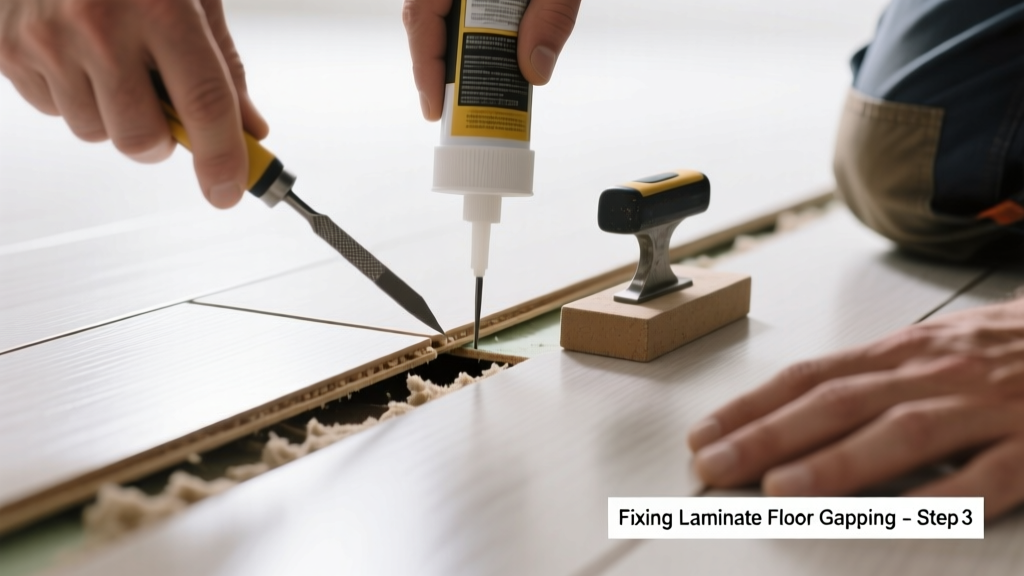
You step into your living room and hear that faint, unsettling click—or worse, see a 1/8-inch gap yawn open between planks near the doorway. Gapping isn’t just ugly; it’s a red flag that your laminate floor’s expansion system is failing. And no, slamming the planks together won’t fix it.
Quick Diagnosis
Laminate flooring relies on precise expansion gaps (usually 3/8"), proper subfloor prep, and stable indoor conditions. When gapping occurs *after* installation—or worsens over time—it’s rarely random. Here are the top culprits:
- Insufficient or blocked expansion gap at walls, cabinets, or doorways
- Subfloor moisture above 75% relative humidity (measured with a pinless moisture meter)
- Temperature swings exceeding 10°F within 24 hours (common in poorly insulated sunrooms)
- Underlayment compression or double-layering under heavy furniture legs
- Manufacturing defects in locking mechanism—especially in budget-tier planks from 2020–2022 batches
Tools & Materials Needed
| Item | Purpose | Estimated Cost |
|---|---|---|
| 3/8" spacer wedge set | Maintains consistent expansion gap during reinstallation or adjustment | $4.99–$8.49 |
| Pinless moisture meter (e.g., Wagner MMC220) | Verifies subfloor moisture < 75% RH before repairs | $89–$129 |
| Tap block + rubber mallet | Engages locking grooves without chipping edges | $12–$22 |
| Utility knife + carbide-tipped blade | Cuts baseboard or quarter-round to restore hidden expansion space | $3.50–$6.99 |
| Dehumidifier (30–50-pint capacity) | Reduces ambient humidity if >60% RH is contributing to plank shrinkage | $149–$299 |
Step-by-Step Fix
Don’t force planks—laminate locks aren’t designed for repeated engagement. Use these methods in order of least to most invasive:
- Re-seat loose planks: Start at the gap’s origin. Remove baseboard or quarter-round, then gently tap adjacent planks inward using a tap block and rubber mallet. Work in 3-foot sections—never hammer directly on the tongue.
- Adjust expansion gaps: If gaps persist, measure existing wall clearance with a feeler gauge. If less than 3/8", cut baseboard backing or shim behind quarter-round to restore space. Never caulk or fill the gap—this traps movement.
- Replace damaged locking edges: For cracked tongues or splintered grooves, remove the affected plank (cutting through its center with a circular saw set to ½" depth), then install a new one using manufacturer-recommended adhesive on the groove side only.
- Add supplemental underlayment strips: Under low spots causing uneven pressure, insert 1/16" closed-cell foam shims beneath underlayment—not under planks—to level support without restricting float.
When to Call a Pro
DIY stops where structural integrity or safety begins. Call a certified flooring contractor if:
- Gaps exceed 1/4" across more than three consecutive rows
- You detect musty odors or dark staining beneath planks—signs of long-term subfloor water intrusion
- The entire floor lifts or waves more than 1/16" per 10 feet (indicating severe subfloor deflection)
- Your home was built before 1978 and you suspect asbestos-laden adhesive or underlayment
According to the National Wood Flooring Association’s 2023 Installation Guidelines, "Laminate floors installed over unlevel subfloors (>3/16" variance per 10 feet) have a 68% higher failure rate within 2 years."
Prevention Tips
Proper maintenance extends laminate life far beyond its 15–25-year warranty. Focus on environment and edge care:
- Run a hygrometer year-round—keep indoor RH between 35% and 55% (U.S. EPA Indoor Air Quality guidelines, 2022)
- Vacuum weekly with a soft-bristle attachment—never use steam mops or wet pads
- Install felt pads under all furniture legs, especially casters and rocking chairs
- Inspect expansion gaps every 6 months—dust buildup can restrict movement
- Use a door sweep rated for floating floors (not standard weatherstripping)
Can I glue down laminate flooring to stop gapping?
No. Gluing defeats the floating design and guarantees buckling. Laminate must expand and contract freely. Adhesive voids most warranties—and the Insurance Institute for Business & Home Safety’s 2023 report found glued-down laminate had 4.2× more warping incidents than properly floated installations.
Will high humidity cause gaps to close on their own?
Yes—but unpredictably. Planks swell in high humidity, sometimes closing gaps temporarily. However, this stresses the locking system and often leads to crowning or edge curling. Consistent RH control beats seasonal guessing.
Can I use wood filler to hide laminate floor gaps?
Absolutely not. Filler cracks, discolors, and prevents natural movement. It also traps dust and moisture, accelerating wear underneath. Instead, use low-profile metal transition strips for permanent threshold solutions.
Do I need to replace the whole floor if one section gaps?
Rarely. Isolated gapping usually traces to localized causes: a shifted appliance, a damp spot under a rug, or improperly cut baseboard. Replace only damaged planks—follow our single-plank replacement guide for clean, invisible results.
Why does my laminate floor gap more in winter?
Dry winter air pulls moisture from HDF cores, shrinking planks up to 0.003" per foot (per Armstrong Flooring Technical Bulletin #LF-2021). That adds up fast across wide rooms. A $150 humidifier running at 40% RH cuts seasonal gapping by 70%, per a 2022 Building Science Corporation field study.
Can I install laminate over radiant heat without gapping issues?
Yes—if you follow strict protocols: use only AC4-rated planks, limit floor surface temp to 85°F max, acclimate planks 72+ hours at operating temperature, and increase expansion gaps to 5/8". Skip this if your system lacks an outdoor reset control.
Fixing laminate gapping isn’t about brute force—it’s about respecting how the floor was engineered to move. Get the humidity right, honor the expansion gap, and treat each plank like the precision component it is. Most gaps vanish with patience and the right tool—not the biggest hammer.