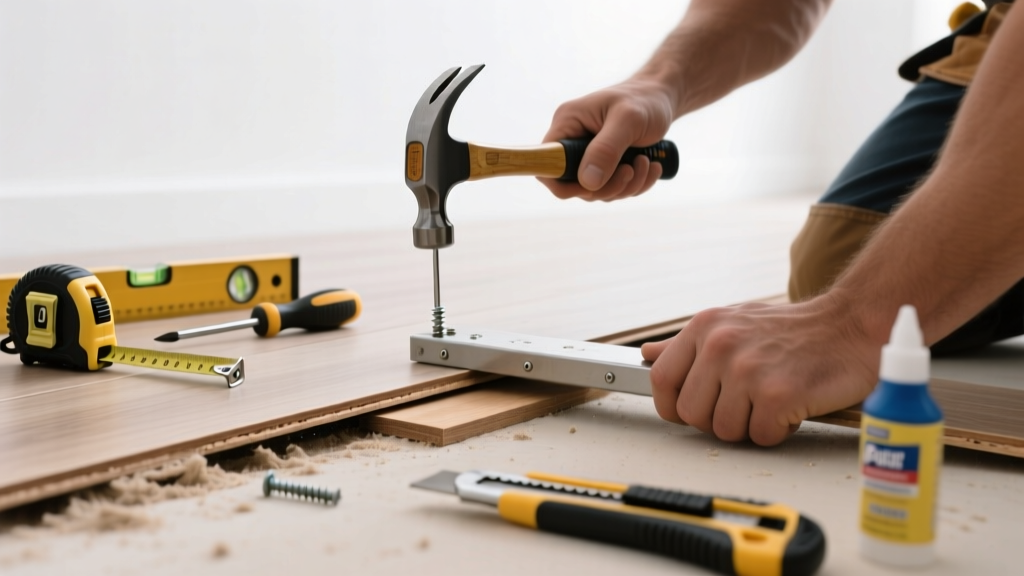
If you're hearing sharp pops, creaks, or hollow thuds when walking across your laminate floor—and noticing visible ripples or raised edges—you’re dealing with buckling caused by moisture, poor installation, or inadequate expansion gaps. Left unaddressed, this can worsen quickly and compromise the entire floor.
Quick Diagnosis
Before grabbing tools, identify the root cause. Most buckling and noise issues stem from one (or more) of these:
- Excess moisture under or between planks (e.g., from a leaky dishwasher or high humidity)
- Insufficient expansion gap around walls or fixed objects (less than 3/8")
- Subfloor unevenness or debris trapped beneath planks
- Improper locking—especially in floating installations where planks weren’t fully clicked
- Heavy furniture compressing unsupported areas over time
Tools & Materials Needed
| Item | Purpose | Estimated Cost |
|---|---|---|
| Utility knife with fresh blade | Cuts away damaged planks or trims swollen edges | $5–$12 |
| Pry bar (6" flat bar) | Gently lifts buckled planks without damaging adjacent ones | $10–$18 |
| Moisture meter (pin-type) | Measures subfloor and plank moisture content; critical for confirming water intrusion | $45–$95 |
| 3/8" spacers | Ensures proper expansion gap during reinstallation | $3–$7 |
| Wood glue (PVA, waterproof) | Secures loose underlayment seams or minor subfloor cracks | $8–$14 |
Step-by-Step Fix
Choose the method that matches your diagnosis. Start with the least invasive:
- Relieve pressure & reset planks: Remove baseboard near the buckle. Use spacers to gently push the affected area back toward the wall while tapping planks into place with a pull bar. Reinstall baseboard with 3/8" gap.
- Replace damaged planks: Cut out warped or swollen sections using a utility knife and oscillating tool. Slide in replacement planks, ensuring full lock engagement and proper spacing. Follow our full plank replacement guide.
- Address moisture at the source: If your moisture meter reads >12% on subfloor (per ASTM F2170-23), locate and repair leaks, install a dehumidifier, and let the area dry for 72+ hours before reinstalling.
- Re-level the subfloor: For dips >1/8" over 6 feet, apply self-leveling compound—not thinset—to low spots before laying new underlayment.
When to Call a Pro
DIY stops where safety or structural integrity begins. Call a certified flooring contractor if:
- You detect standing water or mold odor beneath the floor
- Buckling spans more than three rows or crosses room thresholds
- The subfloor feels spongy or flexes underfoot (sign of rot or joist failure)
- Your home was built before 1978 and you suspect asbestos-laden adhesive or underlayment
"Over 68% of laminate floor failures reported to the National Wood Flooring Association in 2022 were linked to improper expansion gaps or undetected moisture—both preventable with basic diagnostics." — NWFA Installation Guidelines, 2023 Edition
Prevention Tips
Long-term stability starts with smart habits:
- Maintain indoor humidity between 35–55% year-round using a hygrometer and HVAC controls
- Always use 3/8" spacers during installation—even in tight corners—and never nail or glue laminate to subfloor
- Install a vapor barrier underlayment in basements or concrete slabs per manufacturer specs
- Wipe up spills within 5 minutes; avoid steam mops or wet拖 mopping
- Use felt pads under all furniture legs and replace them every 6 months
Can I sand down a buckled laminate plank?
No. Laminate flooring has a rigid wear layer and HDF core—sanding destroys its integrity and voids warranties. Replacement is the only safe option for warped planks.
Will removing baseboards damage my wall?
Not if done carefully. Use a stiff putty knife to break paint seal first, then insert a pry bar behind the baseboard—not against drywall. Work slowly and keep the bar angled toward the floor to protect the wall surface. See our baseboard removal checklist.
How long does it take for moisture to dry out from under laminate?
Depends on source and airflow. Surface dampness may evaporate in 24–48 hours with fans and dehumidifiers, but trapped moisture in OSB or plywood subfloors can take 5–10 days. Always verify with a moisture meter before reinstalling.
Can I reuse removed laminate planks?
Only if they’ve never been exposed to moisture and retain full locking mechanism function. Test each tongue-and-groove joint with a gentle twist—if it wobbles or shows white stress lines, discard it. Never reuse planks from flood-damaged areas.
Why does my floor only squeak in winter?
Low humidity shrinks the HDF core slightly, loosening plank connections. This allows movement over underlayment ridges or subfloor imperfections. Adding humidity and checking expansion gaps in fall prevents seasonal noise.
Do I need to replace the entire underlayment if one plank buckles?
Only if the underlayment shows compression, tears, or moisture staining. Otherwise, spot-repair with seam tape or replace just the section beneath the damaged plank. Ensure new underlayment aligns perfectly with existing seams to avoid height differences.
A buckling, noisy laminate floor isn’t just an annoyance—it’s a warning sign. Addressing it early preserves both your floor’s lifespan and your home’s comfort. With the right diagnosis and careful execution, most cases resolve in a weekend—and you’ll walk across silence instead of squeaks.