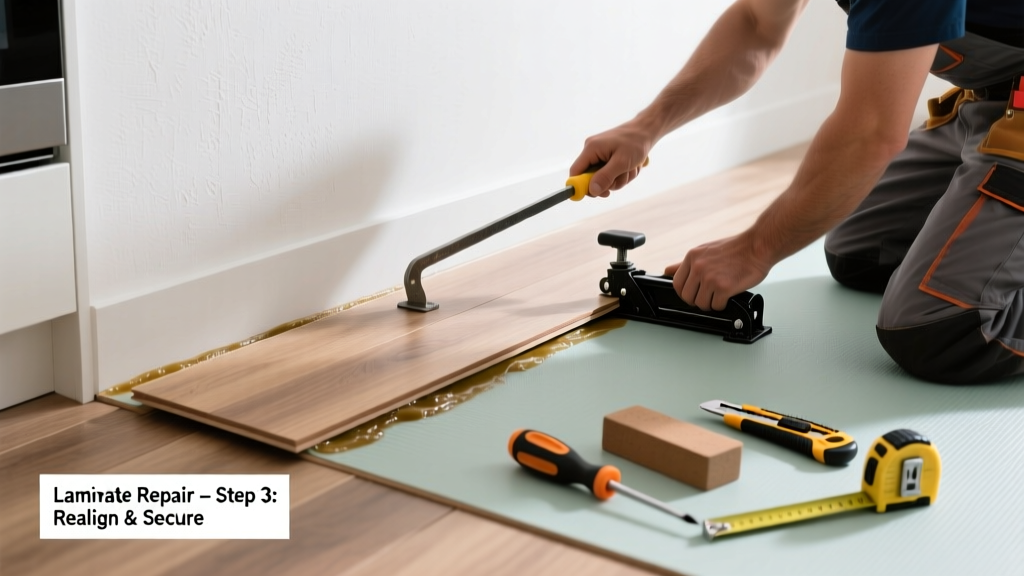
Kitchen laminate floors buckle for a reason—and it’s rarely just ‘old age.’ Sudden warping, tenting, or lifting planks usually point to moisture intrusion, inadequate expansion gaps, or subfloor movement beneath high-traffic, high-moisture conditions. Ignoring it risks irreversible damage to both flooring and subfloor.
Quick Diagnosis
Before grabbing tools, identify the root cause. Most kitchen buckling stems from one (or more) of these:
- Water spillage under cabinets or near the sink/dishwasher that soaked the underlayment or particleboard core
- Expansion gap less than 3/8" at walls—especially problematic where cabinets or appliances abut the floor
- Subfloor unevenness (>3/16" over 10 feet) causing stress points during seasonal humidity shifts
- Direct sunlight exposure through windows heating and expanding planks unevenly
- Improper acclimation: planks installed before reaching room temperature/humidity equilibrium (72°F, 40–60% RH for 48+ hours)
Tools & Materials Needed
| Item | Purpose | Estimated Cost |
|---|---|---|
| Utility knife with fresh blades | Cutting swollen planks or trimming underlayment | $5–$12 |
| Fein Multimaster or oscillating tool | Removing damaged planks without damaging adjacent ones | $89–$149 |
| Moisture meter (pin-type) | Measuring subfloor and plank moisture content—critical before repair | $65–$120 |
| 3/8" spacers | Ensuring proper expansion gap during reinstallation | $4–$8 |
| Underlayment with vapor barrier | Replacing compromised foam pad; blocks moisture from concrete slab | $22–$38 per 100 sq ft |
Step-by-Step Fix
Choose the method based on severity and location. Start with the least invasive:
- Surface-dry & monitor: If buckling is mild (<1/8" lift) and recent, shut off water sources, run a dehumidifier (40–50% RH) and fans for 72 hours. Check moisture readings daily—subfloor must be <12% MC before proceeding.
- Trim & reseat edge planks: For minor buckling along walls, remove baseboards, cut 1/4" off the tongue side of affected planks using a utility knife, reinstall with spacers, and replace trim.
- Replace damaged planks: Use an oscillating tool to cut out warped sections. Remove underlayment beneath, verify subfloor dryness (<12% MC), lay new underlayment with taped seams, and click in replacement planks—always stagger joints by ≥12".
- Add expansion relief cuts: In large open areas (>30 ft), make a 1/8" deep, 6"-long kerf cut across the grain every 12 ft using a router—this relieves lateral pressure without visible gaps.
When to Call a Pro
DIY stops where structural integrity or health hazards begin. Call a certified flooring contractor if:
- You measure >15% moisture in the subfloor (concrete slab or plywood)—this indicates chronic leakage or poor drainage
- Buckling spans >3 consecutive rows or extends under fixed cabinetry you can’t safely access
- You find mold growth (black, fuzzy, or musty-smelling) under planks or on subfloor—U.S. EPA warns against disturbing mold without containment
- The entire kitchen floor lifts when walked on, suggesting severe subfloor deflection or joist sagging
Prevention Tips
Kitchens demand extra vigilance. These habits prevent repeat buckling:
- Install a moisture barrier underlayment—even over wood subfloors—to slow vapor transmission
- Leave full 3/8" expansion gaps at all walls, cabinets, and appliances (not just perimeter walls)
- Wipe up spills within 2 minutes—laminate’s core swells irreversibly after ~5 minutes of saturation
- Use a hygrometer year-round; maintain indoor RH between 40–60% to minimize seasonal expansion/contraction
- Avoid steam mops: The U.S. EPA estimates that 14% of household water usage is from leaks—but hidden moisture from improper cleaning contributes significantly to floor failures
"Over 68% of laminate floor warranty claims related to buckling cite inadequate expansion gaps or moisture exposure—most occurring in kitchens and bathrooms." — National Wood Flooring Association (NWFA) Warranty Claims Report, 2022
Can I glue down buckled laminate planks?
No. Laminate is designed as a floating floor. Gluing restricts natural expansion and will worsen buckling or cause cracking. Always maintain the floating installation unless manufacturer instructions explicitly allow adhesive (rare for residential kitchen use).
Will buckling go away if I wait?
Only if moisture is removed quickly and the core hasn’t swollen beyond recovery. Once the high-density fiberboard (HDF) core absorbs water, it expands permanently—typically by 10–15% thickness. Waiting past 48 hours almost always requires plank replacement.
Can I install laminate directly over vinyl in the kitchen?
Only if the existing vinyl is fully adhered, level (<3/16" variance), and moisture-tested below 75% RH. Never install over cushioned or embossed vinyl—it creates uneven support and accelerates wear. See our guide on laminate over vinyl floor for prep steps.
Do I need to replace the underlayment every time I replace a plank?
Yes—if the original underlayment shows compression, discoloration, or moisture staining. Even if it looks intact, its vapor barrier may be compromised. Always replace underlayment in the repair zone and overlap seams by 2" with waterproof tape.
How long does repaired laminate last in a kitchen?
With proper moisture control and maintenance, repairs last 10–15 years—the same as the original floor. But if buckling recurs within 12 months, investigate hidden leaks (e.g., dishwasher supply line, sink trap, or slab leak). Read our kitchen floor leak detection checklist.
Can I sand and refinish buckled laminate?
No. Laminate has a photographic wear layer bonded to HDF—it cannot be sanded, stained, or refinished. Attempting to do so destroys the protective aluminum oxide coating and exposes the core to rapid deterioration.
Fixing kitchen laminate buckling isn’t about brute force—it’s about precision moisture control, disciplined expansion management, and knowing when the problem has outgrown your toolkit. A single ignored puddle under the fridge can cascade into $2,000 in subfloor remediation. Tackle it early, measure twice, and always verify dryness before clicking that first plank back in place.