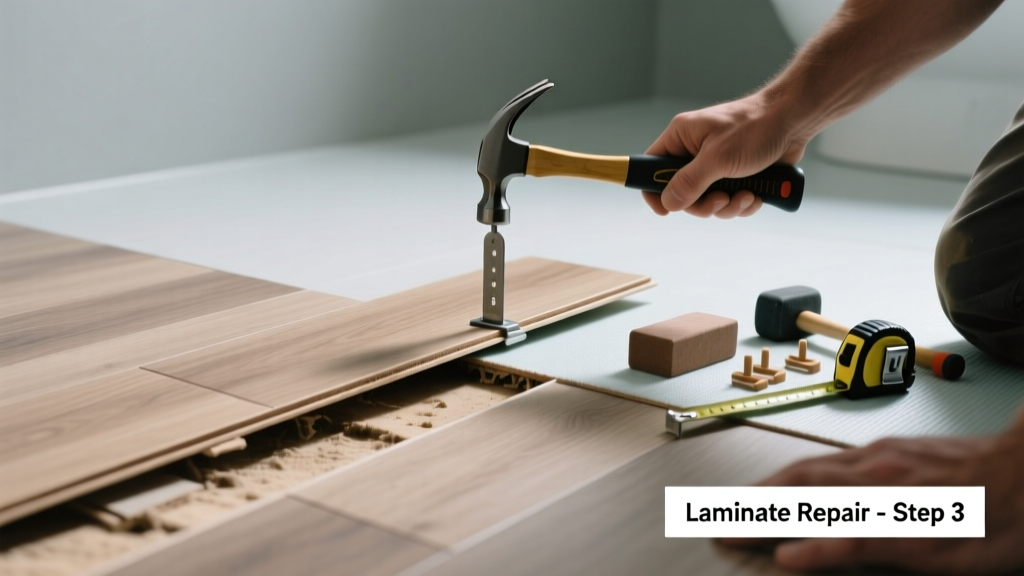
Laminate floor buckling in the bathroom isn’t just unsightly—it’s a red flag screaming about moisture intrusion or installation failure. Unlike living rooms or bedrooms, bathrooms expose laminate to steam, splashes, and hidden humidity that can swell core layers within days. Ignoring it risks irreversible damage or mold growth beneath the planks.
Quick Diagnosis
Buckling rarely happens without cause. Pinpointing the source before pulling up planks saves time and money:
- Moisture under the subfloor (most common—check for leaks under vanity or behind toilet)
- Missing or compressed expansion gap along walls (less than 3/8" gap is a frequent culprit)
- Water trapped between planks from spills not wiped within 10 minutes
- Subfloor not level or not fully dry before install (moisture readings above 12% RH are unsafe)
- Use of non-bathroom-rated laminate (look for AC4 or AC5 rating and explicit 'bathroom-safe' labeling)
Tools & Materials Needed
| Item | Purpose | Estimated Cost |
|---|---|---|
| Moisture meter (pin-type) | Measures subfloor and plank moisture content; critical before any repair | $85–$140 |
| Utility knife with fresh blades | Cuts swollen planks cleanly; prevents chipping during removal | $8–$15 |
| Spacers (3/8" plastic) | Ensures proper expansion gap during reinstallation | $4–$9 |
| Bathroom-rated underlayment (e.g., cork + vapor barrier) | Blocks rising moisture and cushions footfall without off-gassing | $28–$42 per 100 sq ft |
| Acclimated replacement planks (same batch) | Prevents color mismatch and warping due to humidity differential | $2.25–$4.75 per sq ft |
Step-by-Step Fix
Don’t rip out the whole floor—target only damaged zones. Start here:
- Shut off water sources and confirm no active leaks using a shut-off test on sink, shower, and toilet supply lines.
- Measure moisture: Test subfloor (aim for ≤12% RH), planks (≤10%), and concrete slab if applicable (≤75% RH per ASTM F2170).
- Remove buckled planks: Pry up starting at the nearest wall, working toward the buckle—never force center planks. Cut swollen ends with utility knife first.
- Dry thoroughly: Run a dehumidifier (≥50-pint capacity) and fan for 72+ hours. Use silica gel packs in tight corners.
- Reinstall with 3/8" spacers, bathroom-rated underlayment, and acclimated planks—tap gently with pull bar, never hammer directly on edges.
When to Call a Pro
DIY stops where structural integrity or health hazards begin:
- Subfloor moisture exceeds 15% RH after 72 hours of drying
- Buckling covers >12 sq ft or crosses multiple joist bays
- You find black mold (>1 sq ft) under planks or on subfloor (per EPA guidelines, remediation requires containment)
- Visible sagging, squeaking, or flex in the subfloor when stepped on
- No access to plumbing shutoffs or you suspect a slab leak (requires thermal imaging or acoustic leak detection)
Prevention Tips
Long-term stability hinges on moisture discipline—not just materials:
- Install an exhaust fan rated for ≥50 CFM and run it for 20 minutes post-shower (per ASHRAE 62.2-2022)
- Wipe standing water from floors within 10 minutes—especially near tubs and showers
- Seal baseboard gaps with silicone caulk rated for wet areas (e.g., GE Silicone II Kitchen & Bath)
- Check under-sink supply lines quarterly for slow seepage—use a moisture-detecting smart sensor like Moen Flo
- Avoid rubber-backed bath mats; they trap vapor against laminate—opt for breathable cotton or microfiber instead
Can I flatten buckled laminate with weights?
No. Applying pressure won’t reverse core swelling. Once the HDF layer absorbs water, its fiber structure collapses permanently. Attempting to flatten may crack locking mechanisms or delaminate the wear layer. Replacement is the only reliable fix.
Is it safe to use a steam mop on bathroom laminate?
Never. Steam mops force superheated vapor into seams and expansion gaps, accelerating swelling. The National Wood Flooring Association (NWFA, 2023) explicitly prohibits steam cleaning on all laminate products—even 'water-resistant' ones.
Do I need to replace the entire floor if only one area buckles?
Not usually. Isolated buckling often stems from localized leaks or poor gap management. Replace only affected planks—but verify subfloor moisture first. If adjacent planks show edge curling or softness, expand repair zone by 2–3 rows.
Can I install laminate over existing tile in the bathroom?
Yes—if tile is flat (<1/8" variance over 10 ft), fully bonded, and sealed with a moisture-blocking underlayment (e.g., Roberts 100L). But avoid if grout lines exceed 1/4" wide—they’ll telegraph through planks and stress joints.
How long does laminate need to acclimate before bathroom install?
Minimum 72 hours in the bathroom itself—unboxed, laid flat, with HVAC running. Per the North American Laminate Flooring Association (NALFA, 2022), acclimation at site reduces post-install movement by 63% versus off-site storage.
What’s the best underlayment for laminate in humid bathrooms?
Look for dual-layer products: closed-cell foam (for cushioning) laminated to a 6-mil polyethylene vapor barrier. Avoid paper-based or recycled felt underlayments—they wick moisture upward. Brands like FloorMuffler UltraSeal or Kronoswiss AquaGuard meet ANSI A137.1 moisture standards.
"Over 80% of laminate failures in wet areas trace back to skipped moisture testing—not product quality." — Mike Rafferty, Certified Flooring Inspector International (CFII), 2023
Once repaired, monitor humidity with a $25 hygrometer—keep levels between 35–55% year-round. Recheck expansion gaps every 6 months with a feeler gauge, and replace worn spacers before seasonal shifts. For ongoing care, see our guide on how to clean laminate floors and laminate floor underlayment guide. If buckling returns within 90 days, revisit your exhaust fan’s duct path—you may have a disconnected or insulated-over vent line.