Laminate floor buckling—those unsightly ripples, humps, or gaps near walls or seams—usually signals moisture intrusion or improper installation. It’s not just cosmetic: unchecked buckling can worsen quickly, warping planks beyond repair or creating tripping hazards. The good news? Most cases are fixable in a weekend if caught early.
Quick Diagnosis
Before grabbing tools, identify the root cause. Buckling rarely happens without warning—and it’s rarely just one thing.
- Moisture exposure (leaky pipe, high humidity, wet mopping)
- Inadequate expansion gap (less than 3/8" around perimeter)
- Subfloor unevenness or debris under planks
- Direct sunlight heating one area more than others
- Improper acclimation before installation (less than 48 hours in room)
Tools & Materials Needed
| Item | Purpose | Estimated Cost |
|---|---|---|
| Utility knife with fresh blades | Cuts swollen planks cleanly; avoids splintering | $5–$12 |
| Pry bar (6" flat bar) | Gently lifts edge planks without damaging adjacent rows | $10–$18 |
| Moisture meter (pin-type) | Measures subfloor and plank moisture—critical for confirming water damage | $45–$95 |
| Replacement planks (same lot #) | Matching color, texture, and thickness; avoid mixing batches | $2.50–$4.50/ft² |
| Wood shims (1/8"–1/4") | Re-establish proper expansion gap after reinstallation | $3–$7 |
Step-by-Step Fix
Choose the method that matches your buckling severity and location. Start with the least invasive option first.
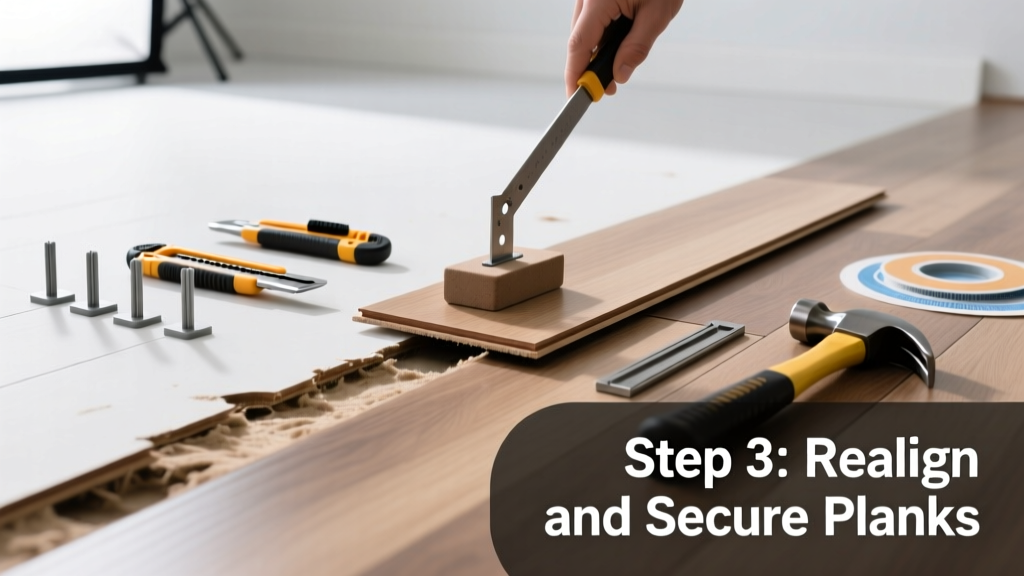
- Release & Re-seat (minor buckling): Remove baseboard near affected area. Gently pry up the last 2–3 rows using a pry bar. Check for debris or moisture. Clean subfloor, re-lay planks with correct expansion gap, and reinstall baseboard.
- Trim & Reset (swollen edges): Use a utility knife to carefully shave 1/16"–1/8" off the swollen tongue or groove edge. Test fit before locking. This works only when swelling is minimal and localized.
- Full Replacement (severe or water-damaged planks): Disassemble back to the damaged plank. Replace it with an exact-match piece. Ensure subfloor moisture is below 12% (per ASTM F2170) before reassembly.
When to Call a Pro
DIY isn’t safe or effective in every scenario. Don’t risk further damage—or void your warranty—by pushing too far.
- Buckling covers more than 10 sq ft or spans multiple rooms
- Moisture meter reads above 15% on subfloor (indicating hidden leak or structural dampness)
- You find black mold, musty odor, or soft subfloor under planks
- The buckling returns within 72 hours of repair (points to unresolved moisture source)
"Over 68% of laminate floor failures traced to moisture issues stem from undetected plumbing leaks—not surface spills." — National Wood Flooring Association (NWFA) Installation Guidelines, 2022
Prevention Tips
Fixing buckling once is smart. Preventing it twice is smarter—and cheaper long-term.
- Maintain indoor humidity between 35–55% year-round using a hygrometer and dehumidifier/humidifier as needed
- Always leave a 3/8" expansion gap at all walls, cabinets, and doorways—even behind baseboards
- Never use steam mops or excessive water during cleaning; opt for pH-neutral laminate cleaners
- Install a vapor barrier over concrete slabs, especially in basements or garages
- Acclimate new planks for 72 hours (not just 48) in the room where they’ll be installed
Can I glue down buckled laminate planks?
No. Laminate flooring is designed as a floating system. Gluing restricts natural expansion and contraction, accelerating future buckling—and voiding most manufacturer warranties. If adhesion is needed, you’re likely dealing with a different product type (e.g., engineered wood), not true laminate.
Will buckling go away if I wait and let it dry out?
Rarely. Once the high-density fiberboard (HDF) core swells, it won’t fully shrink back to original dimensions. Even if surface ripples lessen, internal delamination remains—and weakens structural integrity. Address the cause and replace compromised planks.
Can I sand or refinish buckled laminate?
No. Laminate has no real wood layer to sand. Its wear layer is melamine resin—sanding destroys it instantly, exposing the HDF core and making the plank unusable. Replacement is the only reliable fix.
Do I need to remove all furniture before fixing buckling?
Only furniture directly over affected planks or in the path of disassembly. Move items strategically—use felt pads and cardboard under legs to prevent scratches. For large areas, consider renting a furniture dolly; it saves your back and floors. See our guide on moving furniture without damaging floors.
Is buckling covered by my home warranty?
Usually not. Most home warranties exclude cosmetic or installation-related issues. Manufacturer warranties cover material defects but often exclude moisture damage, improper installation, or lack of maintenance. Review your specific policy—and keep your receipt, acclimation log, and installation photos as proof of due diligence.
Can I install laminate over existing buckled flooring?
Absolutely not. Installing over buckled laminate traps moisture, creates uneven surfaces, and transfers movement stress to the new layer. You must fully remove and inspect the subfloor first. If the old floor is salvageable, it’s still safer—and more durable—to start fresh.
Fixing laminate floor buckling isn’t about brute force—it’s about precision, patience, and respecting how this engineered product behaves. A properly repaired floor should last 15–25 years, but only if the underlying cause stays solved. Monitor humidity weekly, check baseboard gaps seasonally, and treat every puddle like the red flag it is. Your floor will thank you—and so will your next home inspector.