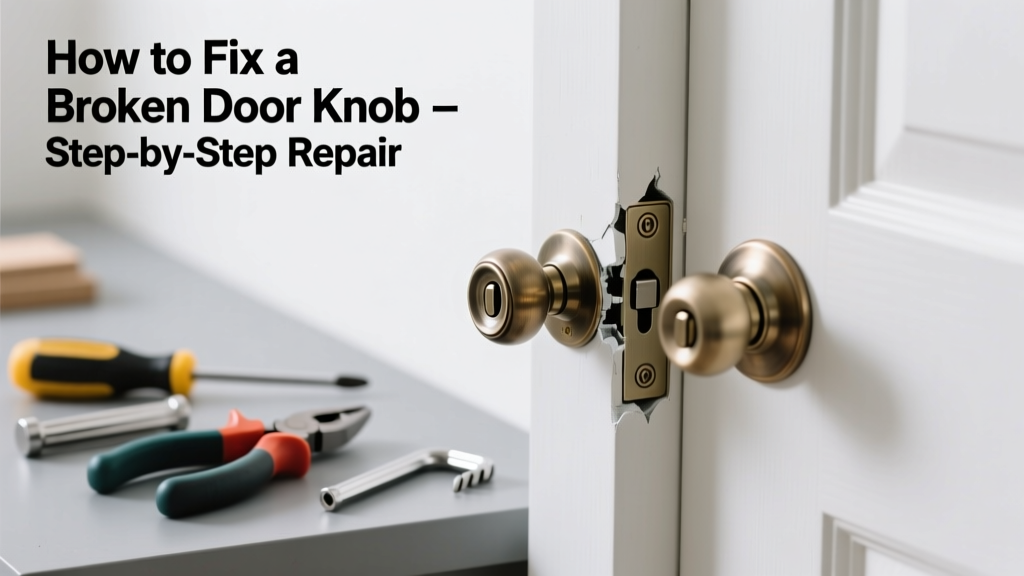
A broken door knob is one of those small failures that throws off your whole day—jammed doors, lost keys, or worse, being locked out of a bedroom or bathroom. It’s rarely catastrophic, but it’s urgent enough to demand attention before the mechanism worsens or the latch seizes completely. Most broken knobs are fixable in under 30 minutes with basic tools and a little patience.
Quick Diagnosis
Before grabbing tools, identify what’s actually broken. A 'knob broken' usually means one of these:
- The knob spins freely without engaging the latch (internal spindle stripped or broken)
- The knob won’t stay attached to the door (set screw missing or stripped)
- The rose plate or mounting plate is cracked or bent
- The latch bolt refuses to retract (jamming inside the strike plate or deadlocking)
- The interior and exterior knobs don’t operate in sync (crossbar or tailpiece disengaged)
Tools & Materials Needed
| Item | Purpose | Estimated Cost |
|---|---|---|
| Phillips #1 and #2 screwdrivers | Remove faceplate screws, mounting hardware, and internal mechanisms | $8–$15 |
| Hex key set (1.5mm–3mm) | Tighten or replace stripped set screws on most modern knobs | $5–$12 |
| Needle-nose pliers | Extract broken spindle fragments or reposition misaligned parts | $6–$10 |
| Replacement knob kit (e.g., Kwikset or Schlage) | Swap entire assembly if internal components are damaged beyond repair | $25–$45 |
| Lightweight machine oil (e.g., Tri-Flow) | Lubricate latch mechanism and spindle to prevent future binding | $7–$9 |
Step-by-Step Fix
- Remove the knob: Locate the small release pin or slot on the interior rose plate. Insert a paperclip or narrow flathead into the hole while pulling the knob outward. If no pin exists, unscrew the two mounting screws hidden beneath the rose plate (often behind decorative caps).
- Inspect the spindle and latch: Check for bending, corrosion, or snapped plastic crossbars. A bent spindle can be straightened gently with pliers; a snapped one requires replacement. Verify the latch moves smoothly when manually depressed with a finger.
- Reassemble with proper alignment: Slide the new or repaired spindle through both knobs, ensuring square ends fully seat in the latch’s drive socket. Tighten set screws firmly—but not overtightened—to avoid stripping threads.
- Test operation: Turn both knobs through full motion. The latch should extend and retract cleanly. If it sticks, apply two drops of machine oil to the latch mechanism and cycle 10 times.
When to Call a Pro
Some knob failures signal deeper issues you shouldn’t tackle alone:
- The door is part of a fire-rated assembly (e.g., bedroom or garage entry)—replacing hardware incorrectly voids UL certification
- You discover evidence of forced entry or tampering, especially on exterior doors—security integrity may be compromised
- The latch bolt won’t retract even after disassembly, suggesting internal spring failure or a warped strike plate requiring mortise adjustment
- The door frame is warped or the jamb has shifted, causing binding that no knob repair can resolve
According to the National Association of Home Builders’ Residential Construction Performance Guidelines (2022), over 62% of door-related service calls stem from improper initial installation—not component failure—so professional assessment often reveals root causes invisible to the untrained eye.
Prevention Tips
Extend knob life with simple habits:
- Tighten set screws every 6 months—vibration loosens them gradually
- Avoid slamming doors; impact stress cracks rose plates and fatigues spindles
- Wipe down metal knobs monthly with a dry microfiber cloth to prevent moisture buildup near set-screw threads
- Replace all interior knobs with the same brand/model family—mixing brands risks incompatible spindle lengths and torque tolerances
Can I use super glue to fix a cracked plastic knob?
No. Superglue creates brittle bonds that fail under rotational stress and temperature shifts. Plastic knobs rely on structural flex; adhesive repairs crack within days. Replace the knob instead—it’s safer and more reliable. See our guide on how to replace an interior door knob for compatible options.
Why does my knob spin but not retract the latch?
This almost always means the spindle is disconnected, stripped, or sheared. Remove the knob and inspect whether the square end of the spindle is intact and seated fully in the latch’s drive socket. If the socket itself is worn smooth, the latch assembly must be replaced—not just the knob.
Do I need to replace both knobs if only one is broken?
Yes—if they’re part of a keyed or privacy set. Mismatched knobs risk misalignment, uneven torque, and premature wear. Even if only one side spins freely, the internal crossbar or spindle likely failed across both sides. Always replace as a pair unless it’s a single-sided passage knob.
Is it safe to file down a stuck latch bolt?
Not recommended. Filing alters the precise geometry needed for secure engagement with the strike plate. A filed latch may not fully extend or could jam during fire egress. Instead, check for paint buildup in the strike plate mortise or lubricate with graphite powder—never oil-based lubricants near fire-rated doors.
How do I know if my knob is ANSI Grade 1, 2, or 3?
Look for an embossed stamp on the edge of the rose plate or latch faceplate. Grade 1 (commercial-grade) will say "ANSI/BHMA A156.2 Grade 1"; Grade 2 (residential heavy-duty) shows "Grade 2"; Grade 3 (standard residential) may omit the grade or list only "ANSI A156.2." Grade 1 knobs withstand 800,000 cycles—over 20 years of daily use—per BHMA standards (2021).
What’s the difference between a passage and privacy knob?
A passage knob has no locking mechanism—it’s for closets or hallways where security isn’t needed. A privacy knob includes a push-button or turn-lock on the interior side, designed for bathrooms and bedrooms. Using a passage knob where privacy is required violates most local building codes—and defeats the purpose of having a functional lock.
Fixing a broken knob isn’t about brute force—it’s about understanding how the parts interact and respecting the engineered tolerances built into even the simplest hardware. When done right, the repair restores not just function but quiet confidence every time you turn the handle. And if you’ve ever wrestled with a knob that spins like a carnival wheel while the door stays stubbornly shut, you’ll appreciate how much smoother things run once the spindle seats properly and the latch glides home.