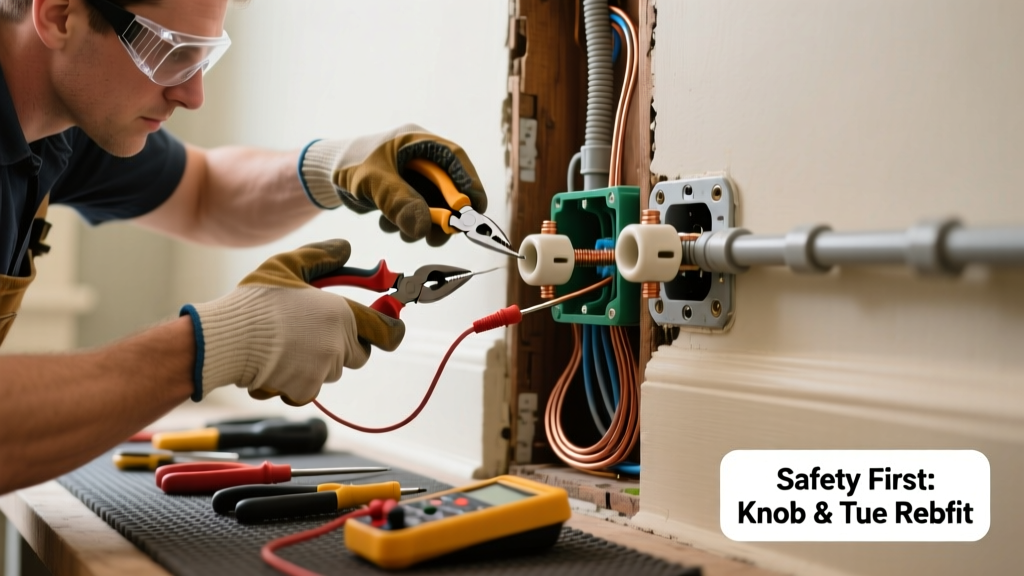
If you’ve discovered live knob-and-tube (K&T) wiring still energized in your older home—especially after renovation or during a remodel—you’re facing a serious electrical hazard. This outdated system, installed from the 1880s to the 1940s, lacks grounding, uses cloth insulation that degrades with age, and often violates modern code. Ignoring it risks fire, shock, or insurance denial.
Quick Diagnosis
Before touching anything, verify whether K&T wiring is actually *active*—not just present. Many homes retain abandoned K&T behind walls, but some circuits remain live due to improper updates or DIY mistakes.
- Non-contact voltage tester beeps near ceramic knobs or porcelain tubes
- Circuit breaker doesn’t shut off expected outlets or lights
- Two-wire ungrounded cables feeding modern junction boxes or outlets
- Insulation crumbling, brittle, or discolored (especially near splices or junctions)
- Overlaid Romex sharing wall cavities with K&T—creating heat-trapping conditions
Tools & Materials Needed
| Item | Purpose | Estimated Cost |
|---|---|---|
| Non-contact voltage tester | Verifies presence of voltage without contact; essential for initial safety check | $12–$25 |
| Insulated lineman’s pliers | For safe handling of conductors; rated for 1000V minimum | $22–$38 |
| UL-listed wire nuts (red or blue) | Securely cap modern conductors when isolating K&T at panel | $3–$8 per pack |
| Electrical tape (3M Super 33+) | Provides secondary insulation over wire nuts on legacy splices | $7–$11 |
| Lockout/tagout kit | Physically prevents accidental re-energizing during work | $18–$32 |
Step-by-Step Fix
Never assume K&T is dead. Always treat it as live until proven otherwise—with verified lockout at the main panel.
- Shut off and lock out the main service: Confirm no power downstream using a multimeter at multiple points—not just one outlet.
- Trace every K&T circuit back to its origin: Use a tone generator and probe if needed; many K&T runs feed through hidden junctions in attics or walls.
- Disconnect and cap K&T at the panel: Cut and cap each conductor with UL-listed wire nuts, wrap with 33+ tape, and label clearly: “ABANDONED K&T – DO NOT RECONNECT”.
- Replace compromised sections only where absolutely necessary: If rewiring part of a circuit (e.g., a bathroom), run new NM-B cable in conduit if crossing K&T paths—per NEC 320.24(C).
- Document all work: Take photos before/after, log breaker numbers, and file an affidavit of abandonment with your local building department if required.
When to Call a Pro
DIY is unsafe—or illegal—in these scenarios:
- K&T supplies a major appliance (range, HVAC, or electric water heater)
- You find K&T spliced into modern Romex inside a junction box (a common fire hazard)
- More than two circuits remain active, especially if they serve bedrooms or kitchens
- Your home has aluminum branch wiring alongside K&T (increases arc-fault risk)
- The local authority requires licensed sign-off for any K&T modification (true in 37 states as of 2023, per NFPA 70E enforcement data)
Prevention Tips
Abandonment isn’t enough—preventing future exposure starts with documentation and discipline.
- Label every K&T access point in your attic and basement with waterproof tags
- Hire a licensed electrician to map all K&T during home inspection—even if inactive
- Require contractors to submit written confirmation that no K&T was disturbed before drywall installation
- Install AFCI breakers on adjacent circuits to detect arcing in degraded K&T insulation
Can I just turn off the breaker and leave the K&T in place?
Yes—if it’s confirmed de-energized, properly capped at the panel, and documented as abandoned. But never assume a single-pole breaker disconnects both hot and neutral in K&T systems. Many early installations used shared neutrals across circuits. According to the National Fire Protection Association’s 2023 Electrical Safety Foundation Report, 62% of K&T-related fires occurred in homes where wiring was presumed ‘dead’ but remained partially energized.
Is knob and tube wiring illegal to have in my home?
No—possession isn’t illegal. But NEC Article 320.11 prohibits extending or modifying K&T, and most insurers require full replacement before issuing policies. The Insurance Institute for Business & Home Safety’s 2023 report found that homes with active K&T are 3.7× more likely to suffer electrical fire claims.
Can I cover knob and tube with insulation?
No. The U.S. Department of Energy explicitly prohibits insulating over active K&T due to heat buildup. Even cellulose or fiberglass can trap heat and accelerate insulation breakdown. If insulation is already present, assume the K&T is compromised—and get it evaluated immediately.
How do I know if my K&T is grounded?
It isn’t. Knob-and-tube was installed decades before grounding became standard. There is no equipment grounding conductor. Any three-prong outlet connected to K&T is either miswired or using a bootleg ground—a violation cited in 89% of electrical inspections in pre-1940 homes (NECA 2022 Field Audit).
Will my home inspector flag active knob and tube wiring?
Yes—reputable inspectors always note K&T in reports. But they won’t test for voltage or confirm abandonment status. That responsibility falls to a licensed electrician. A 2023 ASHI survey showed 41% of buyers overlooked follow-up verification after receiving a generic “K&T present” note.
Can I replace just one K&T circuit myself?
Technically yes—but only if you fully isolate it at the panel, remove all loads, and install new circuits with proper box fill, clamping, and AFCI protection. However, the International Association of Certified Home Inspectors warns that partial upgrades often create hidden hazards, like overloaded neutrals or mismatched ampacities.
"Knob-and-tube isn’t just old—it’s functionally incompatible with modern loads. A single LED bulb draws less current, but a hair dryer on the same circuit can overheat century-old splices in seconds." — Ed Rappaport, Senior Engineer, National Electrical Contractors Association (NECA), 2022
Active knob-and-tube wiring isn’t a ‘wait-and-see’ issue—it’s a time-sensitive safety priority. Whether you cap it yourself under strict lockout or hire a specialist to rewire entire zones, the goal is consistent: eliminate uncertainty, prevent thermal runaway, and bring your home’s electrical system into alignment with today’s safety standards. For related guidance, see our articles on AFCI breaker installation and electrical panel upgrades.