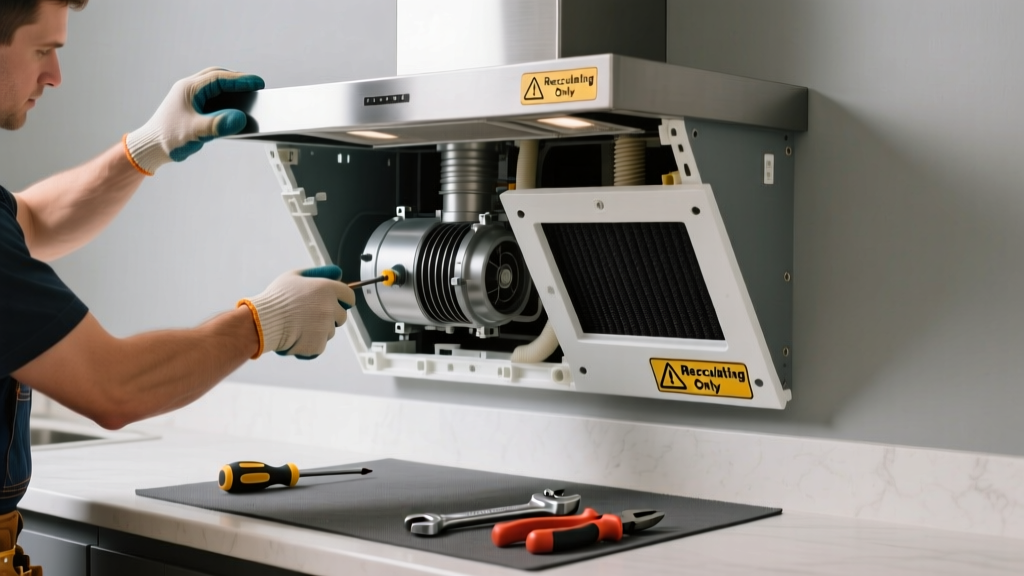
Your kitchen hood hums but doesn’t vent outside — just blows greasy air back into the room. That’s not normal operation; it means your ducted system has failed or was never installed correctly. Most modern hoods can switch between ducted exhaust and recirculating modes, but when they default to recirculation unexpectedly, it’s usually a sign of a blocked duct, missing vent cap, or wiring issue.
Quick Diagnosis
Before grabbing tools, confirm what’s really happening. A hood stuck in recirculating mode often stems from one of these five issues:
- No exterior vent cap installed or it’s sealed shut with caulk or paint
- Ductwork collapsed, disconnected, or clogged with grease and debris
- Backdraft damper frozen open or jammed closed
- Switch or control board misconfigured (especially after filter cleaning or power outage)
- Missing or improperly installed duct transition piece between hood and wall
Tools & Materials Needed
| Item | Purpose | Estimated Cost |
|---|---|---|
| Stud finder with AC detection | Finds wall studs and live wires before drilling near duct path | $25–$45 |
| Flexible aluminum duct (6" diameter) | Replacement for kinked or corroded duct sections | $12–$22 |
| Aluminum foil tape (UL 181 rated) | Seals joints without off-gassing or melting at high temps | $8–$14 |
| Grease-cutting degreaser (e.g., Simple Green Pro HD) | Cleans interior duct surfaces and fan housing safely | $10–$18 |
| Insulated exterior vent cap (with backdraft damper) | Prevents cold air infiltration and ensures proper airflow | $28–$42 |
Step-by-Step Fix
Follow these methods in order — most recirculating-only issues resolve at Step 1 or 2.
- Check the exterior vent cap: Go outside and locate your hood’s exhaust termination. If there’s no cap, or it’s painted over or covered with insulation, that’s your problem. Remove obstructions and install a UL-listed, insulated cap with a working damper.
- Inspect duct connections: Turn off power at the breaker. Remove the hood’s bottom panel and follow the duct upward. Look for loose clamps, disconnected sections, or visible grease buildup inside accessible duct runs. Reconnect with foil tape — never duct tape.
- Test the backdraft damper: With the hood running on high, hold a tissue near the exterior vent. If it doesn’t flutter, the damper is stuck. Clean its hinge with isopropyl alcohol and a soft brush; replace if bent or corroded.
- Reset the control board: Unplug the hood for 5 minutes. Some models (e.g., Broan 41300 series) revert to recirculating mode after a power interruption unless manually reset via button sequence — check your manual.
When to Call a Pro
Don’t risk fire or carbon monoxide exposure by forcing a DIY fix in these scenarios:
- You find evidence of rodent nesting or chewed wiring inside the duct chase
- The duct runs through an attic or crawl space and you can’t access it without cutting drywall
- Your home uses a shared vertical duct stack (common in condos), and neighbors report similar issues
- You measure >120°F at the fan motor housing while running — indicates bearing failure or electrical fault
According to the National Fire Protection Association’s Fire Loss in the U.S. 2023 Report, 22% of residential cooking fires involve faulty or improperly installed ventilation systems — many linked to DIY duct modifications without airflow verification.
Prevention Tips
Keep your hood exhausting properly year after year with these habits:
- Clean grease filters every 2 weeks if frying daily; soak in hot water + degreaser for 15 minutes
- Inspect the exterior vent cap twice yearly — especially after winter ice buildup
- Replace flexible duct every 7 years — it degrades, sags, and traps grease
- Install a duct airflow sensor (like the AirTec DAS-1) to get alerts before performance drops
Can I use bleach on the grease filter?
No. Bleach reacts with grease to form toxic chlorinated hydrocarbons and damages stainless steel mesh. Use a dedicated degreaser like Goo Gone Kitchen Degreaser instead — it breaks down polymerized oils without corrosion.
Why does my hood recirculate only when the fan is on high?
This points to static pressure overload — likely a partially blocked duct or undersized vent cap. High-speed airflow increases resistance, triggering the hood’s internal safety logic to default to recirculation. Measure static pressure with a manometer: above 0.3" WC means blockage.
Is recirculating mode ever acceptable?
Yes — but only as a temporary workaround. The U.S. EPA estimates that 14% of household water usage is from leaks, but for ventilation, recirculation removes zero moisture or combustion byproducts. It’s fine for light steaming or boiling, never for frying, grilling, or gas stove use.
How do I know if my duct is too long?
For 6" rigid duct, max recommended length is 30 feet with no more than two 90° elbows. Each elbow adds ~5 feet of equivalent length. Use a duct calculator like the HVAC Duct Sizing Tool to verify — longer runs cause airflow collapse and automatic recirculation fallback.
Do charcoal filters need replacing even if they look clean?
Absolutely. Charcoal filters saturate chemically after 3–6 months depending on cooking frequency. They won’t trap odors past that point, even if visually unchanged. Mark your calendar or use a smart reminder app synced to your smart plug schedule.
Can I convert a recirculating hood to ducted?
Sometimes — but only if the hood model supports both configurations (check model number on the rating plate). Broan, Zephyr, and Vent-A-Hood offer convertible units. Never force ducting onto a hood designed solely for recirculation — internal fan curves and motor windings aren’t rated for exhaust resistance.
A properly ducted hood should move at least 150 CFM for a standard 30" range — and that only works if every inch of duct is sealed, sized right, and terminates outdoors. Fixing recirculation isn’t just about airflow; it’s about protecting your home’s indoor air quality and structural longevity. When in doubt, pull the cover plate and take a photo — most HVAC techs will diagnose it remotely for $25 before scheduling a visit.