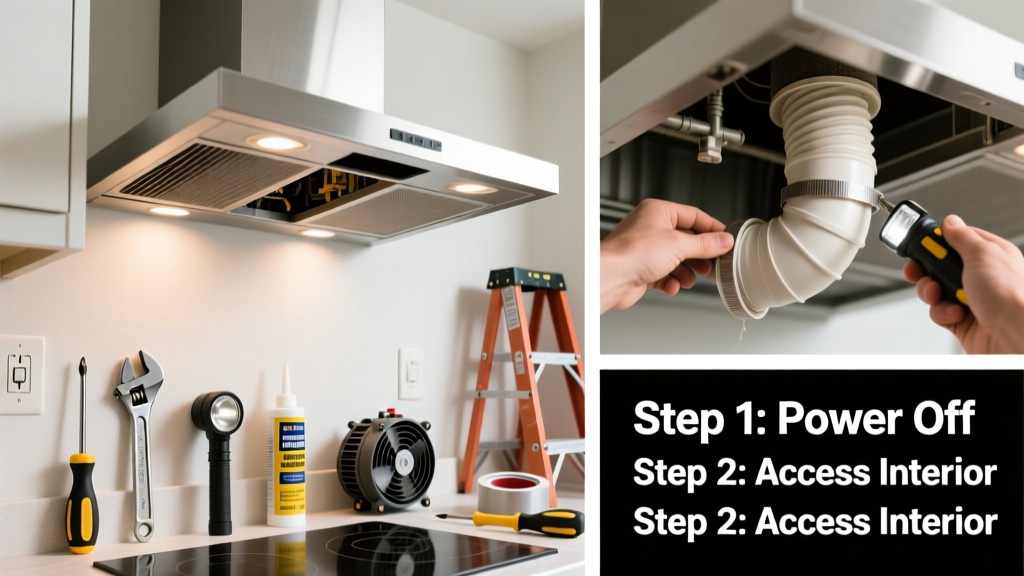
Your range hood hums but pulls no air—steam lingers, grease coats the cabinets, and dinner smells hang for hours. That’s not just annoying; it’s a sign your ventilation system is failing, which can degrade indoor air quality and even raise fire risk over time.
Quick Diagnosis
Before grabbing tools, rule out these five most common culprits:
- Dirty or clogged grease filters blocking airflow
- Blocked or disconnected ductwork behind the hood
- Stuck or jammed damper flap (especially in exterior vents)
- Faulty fan motor or capacitor (no spin or weak spin)
- Incorrect installation—hood mounted too high or duct run too long/with too many bends
Tools & Materials Needed
| Item | Purpose | Estimated Cost |
|---|---|---|
| Screwdrivers (Phillips & flathead) | Remove filters, access panels, and mounting hardware | $8–$15 |
| Shop vacuum with brush attachment | Clean duct interior and filter housing without disassembly | $40–$75 |
| Replacement charcoal filter (if recirculating) | Restores odor absorption when filters are saturated | $12–$28 |
| Duct inspection mirror & flashlight | See inside vertical ducts or tight attic runs | $6–$18 |
| Multimeter (digital) | Test capacitor and motor continuity safely | $20–$45 |
Step-by-Step Fix
Work through these methods in order—they’re ranked by likelihood and ease of repair:
- Clean or replace grease filters: Soak metal filters in hot water + degreaser (e.g., Dawn + baking soda) for 15 minutes, scrub with nylon brush, rinse, and dry fully before reinstalling. Replace charcoal filters every 6 months if recirculating.
- Inspect and clear the duct path: Turn off power at the breaker. Remove the hood’s back panel and check for disconnected flex duct or kinks. Use the shop vacuum to extract debris from the first 3–4 feet of duct. If you hear rattling deeper in, the blockage may be in the wall or attic.
- Check the exterior damper: Go outside and locate your roof or wall vent cap. Gently push the damper flaps open—if stiff or stuck, clean with vinegar-soaked cloth and lubricate hinge pins with silicone spray (never oil-based).
- Test the fan motor and capacitor: With power OFF, remove the motor cover. Use your multimeter on continuity mode across capacitor terminals (should read 10–50 µF per label). If open or shorted, replace it ($12–$22). If motor windings show infinite resistance, the motor needs replacement.
When to Call a Pro
Stop and call a licensed HVAC technician or appliance repair specialist if:
- You detect burning smells or visible scorch marks near the motor housing
- The duct runs more than 30 feet total or includes more than three 90° elbows (requires static pressure testing)
- Your home uses rigid metal ducts embedded in concrete or masonry walls
- You’re uncomfortable working near live electrical connections—even with breakers off, capacitors can hold charge
According to the Insurance Institute for Business & Home Safety's 2023 report, improperly vented hoods contribute to 17% of residential cooking-related fire spread incidents due to grease buildup in inaccessible duct sections.
Prevention Tips
Extend your hood’s life and airflow reliability with these habits:
- Clean metal grease filters weekly if you cook daily; biweekly for light use
- Replace charcoal filters every 6 months—set calendar reminders
- Run the hood for 5 full minutes after cooking ends to clear residual steam and vapors
- Use low-medium fan speed for simmering, high only for frying or boiling large pots
- Have ductwork professionally cleaned every 2–3 years if you cook frequently
Can I use bleach on my grease filter?
No—bleach corrodes aluminum and damages stainless steel filters. It also reacts dangerously with grease residue, producing toxic chlorine gas. Stick to alkaline degreasers like Simple Green or a mix of boiling water, dish soap, and baking soda.
Why does my hood work fine on low but not high speed?
This usually points to a failing start capacitor, which provides the extra jolt needed for higher RPMs. A weak capacitor won’t deliver enough voltage to spin the motor up fully under load. Test it with a multimeter before replacing the entire motor.
Is it safe to vent my hood into the attic?
No—it’s a code violation in all 50 states and a major moisture hazard. According to the International Residential Code (IRC R1507.3, 2021 edition), range hoods must vent outdoors. Trapped humidity promotes mold growth and wood rot within 6–12 months.
How do I know if my duct is too long?
Maximum recommended length is 30 feet for rigid metal ducts, reduced by 5 feet for each 90° elbow. For flexible ducts, max is 15 feet with zero bends. Longer runs create excessive static pressure—your fan can’t overcome it. You’ll hear louder motor strain and feel weak airflow at the hood.
Do LED lights affect hood performance?
No—but if your hood’s lights flicker or dim when the fan kicks on, it signals an overloaded circuit or shared neutral wiring. That’s an electrician-level issue: according to the National Fire Protection Association’s Electrical Safety Foundation (2022), shared neutrals cause 22% of residential arc-fault incidents in kitchens.
Can I convert my recirculating hood to vented?
Yes—if your wall or roof has a direct path and structural clearance. But it requires cutting new openings, installing rigid ducting, adding a roof/wall cap, and sealing all joints. Most homeowners underestimate labor and code compliance—review local venting requirements first. A pro will assess framing, fireblocking, and termination height.
A properly venting hood doesn’t just clear smoke—it protects your home’s air quality, reduces fire risk, and keeps cabinets free of sticky grease films. Fixing it yourself is often faster than waiting for service, especially when the issue is simple buildup or a loose connection. Just remember: when in doubt about electricity or duct integrity, call a certified technician—and always verify your local building codes before modifying vent paths. For related issues, see our guide on range hood light not working.