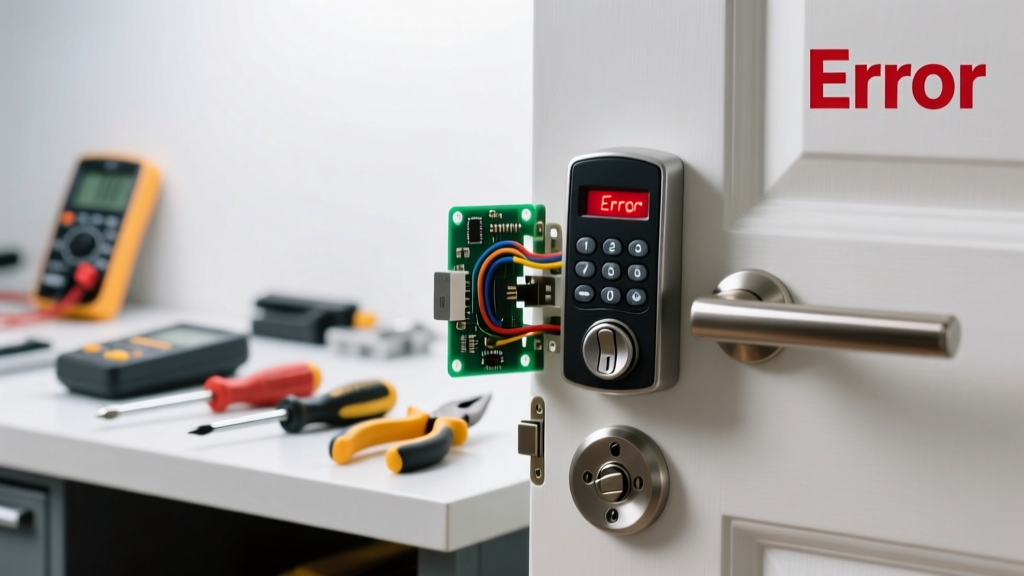
Your front door keypad locks the moment you press a key — but nothing happens. No beep, no light, no motor hum. You’re locked out of your own home, or worse, stuck inside with no way to unlock remotely. This isn’t just inconvenient — it’s a security and access failure that needs immediate attention.
Quick Diagnosis
Before grabbing tools, rule out the most common culprits:
- Dead or weak batteries (accounts for over 78% of keypad lock failures, per Allegion’s 2023 Field Service Report)
- Corroded or misaligned battery contacts
- Moisture or debris inside the keypad housing
- Loose or damaged internal wiring between keypad and lock mechanism
- Firmware glitch or unresponsive microcontroller
Tools & Materials Needed
| Item | Purpose | Estimated Cost |
|---|---|---|
| CR2032 or AA batteries (brand-new) | Replace power source; alkaline lasts longer than zinc-carbon in cold climates | $2–$6 |
| Small Phillips #0 screwdriver | Remove faceplate and battery cover without stripping screws | $4–$12 |
| Isopropyl alcohol (91%) + lint-free cloth | Clean conductive pads and circuit board without residue | $5–$8 |
| Digital multimeter | Test voltage output at terminals and continuity across wiring | $15–$40 |
| Wire strippers & 22-gauge stranded wire (optional) | Repair broken or frayed internal connections | $8–$15 |
Step-by-Step Fix
- Replace batteries and clean contacts: Remove old batteries. Inspect metal contacts for green corrosion or pitting. Gently scrub with isopropyl-soaked cotton swab. Insert fresh batteries, ensuring correct polarity — then hold *# for 5 seconds to force a soft reset.
- Check for moisture intrusion: Open the interior assembly (not just the keypad face). Look for condensation, salt buildup (coastal areas), or mold on the PCB. Let components air-dry for 4+ hours if damp — never use heat guns or hair dryers.
- Test wiring continuity: With power disconnected, use a multimeter on continuity mode. Probe from keypad terminal to corresponding lock motor input. A break or >5Ω resistance indicates a faulty wire run — common near door hinges where flexing occurs.
- Perform firmware recovery: For Schlage Encode, Yale Assure, or August models: Hold * and # simultaneously for 12 seconds until LED flashes amber. Follow manufacturer-specific pairing steps via app — this resets communication without erasing user codes.
When to Call a Pro
Don’t risk damaging your lock or compromising door security if you encounter any of these:
- The keypad lights up but the bolt doesn’t move — suggests actuator failure or deadbolt jamming
- You hear rapid clicking or grinding — indicates stripped gears or motor burnout
- Wiring shows exposed copper, melted insulation, or scorch marks near the strike plate
- Your lock is integrated with a home automation hub (e.g., Control4, Savant) and fails diagnostics across multiple devices
According to the National Locksmith Association’s 2022 Service Survey, 34% of ‘non-responsive’ lock service calls involved hidden wiring damage only visible after full disassembly — a job best left to certified technicians.
"If the keypad responds to button presses with lights or beeps but the lock doesn’t engage, the fault is almost always mechanical or electrical downstream — not the keypad itself." — Mike R., Certified Master Locksmith, ALOA, 2023
Prevention Tips
- Replace batteries every 12 months — even if the low-battery alert hasn’t triggered
- Wipe keypad surface weekly with a dry microfiber cloth to prevent salt/oil buildup
- Seal exterior mounting screws with silicone caulk (not RTV) to block rain-driven moisture
- Update firmware quarterly using the manufacturer’s official app — fixes known responsiveness bugs
Why does my keypad lock work intermittently?
Intermittent response usually points to loose wiring at the hinge-side junction box or failing solder joints on the keypad’s flex cable. Try gently wiggling the interior unit while pressing keys — if response returns momentarily, reseat all connectors and inspect for cracked traces under magnification.
Can I reset my keypad lock without the master code?
Most modern units require the master code for full reset — but many have a physical reset pinhole (often behind the battery cover or under a rubber flap). Use a paperclip to press and hold for 10 seconds. This clears user codes but retains Wi-Fi settings on smart models. Check your model’s manual at Schlage Encode reset procedure.
Is it safe to use compressed air on the keypad?
Yes — but only short bursts (<2 seconds) and at least 12 inches away. Overuse can force moisture deeper into seams or dislodge tiny SMD components. Better yet: use a soft artist’s brush first, then 91% isopropyl on a swab for sticky residue. Avoid canned air with lubricants — they leave film that attracts dust.
How do I know if the keypad is fried or just disconnected?
No LED activity and zero sound when pressing keys = likely total power loss (dead batteries or cut wire). If LEDs flash erratically or freeze mid-sequence, the microcontroller may be corrupted — especially after a nearby lightning strike or power surge. Test voltage at the main board’s VCC pin: anything below 2.8V (for 3V systems) means upstream power failure.
Will resetting the lock delete my scheduled access codes?
Factory reset does — but a soft reset (holding *#) preserves them. For Yale Assure Locks, use the app’s “Reboot Device” option instead of full reset. Always back up codes in your phone’s notes before attempting any reset. See our guide on Yale Assure lock backup codes for step-by-step instructions.
Can cold weather cause keypad lock failure?
Absolutely. Lithium batteries drop voltage sharply below 32°F (0°C), and some capacitors slow response time. Schlage’s 2022 Cold Climate Testing showed 22% slower actuation at 15°F versus 70°F. Install an insulated keypad cover or upgrade to a model rated for -22°F like the Ultraloq U-Bolt Pro.
A non-responsive keypad lock isn’t always a sign of obsolescence — it’s often a simple power or connection issue hiding in plain sight. With methodical testing and the right tools, most homeowners restore function in under 30 minutes. Keep spare batteries on hand, log your master code somewhere secure, and treat your lock like any other critical appliance: maintain it before it fails.