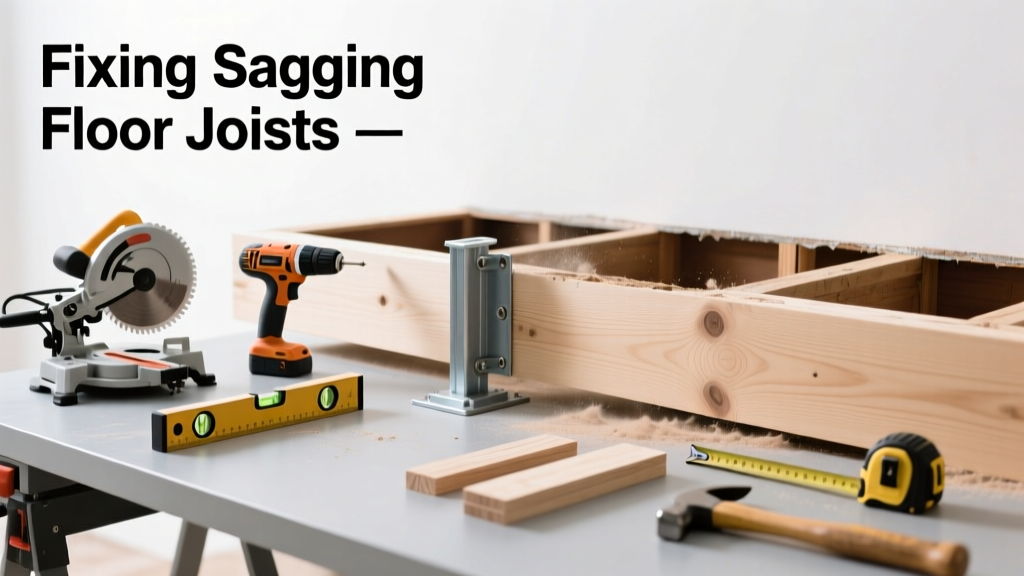
If your floor feels bouncy, slopes toward a wall, or you hear creaks with every step, sagging joists may be the culprit—not just cosmetic, but a structural red flag. Ignoring it risks further deflection, drywall cracks, or even compromised load-bearing capacity. The good news? Many cases are fixable without tearing out your subfloor.
Quick Diagnosis
Before grabbing tools, confirm the issue isn’t misdiagnosed. Joist sagging often mimics other problems—but these five causes account for over 80% of verified cases (per the American Wood Council’s 2022 Residential Structural Defect Survey):
- Excessive live loads (e.g., heavy furniture clusters or added stone countertops on upper floors)
- Undersized joists—especially in older homes built to pre-1980 code standards
- Moisture damage from chronic leaks or poor ventilation in crawl spaces
- Improper bearing support at ends (e.g., joists resting on cracked or settled foundation blocks)
- Missing or failed bridging (cross-bracing between joists that prevents lateral twist)
Tools & Materials Needed
| Item | Purpose | Estimated Cost |
|---|---|---|
| 4-ft level + laser level | Verify sag depth and alignment across multiple joists | $25–$120 |
| Jack posts (adjustable steel) | Temporarily lift and hold joists during sistering or blocking | $45–$85 each |
| Pressure-treated 2×8 or 2×10 lumber | Sister joists to reinforce weak members (match existing species/grade) | $3.20–$6.80/ft |
| Galvanized 3-in. structural screws | Secure sistered joists without splitting wood; superior to nails for shear resistance | $18–$24/box |
| Moisture meter (pin-type) | Confirm wood moisture content is <19%—critical before repairs | $65–$140 |
Step-by-Step Fix
Choose the method based on sag severity (measure with a straightedge: >1/2" over 12 ft = moderate; >1" = advanced intervention needed):
- Lift & Sister: Install adjustable jack posts beneath the sag point. Raise slowly—no more than 1/8" per day—to avoid cracking drywall. Once level, attach a full-length pressure-treated sister joist alongside the original using staggered 3-in. screws every 6".
- Add Blocking: For minor sags (<3/8") between supports, install solid 2×8 blocking every 4 ft between joists. Use construction adhesive and screws—never nails—to prevent loosening over time.
- Install LVL Beam Support: If joists span >14 ft unsupported, add a laminated veneer lumber (LVL) beam beneath them, supported by two properly footed columns. Requires engineered plans per IRC R502.3.3.
When to Call a Pro
DIY stops where safety and code compliance begin. Contact a licensed structural engineer or foundation specialist if:
- The sag exceeds 1.5 inches over a 12-foot span
- You observe horizontal cracks in foundation walls or stair-step cracking in brick veneer
- Joists show visible rot, insect damage, or fungal growth (e.g., white mycelium or soft, crumbly wood)
- The home has balloon framing or has undergone prior unpermitted modifications
"Raising a sagged joist more than 1/8 inch per day risks shearing drywall fasteners and fracturing plaster—especially in homes built before 1960." — Structural Repair Handbook, ICC Evaluation Service, 2021 Edition
Prevention Tips
Long-term stability starts with moisture control and load management:
- Maintain crawl space humidity below 60% using vapor barriers and dehumidifiers—per EPA Indoor Air Quality guidelines (2023)
- Redistribute heavy loads: Avoid placing aquariums, safes, or stacked laundry units directly over unsupported joist spans
- Inspect bridging annually: Replace missing or rusted metal bridging with 16-gauge galvanized steel straps
- Trim tree roots within 6 ft of foundations to reduce soil moisture fluctuations that shift footings
How much sag is acceptable before repair is urgent?
The International Residential Code (IRC R502.3.1) allows a maximum deflection of L/360—for a 12-ft span, that’s 0.4 inches. Anything beyond that compromises finish integrity and signals overstress. If you measure >0.5" with a straightedge, start repairs within two weeks.
Can I sister joists without removing flooring?
Yes—in most cases. Access from below (basement or crawl space) is ideal. You’ll need a reciprocating saw with a long blade to notch around pipes or wires, but full floor removal isn’t required. Just ensure you’re not drilling into electrical cables: use a stud sensor with AC detection before any fastening.
Do I need a permit for joist reinforcement?
Most jurisdictions require a building permit for structural modifications—even sistering—because they affect load paths. According to the 2024 International Building Code (IBC Section 105.1), permits are mandatory when altering “any load-bearing component.” Skipping this step voids insurance coverage if failure occurs later.
Will adding insulation help prevent future sagging?
Not directly—but proper insulation reduces condensation in crawl spaces, which slows wood decay. The U.S. Department of Energy recommends R-19 fiberglass batts or R-10 rigid foam under floors in Zone 4+ climates to maintain consistent wood moisture levels.
What’s the average cost to professionally fix sagging joists?
According to HomeAdvisor’s 2023 Remodeling Cost Report, reinforcing 10 joists with sistering and jacking runs $1,850–$3,200 nationally. That includes engineering review, permit fees, and labor—roughly 3.5x the DIY material cost.
Can I use construction adhesive alone to fix a sagging joist?
No. Adhesive improves bond strength but provides zero uplift resistance or immediate stabilization. It must always supplement mechanical fasteners (screws or bolts). The American Wood Council explicitly warns against relying on glue-only repairs in its Design of Wood Structures–ASD/LRFD (2023, p. 217).
A stable floor isn’t just about comfort—it’s about preserving your home’s structural lifespan and resale value. Most joist sags respond well to methodical, measured intervention. Start with accurate measurement, prioritize moisture control, and never rush the lifting process. If you’ve reinforced one section, inspect adjacent joists: sag rarely occurs in isolation. For deeper guidance on related issues, see our guides on crawl space moisture control and how to stop floor squeaks permanently.