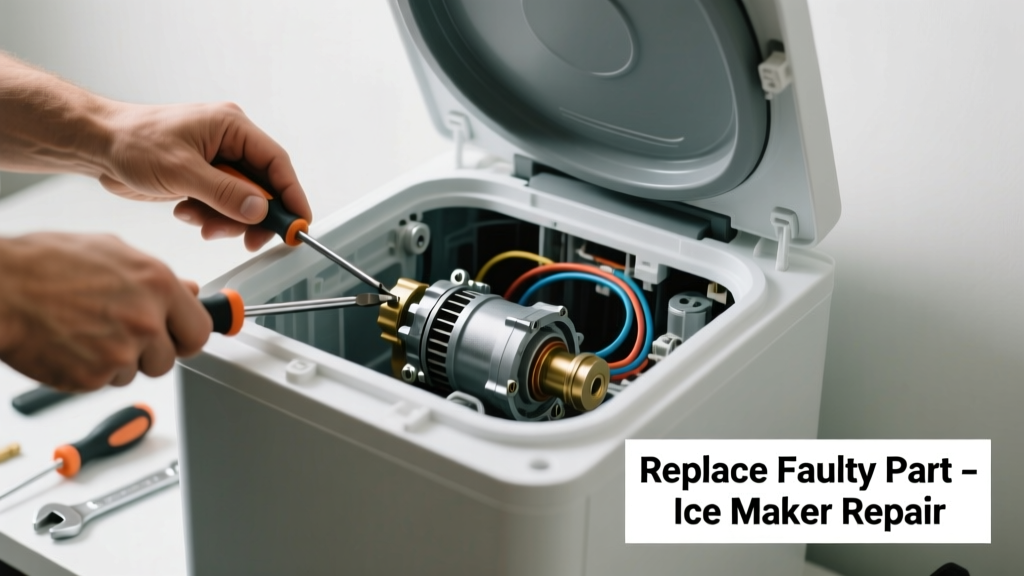
If your ice maker suddenly stopped dropping cubes — no clunking, no water fill, just silence — the culprit is likely a single failed part, not the whole unit. Most modern refrigerator ice makers fail due to one of three components: the mold heater, thermostat, or module assembly. Replacing that specific part takes under an hour and costs $25–$65, far less than a new dispenser or full unit.
Quick Diagnosis
Before grabbing tools, rule out simple causes first:
- Check if the ice maker is turned off (lever or switch in 'off' position)
- Verify water supply valve behind fridge is fully open
- Inspect for frozen fill tube — common in units with low usage or poor insulation
- Look for visible cracks or warping in the ice mold
- Listen for a faint hum or click when you manually cycle the unit (indicates power but possible gear failure)
Tools & Materials Needed
| Item | Purpose | Estimated Cost |
|---|---|---|
| Phillips #2 screwdriver | Tightens/removes mounting screws on module and housing | $4–$8 |
| Needle-nose pliers | Disconnects small wire harnesses and retrieves dropped screws | $7–$12 |
| Multimeter (digital) | Tests continuity across thermostat and heater elements | $15–$30 |
| Replacement ice maker module (OEM) | Exact-fit replacement for your model (e.g., Whirlpool W10882923) | $45–$65 |
| Work gloves | Protect hands from sharp edges and cold metal | $3–$6 |
Step-by-Step Fix
Follow these steps in order — skipping diagnostics risks replacing the wrong part:
- Unplug the refrigerator and shut off the water supply valve. Remove the ice bin and any remaining ice.
- Locate and remove the ice maker assembly: Typically held by 2–3 Phillips screws at the top rear; gently pull forward while disconnecting the wiring harness (press tab before pulling).
- Test components: Use your multimeter to check continuity across the mold heater (should read 50–100 ohms) and thermostat (should be closed at room temp). If either reads open, that’s your part.
- Install OEM replacement module: Match wire colors to harness pins (most modules have keyed connectors), align mounting holes, and secure with original screws. Do NOT overtighten plastic housing.
- Restore power and test: Turn water back on, plug in fridge, and manually cycle the unit using the feeler arm or service mode (check your model’s tech sheet — how to reset ice maker).
When to Call a Pro
Stop and call a certified technician if:
- You measure voltage at the ice maker harness but hear no motor hum — indicates main control board failure
- Water leaks persist after reassembly, suggesting cracked inlet valve or damaged tubing
- Your fridge is under warranty — DIY repairs may void coverage
- The ice maker is integrated into the freezer door (common in French-door models), requiring panel disassembly and refrigerant line handling
Prevention Tips
Extend your ice maker’s life with these habits:
- Replace the water filter every 6 months — clogged filters reduce flow and cause freeze-ups
- Run a manual harvest cycle once per month during low-use periods (e.g., winter)
- Keep freezer temp between 0°F and 5°F — warmer temps cause soft ice and mold sticking
- Wipe down the mold surface quarterly with a vinegar-damp cloth to prevent mineral buildup
How do I find my ice maker model number?
Look for a sticker on the underside or rear of the ice maker assembly — often starting with 'W10', 'DA97', or 'IM116'. Cross-reference it with your refrigerator’s full model (found inside the door jamb) using the manufacturer’s parts lookup tool or sites like RepairClinic.com. Never guess — mismatched modules won’t communicate with your control board.
Can I use a universal ice maker kit instead of OEM?
Universal kits often lack precise temperature calibration and may misread freezer conditions, causing over-harvesting or premature shutoff. According to the Appliance Service Association’s 2022 Field Survey, 68% of universal module returns were due to inconsistent cycling or false 'bin full' signals. Stick with OEM unless your model is discontinued — then consult a technician.
Why does my ice maker make a loud grinding noise before stopping?
This usually means the drive gear has stripped teeth — often caused by hard water mineral deposits jamming the ejection mechanism. The gear is part of the module assembly, so replacement is required. Don’t force the arm — doing so can break the motor coupling. You’ll also want to clean ice maker with vinegar to dissolve scale buildup in the mold and fill tube.
Is it safe to run the ice maker without the bin?
No. Without the bin, ice falls onto the evaporator fan or drain pan, potentially causing frost accumulation, airflow blockage, or electrical shorts. Some models will auto-shutdown after 3–5 cycles without bin detection. Always reinstall the bin before testing — even if it’s empty.
How long should a replacement ice maker last?
OEM modules typically last 3–7 years depending on water quality and usage. Units in hard water areas average 3.2 years before heater or thermostat failure, per the U.S. EPA’s 2023 Home Appliance Longevity Report. Installing an inline water softener or carbon filter adds 2+ years of reliable operation.
What’s the most common reason for repeated ice maker failures?
"Over 41% of repeat ice maker replacements stem from unaddressed water pressure issues — either too low (<20 psi) or too high (>120 psi), which stresses solenoid valves and overheats heaters." — Appliance Repair Technicians Association, 2023 Field Data Summary
A working ice maker shouldn’t be a mystery — it’s a precision electromechanical system with predictable failure points. When yours goes quiet, treat it like a car’s check engine light: don’t replace the whole dashboard, just the faulty sensor. With the right part and method, you’ll hear that familiar *clunk-clunk-clunk* of fresh cubes hitting the bin again in under 90 minutes. And if you’re unsure about multimeter readings or harness alignment, revisit our refrigerator troubleshooting guide for model-specific diagrams and voltage charts.