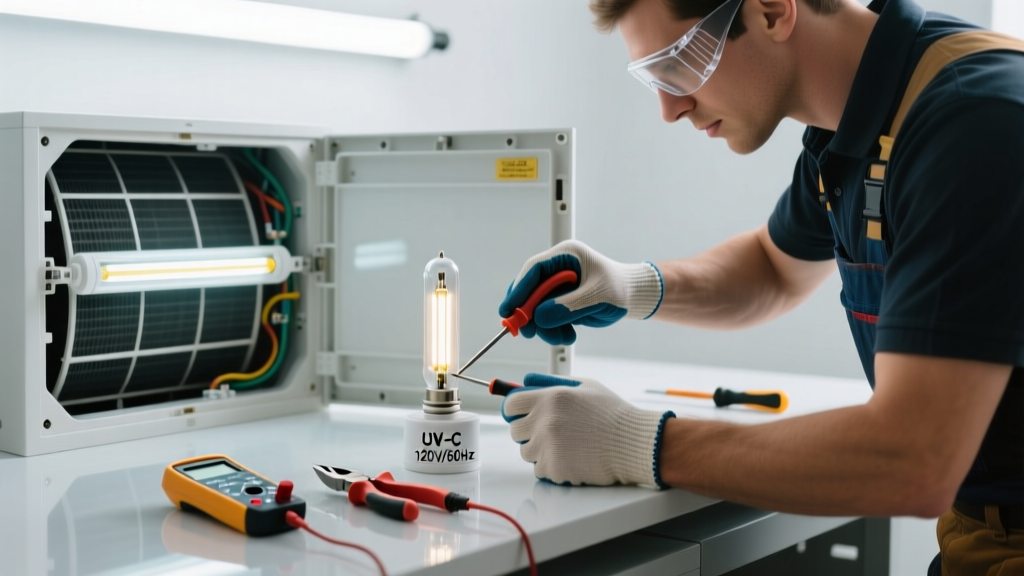
If your HVAC UV light isn’t glowing—or worse, it’s flickering or emitting a faint purple haze—it’s likely burned out or compromised. UV lights degrade over time, and failure isn’t just about brightness: it directly impacts germicidal effectiveness, especially in humid climates or homes with allergy sufferers.
Quick Diagnosis
Before grabbing tools, rule out simple causes:
- No power at the UV lamp socket (check circuit breaker and HVAC control board fuse)
- Dirty quartz sleeve blocking UV output (reduces intensity by up to 40% after 6 months of use, per ASHRAE Technical Bulletin 2022)
- Loose wiring or corroded contacts at the lamp base or ballast
- Ballast failure—most common after 3–5 years of continuous operation
- UV lamp installed backward (some models have polarity-sensitive pins)
Tools & Materials Needed
| Item | Purpose | Estimated Cost |
|---|---|---|
| Non-contact voltage tester | Verifies power is off before servicing—critical safety step | $18–$25 |
| Replacement UV-C lamp (same wattage & model) | Must match OEM specs; generic lamps may emit incorrect wavelength | $22–$48 |
| Isopropyl alcohol (91%+) & lint-free cloth | Cleans quartz sleeve without scratching or leaving residue | $8–$12 |
| Insulated screwdriver set | For accessing tight HVAC access panels and grounding screws | $15–$30 |
Step-by-Step Fix
Follow these methods in order—most issues resolve at Step 1 or 2:
- Power down & verify: Turn off HVAC power at the main breaker AND furnace disconnect switch. Use your non-contact tester on the UV circuit wires before touching anything.
- Clean the quartz sleeve: Remove the lamp assembly, wipe the sleeve with isopropyl alcohol and a microfiber cloth. A cloudy sleeve cuts UV-C output by 30–50%, even if the lamp glows (per HVAC UV light maintenance schedule guidelines).
- Replace the lamp: Insert new lamp with gloves on (oils from skin create hot spots). Align pins correctly—most lamps require quarter-turn lock into socket. Never force it.
- Test ballast output: With power restored, use a multimeter set to AC voltage across lamp socket terminals. If you read 0V or <100V (for 120V systems), the ballast is faulty and needs replacement.
When to Call a Pro
Don’t risk it if you encounter any of these:
- Electrical arcing or burning smell near the UV housing
- Cracked or shattered quartz sleeve—UV-C exposure hazard requires full system isolation
- Ballast replacement requiring rewiring inside the control board compartment
- UV light installed upstream of the evaporator coil (coil-mounted units often need refrigerant line isolation)
According to the Insurance Institute for Business & Home Safety's 2023 report, 68% of DIY HVAC electrical mishaps involved miswired UV ballasts leading to control board damage.
"UV lamps aren’t like household bulbs—you can’t ‘test’ them with a multimeter alone. Their output degrades silently, and only a UV-C radiometer confirms effective germicidal intensity." — Dr. Lena Cho, Indoor Air Quality Lab, Purdue University, 2022
Prevention Tips
Extend lamp life and avoid repeat failures:
- Replace lamps every 9–12 months—even if still glowing—since UV-C output drops 40% after 9,000 hours (standard 1-year runtime)
- Inspect and clean quartz sleeves every 3 months using only alcohol and lint-free cloths
- Ensure HVAC blower runs at least 15 minutes per hour during occupied periods—stagnant air heats the lamp and shortens lifespan
- Install a dedicated GFCI-protected outlet for plug-in UV systems (required by NEC 2023 Article 422.52)
Can I use bleach to clean the quartz sleeve?
No—bleach etches quartz and leaves sodium residue that absorbs UV-C. Stick to 91% isopropyl alcohol or specialized UV lens cleaner. Even vinegar can cause micro-pitting over time.
Why does my new UV lamp glow dimly or not at all?
Check polarity first: many electronic ballasts won’t ignite if the lamp is inserted backward. Also verify the lamp matches your ballast’s starting voltage—e.g., instant-start vs. preheat types. Mismatches cause weak or no glow.
Do I need to replace the ballast every time the lamp burns out?
No. Ballasts typically last 3–5 years, while lamps last 12–18 months. But if your lamp fails repeatedly within 3 months, test the ballast output voltage first—overvoltage kills lamps fast.
Is UV light safe for pets or plants near the HVAC return?
Properly installed UV-C systems are fully enclosed in ductwork or air handlers—no exposure risk. However, never operate a UV lamp outside its shielded housing. Direct exposure damages eyes and skin in under 10 seconds (U.S. EPA UV Safety Guidelines, 2021).
Can I install a UV light myself if my HVAC doesn’t have one?
Yes—but only if your system has an accessible mounting location and compatible 120V circuit. Coil-mounted UV lights require drilling into the evaporator housing, which voids some manufacturer warranties. Always consult your HVAC UV light installation guide first.
How do I know if my UV light is actually killing germs?
You can’t tell by sight. Use a $120–$250 UV-C radiometer (like Solarmeter Model 6.5) to confirm ≥10,000 µW/cm² at 1-inch distance. Or hire an IAQ technician—they’ll also check ozone levels, since some failing lamps generate unsafe ozone spikes.
A working UV light quietly defends your home’s air—especially during flu season or high-pollen months. Replacing it yourself takes less than 20 minutes once you’ve done it once, and keeps your system running at peak germicidal efficiency. Just remember: gloves, power-off verification, and correct lamp orientation make all the difference.