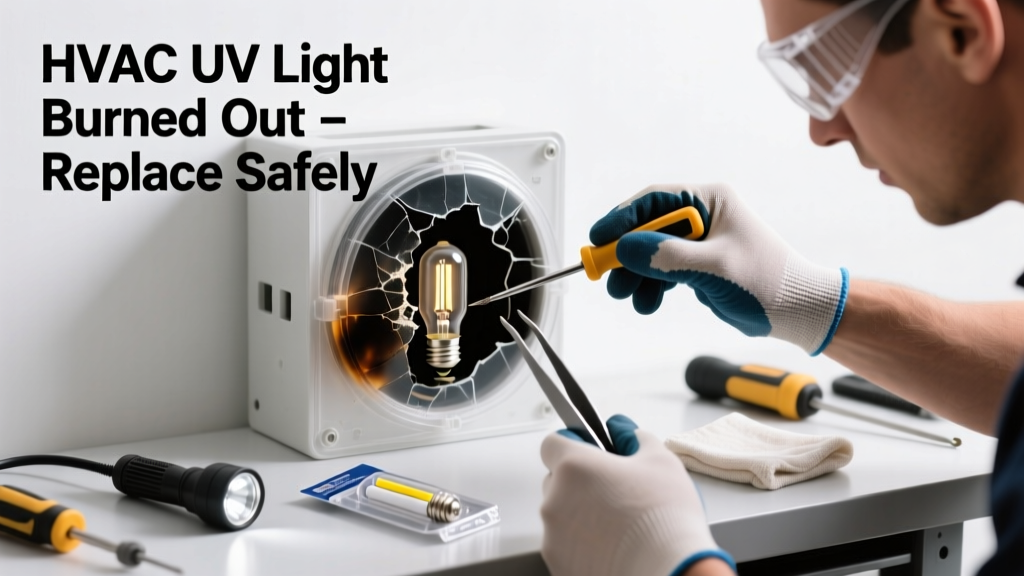
If your HVAC UV light has gone dark, it’s not just an inconvenience—it’s a potential health and efficiency risk. UV lamps in air handlers typically last 9–14 months, and once they burn out, they stop killing mold spores and bacteria on the coil and drain pan. Ignoring it can lead to musty odors, reduced airflow, and even microbial growth that compromises indoor air quality.
Quick Diagnosis
Before assuming the bulb is dead, rule out these common causes:
- The lamp’s power switch (often near the air handler or furnace) is turned off
- A tripped GFCI outlet or dedicated circuit breaker supplying the UV unit
- Corroded or loose wiring connections at the lamp socket or ballast
- Faulty electronic ballast—especially if you hear buzzing or see flickering before failure
- Physical damage to the quartz sleeve (cracks or clouding block UV output even if the bulb glows)
Tools & Materials Needed
| Item | Purpose | Estimated Cost |
|---|---|---|
| UV-C replacement bulb (same wattage & base type) | Exact match ensures compatibility and UV output; never substitute with standard fluorescent bulbs | $25–$45 |
| Insulated screwdriver set | Safely remove access panels and secure wiring without shorting live circuits | $12–$28 |
| Non-contact voltage tester | Verifies power is off before handling wires—critical for safety | $15–$30 |
| Clean microfiber cloth + isopropyl alcohol (90%+) | Removes dust/oil from quartz sleeve and new bulb surface—oils reduce UV transmission by up to 40% | $8–$14 |
| Work gloves (nitrile or UV-rated) | Protects skin from accidental UV exposure and glass shards; regular cotton gloves won’t block UV-C | $6–$12 |
Step-by-Step Fix
- Shut off power: Turn off the HVAC system at the thermostat, then cut power at the main furnace disconnect switch or circuit breaker labeled "Air Handler" or "UV System." Verify with your non-contact tester.
- Access the UV unit: Remove the access panel on your air handler—usually near the evaporator coil. Most units mount the lamp horizontally above or alongside the coil.
- Inspect and clean: Wipe the quartz sleeve (if present) with isopropyl alcohol and a microfiber cloth. Check for cracks or white haze—if cloudy or damaged, replace the sleeve ($18–$32) along with the bulb.
- Swap the bulb: Gently twist the old bulb counterclockwise to remove. Insert the new bulb firmly but don’t overtighten—finger-tight plus ¼ turn is sufficient. Avoid touching the glass with bare fingers.
- Reassemble and test: Replace the access panel, restore power, wait 2–3 minutes, then check for a faint blue glow through the viewing port. Confirm operation with a UV meter if available—or use a $12 UV detection card to verify output.
When to Call a Pro
DIY replacement is safe *only* if your system uses a plug-in or screw-base UV-C lamp wired to a simple ballast. Call an HVAC technician if:
- Your UV system integrates directly into the control board (e.g., Carrier Infinity, Lennox iComfort)
- You detect burning smells, melted wire insulation, or charring at the socket
- The ballast fails repeatedly within 6 months—indicates grounding issues or voltage spikes
- Your home has high humidity (>60% RH) and visible mold on the coil, requiring professional cleaning before bulb replacement
Prevention Tips
Extend UV lamp life and system performance with these habits:
- Replace bulbs every 12 months—even if still glowing—as UV-C output degrades 30–40% after one year (according to the Illuminating Engineering Society’s Lighting Handbook, 10th Ed., 2022)
- Change your HVAC filter every 30–90 days; clogged filters increase coil temperature and accelerate bulb aging
- Install a timer or smart relay to run UV lights only during fan cycles—reduces runtime by ~60% without sacrificing protection
- Use a hygrometer to monitor indoor humidity; keep it between 30–50% RH to minimize condensate and microbial growth on coils
Can I use regular household LED bulbs instead of UV-C tubes?
No—standard LEDs emit zero UV-C radiation. Only certified low-pressure mercury vapor lamps (or newer UV-C LEDs rated for 254 nm output) kill microbes. Substituting risks equipment damage and voids warranties. See our guide on HVAC UV light types explained.
How do I know if the quartz sleeve is cracked or just dirty?
Hold the sleeve up to bright light: hairline cracks appear as thin, silvery lines; cloudiness or white film is mineral deposit buildup. Wipe with 90% isopropyl alcohol—if haze lifts, it’s cleanable. If cracks are visible or the sleeve feels gritty, replace it—cracked quartz allows ozone leakage and reduces UV intensity by over 70% (U.S. EPA Indoor Air Quality Tools for Schools, 2021).
Do I need to wear eye protection when replacing the bulb?
Yes—even brief exposure to unshielded UV-C can cause photokeratitis (a painful corneal sunburn) within seconds. Wear ANSI Z87.1-rated UV-blocking safety goggles, not sunglasses. As HVAC technician Marcus Lee told Contractor Magazine in 2023: "I’ve seen three ER visits this year from DIYers who thought ‘just a quick look’ was safe. UV-C doesn’t sting until 6 hours later—and by then, the damage is done."
Why does my new UV bulb glow dimly or not at all after installation?
First, double-check power and switch position. Then inspect the ballast—listen for a faint hum. No hum? Ballast is likely dead. A weak glow may indicate incompatible voltage (e.g., installing a 120V bulb on a 240V circuit) or poor socket contact. Test continuity across the socket terminals with a multimeter if comfortable.
Is it safe to run the HVAC system while the UV light is out?
Yes—the system cools and heats normally. But microbial growth on the evaporator coil accelerates rapidly without UV exposure. According to the American Society of Heating, Refrigerating and Air-Conditioning Engineers (ASHRAE), coil contamination increases pressure drop by up to 22% within 6 weeks of UV deactivation, raising energy use and shortening compressor life.
Can I install a UV light if my system doesn’t have one?
Yes—but choose carefully. Coil-sanitizing UV-C lamps require precise mounting distance (typically 12–18 inches from coil surface) and compatible ballasts. Duct-mounted units need proper reflectivity and airflow clearance. We cover options in our how to add UV light to existing HVAC guide.
Replacing a burned-out HVAC UV light isn’t rocket science—but skipping safety steps or using mismatched parts invites bigger problems. Treat it like changing a furnace filter: routine, necessary, and worth doing right. Keep a spare bulb in your garage, mark your calendar for annual replacement, and you’ll avoid moldy air, higher bills, and unnecessary service calls down the road.