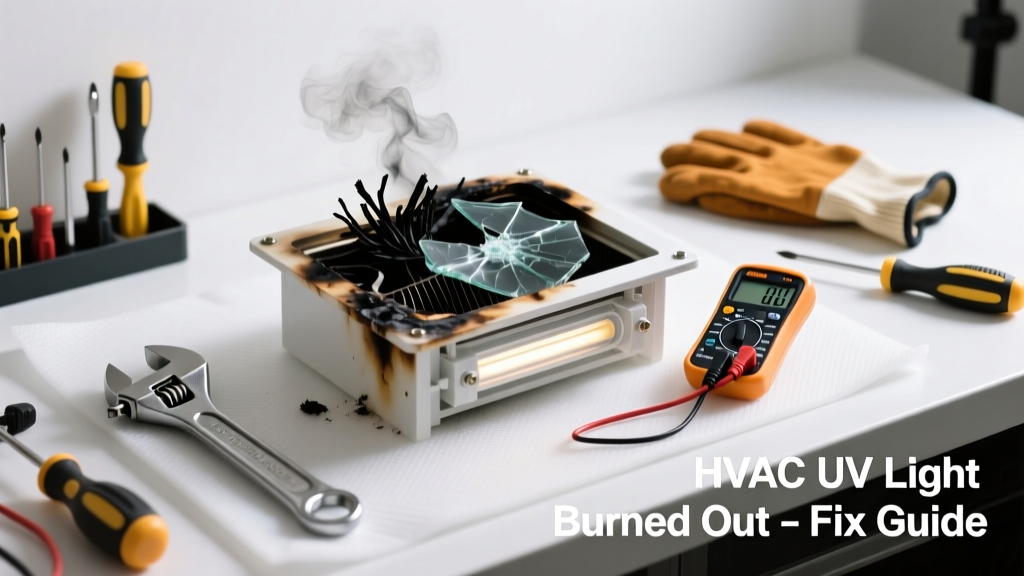
If your HVAC system suddenly starts buzzing, crackling, or emitting sharp ozone-like smells—and your UV light isn’t glowing—you’re likely dealing with a burned-out UV lamp that’s arcing internally or shorting out. This isn’t just an annoyance: it can damage your coil, degrade air quality, and pose fire or shock risks if ignored.
Quick Diagnosis
Before grabbing tools, rule out these five most common causes:
- The UV lamp is visibly blackened at one or both ends (sign of end-of-life failure)
- You hear intermittent snapping or sizzling near the air handler’s UV chamber
- A faint blue glow is missing—even when power is confirmed at the ballast
- Ozone smell intensifies during operation (indicates arcing or cracked quartz sleeve)
- Tripped circuit breaker or GFCI outlet upstream of the UV system
Tools & Materials Needed
| Item | Purpose | Estimated Cost |
|---|---|---|
| Non-contact voltage tester | Verifies power is OFF before accessing UV chamber—critical for safety | $12–$25 |
| UV lamp replacement (same model) | Must match wattage, length, and base type (e.g., G23, PL-L 36W) | $28–$65 |
| Microfiber cloth + 70% isopropyl alcohol | Cleans quartz sleeve without scratching or leaving residue | $8–$14 |
| Insulated screwdriver set | Prevents accidental grounding while working inside live HVAC compartments | $16–$32 |
| Work gloves (nitrile + cut-resistant) | Protects against UV exposure, glass shards, and sharp sheet metal edges | $10–$22 |
Step-by-Step Fix
Follow this sequence—never skip step 1. Most noise issues resolve after lamp and sleeve replacement.
- Power down completely: Turn off the HVAC system at the thermostat and shut off the dedicated circuit breaker (usually labeled “Air Handler” or “UV System”). Verify no voltage at the UV ballast terminals using your non-contact tester.
- Access the UV chamber: Locate the access panel—typically on the return duct or inside the air handler near the evaporator coil. Remove screws carefully; some panels have hidden tabs or spring clips.
- Inspect and remove old lamp: Look for darkening, bulging, or white powder inside the tube. If the quartz sleeve is cloudy, cracked, or coated in mineral film, replace it too—even if the new lamp fits. Gently twist the lamp 90° and pull straight out.
- Clean and reinstall: Wipe the quartz sleeve and lamp socket contacts with isopropyl alcohol and microfiber. Insert the new lamp firmly until it clicks or seats fully. Reinstall the sleeve if replaced.
- Test and verify: Restore power, wait 2 minutes, then check for steady blue glow through the inspection window. Listen closely: no buzz, pop, or hum should persist beyond initial startup.
When to Call a Pro
Stop and call an HVAC technician immediately if you observe any of these:
- Visible charring or melted plastic around the ballast or wiring
- Ballast emits a burnt odor or feels hot to the touch after 5 minutes of operation
- UV light flickers erratically even after full replacement (points to failing ballast or control board)
- Your system uses a high-output 120V or 240V UV system—not the standard 24V residential type
- You detect ozone levels above 0.05 ppm (use an ozone meter; prolonged exposure harms lungs)
According to the U.S. EPA’s 2022 Indoor Air Quality Guidelines, UV-C systems operating with damaged lamps or sleeves can generate unsafe ozone concentrations—especially in tightly sealed homes.
Prevention Tips
Extend UV lamp life and avoid repeat failures with these field-tested habits:
- Replace lamps every 9–12 months—even if still glowing—since UV output degrades by ~40% after 9,000 hours (Philips UV Lamp Technical Bulletin, 2021)
- Wipe the quartz sleeve every 3 months with alcohol; mineral buildup causes overheating and premature burnout
- Ensure your air filter is changed every 30–60 days—dust accumulation on the sleeve insulates heat and stresses the lamp
- Install a timer or smart relay so UV only runs when the blower is active—reduces lamp runtime by up to 65%
Can I use regular LED bulbs instead of UV-C lamps?
No. Standard LEDs emit zero germicidal UV-C (254 nm) radiation. Substituting them creates a false sense of protection and may overload the ballast, triggering thermal shutdown or arcing noise.
Why does my new UV lamp buzz louder than the old one?
A low-frequency hum is normal—but loud buzzing or vibration usually means the lamp isn’t fully seated or the ballast is incompatible. Double-check base alignment and confirm your replacement matches the original’s wattage and pin configuration (e.g., G23 vs. G10q).
Is it safe to look at the UV light when it’s on?
No. Direct exposure—even brief—can cause photokeratitis (‘welder’s flash’) and corneal burns within seconds. Always power down before inspecting, and never operate the system with the access panel removed.
Do I need to clean the evaporator coil when replacing the UV lamp?
Yes—if the coil hasn’t been cleaned in over 12 months. UV lamps work best on clean surfaces; biofilm and dust absorb UV energy and reduce effectiveness by up to 70%, per ASHRAE Handbook HVAC Applications (2023 edition). Use a no-rinse coil cleaner and soft brush.
Can a faulty UV light damage my HVAC blower motor?
Indirectly, yes. Ozone from arcing UV lamps corrodes rubber gaskets and insulation on nearby wiring. Over time, this can lead to short circuits in the blower control board—especially in older Lennox or Carrier units with shared grounding paths.
What’s the difference between coil-sanitizing and air-stream UV systems?
Coil-sanitizing lamps mount near the evaporator and run continuously to prevent mold; air-stream models sit in the duct and pulse only when air flows. The former rarely makes noise unless failing—the latter often buzzes if airflow sensors misfire or mounting brackets loosen.
A properly replaced UV lamp should run silently for another year—no hum, no pop, no smell. If noise returns within weeks, suspect undersized wiring, a failing transformer, or moisture intrusion in the chamber. For long-term reliability, pair your UV system with a high-MERV filter schedule and annual coil maintenance. And always keep spare lamps on hand—most failures happen mid-winter or during allergy season, when you’ll want that clean-air boost back online fast.