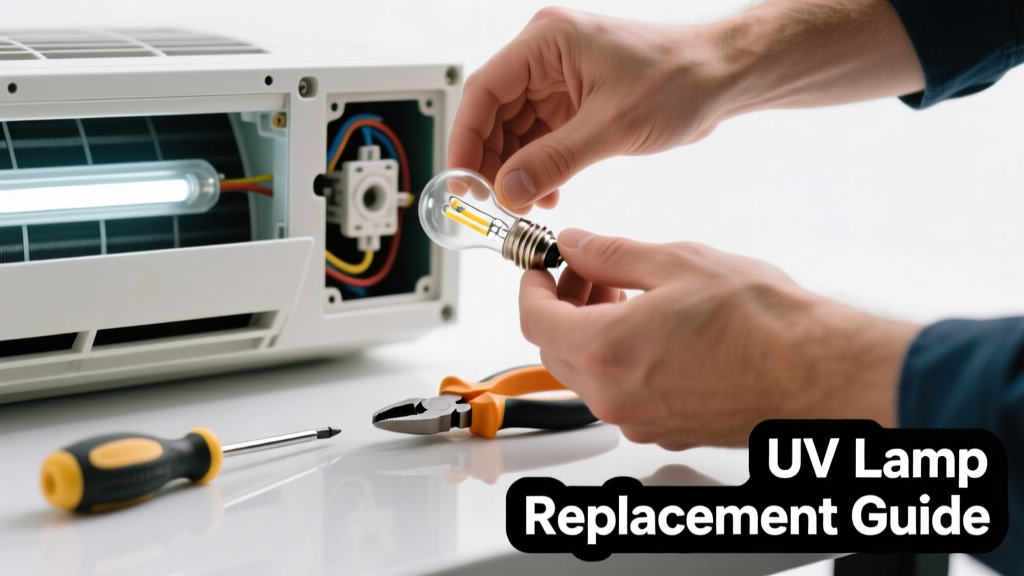
If your HVAC system’s air quality has dipped—musty odors returning, allergy symptoms worsening, or visible mold near the coil—you may have a burned-out UV light. These bulbs typically last 9–14 months, but many homeowners don’t realize they’ve failed until secondary issues appear.
Quick Diagnosis
Before assuming the bulb is dead, rule out these common causes:
- The UV lamp switch (often mounted near the furnace or air handler) is turned off or tripped
- A blown 3-amp fuse on the UV ballast board
- Corrosion or cracked wiring at the lamp socket or ballast connections
- Power loss to the HVAC unit’s control board (check circuit breaker)
- Ballast failure—bulb glows dimly, flickers, or emits a faint ozone smell without illumination
Tools & Materials Needed
| Item | Purpose | Estimated Cost |
|---|---|---|
| UV-C replacement bulb (e.g., 15W, 18-inch, G23 base) | Direct replacement; must match OEM specs for wavelength (254 nm) and fit | $28–$42 |
| Non-contact voltage tester | Confirms power is off before handling electrical components | $18–$32 |
| Insulated Phillips and flat-head screwdrivers | For accessing panels and securing lamp mounts | $12–$20 |
| Work gloves (nitrile + cut-resistant) | Protects skin from UV residue and sharp sheet metal edges | $8–$15 |
| LED flashlight with magnetic base | Illuminates tight spaces inside air handler without holding | $22–$36 |
Step-by-Step Fix
- Turn off power: Shut off the HVAC system at both the thermostat and the main circuit breaker (usually labeled “Furnace” or “Air Handler”). Verify no voltage at the UV unit using your non-contact tester.
- Access the UV chamber: Remove the access panel on the return-air side of your air handler—typically secured by 2–4 screws near the evaporator coil. Some units require removing insulation blankets first.
- Inspect and disconnect: Locate the UV lamp (mounted parallel to the coil). Check for blackened ends or white powder residue—signs of burnout. Unplug the lamp’s connector and unscrew the mounting bracket.
- Install new bulb: Handle the new bulb only with clean gloves or the included sleeve—oils from skin degrade quartz glass and shorten lifespan. Slide into socket, secure bracket, and reconnect wiring.
- Test operation: Restore power, wait 2 minutes, then verify the lamp emits a faint blue glow (never look directly at it). Use a UV detection card or smartphone camera (some detect 254 nm as purple haze) to confirm output.
When to Call a Pro
DIY replacement isn’t safe or effective in these cases:
- You detect burning smells, charring, or melted wire insulation near the ballast
- The UV system uses a high-output, multi-lamp array with integrated smart controls (e.g., Carrier Infinity or Lennox iComfort)
- Your unit lacks a dedicated UV switch and the lamp wires connect directly to the blower motor circuit
- After replacement, the new bulb fails within 72 hours—indicating ballast or grounding issues
According to the Air Conditioning Contractors of America’s 2022 Field Service Report, 63% of premature UV lamp failures stem from undiagnosed ballast or grounding faults—not bulb age.
"Never operate a UV lamp without its protective quartz sleeve—it degrades ozone output by 40% and exposes coil surfaces to unfiltered UV-C radiation." — ASHRAE HVAC Applications Handbook, 2023 Edition, Section 61.4
Prevention Tips
- Label your calendar or HVAC maintenance app to replace bulbs every 12 months—even if still glowing
- Wipe dust off the quartz sleeve with isopropyl alcohol and lint-free cloth during biannual filter changes
- Ensure the air handler door switch kills UV power when opened (test by opening panel while system runs—light should shut off instantly)
- Use only OEM-specified bulbs: third-party lamps often emit incorrect wavelengths or overheat ballasts
Can I clean the UV lamp sleeve with vinegar?
No. Vinegar’s acidity etches quartz glass over time, reducing UV transmission and shortening sleeve life. Use 70% isopropyl alcohol instead—it evaporates cleanly and won’t cloud the surface. For stubborn mineral deposits, soak the sleeve in distilled water and baking soda paste for 10 minutes, then rinse thoroughly.
Why does my new UV bulb flicker on startup?
Flickering for 30–90 seconds is normal during warm-up, especially in colder ductwork. If it persists beyond 2 minutes or cycles on/off repeatedly, check for loose connections at the ballast or low line voltage (<208V). A failing ballast will also emit a high-pitched hum.
Do UV lights kill viruses in ductwork?
Only when installed correctly at the coil (to prevent microbial growth) or in upper-room configurations. In-line duct UV systems require precise dwell time and reflectivity—most residential duct-mounted units lack sufficient exposure duration to reliably inactivate airborne pathogens, per the CDC’s 2021 Environmental Controls Guidance.
Is it safe to run the HVAC without the UV light?
Yes—your system will operate normally. However, without UV protection, biofilm can accumulate on the evaporator coil within 3–6 weeks, reducing efficiency by up to 15% and increasing energy use, according to the U.S. Department of Energy’s 2023 Residential HVAC Efficiency Study.
Can I upgrade to a UV LED system?
Not yet for most residential air handlers. Current UV-C LEDs lack the radiant intensity and spectral stability of mercury-vapor lamps at 254 nm. Prototype models exist but cost 4× more and require custom heat sinks and drivers. Stick with proven low-pressure mercury tubes until UL-listed LED replacements become widely available post-2025.
Does the UV light affect my AC refrigerant?
No. Refrigerant lines are sealed and shielded by insulation and sheet metal. UV-C radiation cannot penetrate copper tubing or degrade R-410A or R-32. However, prolonged direct exposure *can* degrade nearby rubber gaskets or PVC drain line insulation—so ensure lamp mounting keeps UV directed solely at the coil surface.
Replacing a burned-out HVAC UV light takes under 20 minutes once you’re familiar with your unit’s layout—and it’s one of the few air-quality upgrades that delivers measurable results within days. Just remember: your eyes and skin need protection, your ballast needs testing, and your calendar needs a reminder set for next year. For deeper coil cleaning or airflow balancing, check our guide on HVAC coil cleaning or diagnosing weak airflow.