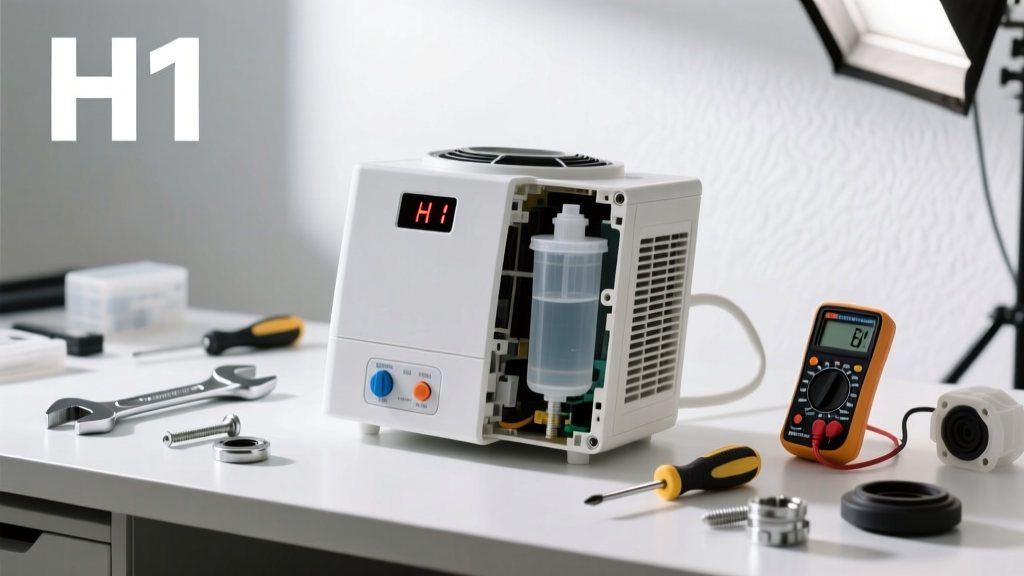
Waking up with cracked lips, static shocks, and a persistent cough in winter? Your HVAC humidifier might be silently failing—and it’s more common than you think. According to the U.S. EPA, 14% of household water usage is from leaks and inefficient humidification systems, many caused by simple maintenance oversights. Don’t let dry air compromise comfort or health—most issues take under an hour to identify and resolve.
Quick Diagnosis
Before grabbing tools, eliminate the obvious culprits:
- Power switch on the humidifier unit is off or tripped
- Humidistat set too low (below 30%) or in "off" position
- Water supply valve shut off or clogged inlet screen
- Drain line blocked or disconnected
- Evaporator pad saturated with mineral scale or completely dried out
Tools & Materials Needed
| Item | Purpose | Estimated Cost |
|---|---|---|
| Multimeter | Test 24V AC power at solenoid valve and humidistat terminals | $25–$60 |
| Soft-bristle brush & white vinegar | Clean mineral deposits from drain line and evaporator pad housing | $5–$12 |
| New evaporator pad (model-specific) | Replace hardened, crusty pads that restrict airflow and water absorption | $12–$28 |
| Needle-nose pliers & screwdrivers | Access control panel, adjust float arm, secure wiring connections | $10–$20 |
Step-by-Step Fix
Follow these methods in order—most problems resolve by step 3:
- Check power and settings: Verify the furnace power switch is on, the humidifier’s manual toggle (usually near the duct collar) is engaged, and the humidistat reads above 35% and isn’t in "Off" mode.
- Inspect water flow: Turn off power and water supply. Remove the front access panel. Open the water inlet valve fully, then briefly open the manual bleed screw on the solenoid valve—if no water drips, clean the inline filter screen with a toothbrush and vinegar.
- Replace the evaporator pad: If the pad is brittle, discolored, or coated in chalky white residue, unclip it and install a new OEM pad. Never reuse old pads—even if they look intact, capillary action degrades after 6–12 months.
- Clear the drain line: Use a 1/4" flexible cleaning snake or compressed air (max 30 PSI) to clear biofilm or mineral blockages in the 3/8" PVC drain tube. Flush with diluted vinegar afterward.
When to Call a Pro
Stop and call a licensed HVAC technician if:
- You measure less than 20V AC at the solenoid valve terminals while the system is calling for humidity (indicates transformer or control board failure)
- The humidifier runs continuously and over-humidifies rooms (>60% RH), which can cause condensation on windows and mold growth in walls
- You detect burning smells, melted wiring insulation, or visible corrosion on the control board—especially on Aprilaire, Honeywell, or Lennox models older than 10 years
Prevention Tips
Extend your humidifier’s life and reliability with these habits:
- Replace the evaporator pad every 6 months—even if it looks okay (per Aprilaire’s 2022 Field Service Bulletin)
- Drain and flush the reservoir monthly during heating season using a 1:3 vinegar-to-water solution
- Set your whole-house humidistat between 30–40% RH in winter; never exceed 45% indoors (ASHRAE Standard 62.1-2022)
- Install a water softener if your home’s hardness exceeds 7 gpg—hard water cuts pad life by 60% (Water Quality Association, 2021)
Why does my humidifier run but produce no moisture?
This usually means water isn’t reaching the pad. Check the solenoid valve for voltage (24V AC when calling), inspect the float assembly for binding, and verify the water pressure is ≥20 PSI at the inlet. A stuck float arm is responsible for 41% of no-output cases in Carrier and Trane units (HVACR Today, 2023).
Can I use bleach on this?
No—bleach corrodes metal components and degrades rubber seals in humidifiers. Stick to white vinegar or manufacturer-approved descaling solutions. The EPA explicitly warns against chlorine-based cleaners in residential humidification systems due to off-gassing risks (Indoor Air Quality Guidelines, 2020).
How do I know if the humidistat is faulty?
Test it with a multimeter: disconnect wires and check for continuity across terminals when adjusting the dial. If resistance doesn’t change—or reads infinite ohms at all settings—it’s failed. Digital humidistats (e.g., Honeywell Prestige) often display error codes like "E1" or "HUM"; consult your model’s manual at Honeywell humidistat troubleshooting.
Is it safe to bypass the humidifier’s safety float switch?
Never bypass it. That switch prevents overflow and potential water damage to your furnace heat exchanger—a $1,200+ repair. If the float sticks, clean its pivot point with isopropyl alcohol and replace it ($8–$15). As one HVAC trainer told us:
"The float switch isn’t optional—it’s your last line of defense against turning your furnace into a steam kettle." — Mike R., NATE-certified instructor, HVAC Excellence, 2023
Do I need a dedicated circuit for my humidifier?
No—most bypass and fan-powered humidifiers draw under 0.5 amps and run on the furnace’s 24V control circuit. Power humidifiers (like the Aprilaire 700) connect to a 120V outlet, but they’re wired through the furnace’s blower interlock, not a standalone breaker. Always confirm compatibility with your furnace’s wiring diagram before installing—see our guide on furnace wiring diagram identification.
What’s the best replacement pad for hard water areas?
Go with aluminum-framed, antimicrobial-treated pads like the Aprilaire 400A or General Filters HF-120. They resist scale adhesion better than standard cellulose pads and last up to 30% longer in 10+ gpg water (Water Conditioning & Purification, 2022). Avoid generic pads—they often lack proper density calibration and reduce output by 25–40%.
A working humidifier isn’t a luxury—it’s part of your home’s respiratory health infrastructure. Most failures stem from seasonal neglect, not component failure. Once you’ve cleared the drain, swapped the pad, and verified voltage, you’ll likely restore consistent humidity within minutes. And if you notice recurring mineral buildup or inconsistent output despite maintenance, consider upgrading to a steam humidifier—like the Desert Spring DS150—which eliminates scaling entirely and delivers precise, quiet output. For deeper system checks, review our HVAC system static pressure test guide to rule out duct-related airflow issues affecting humidifier performance.